
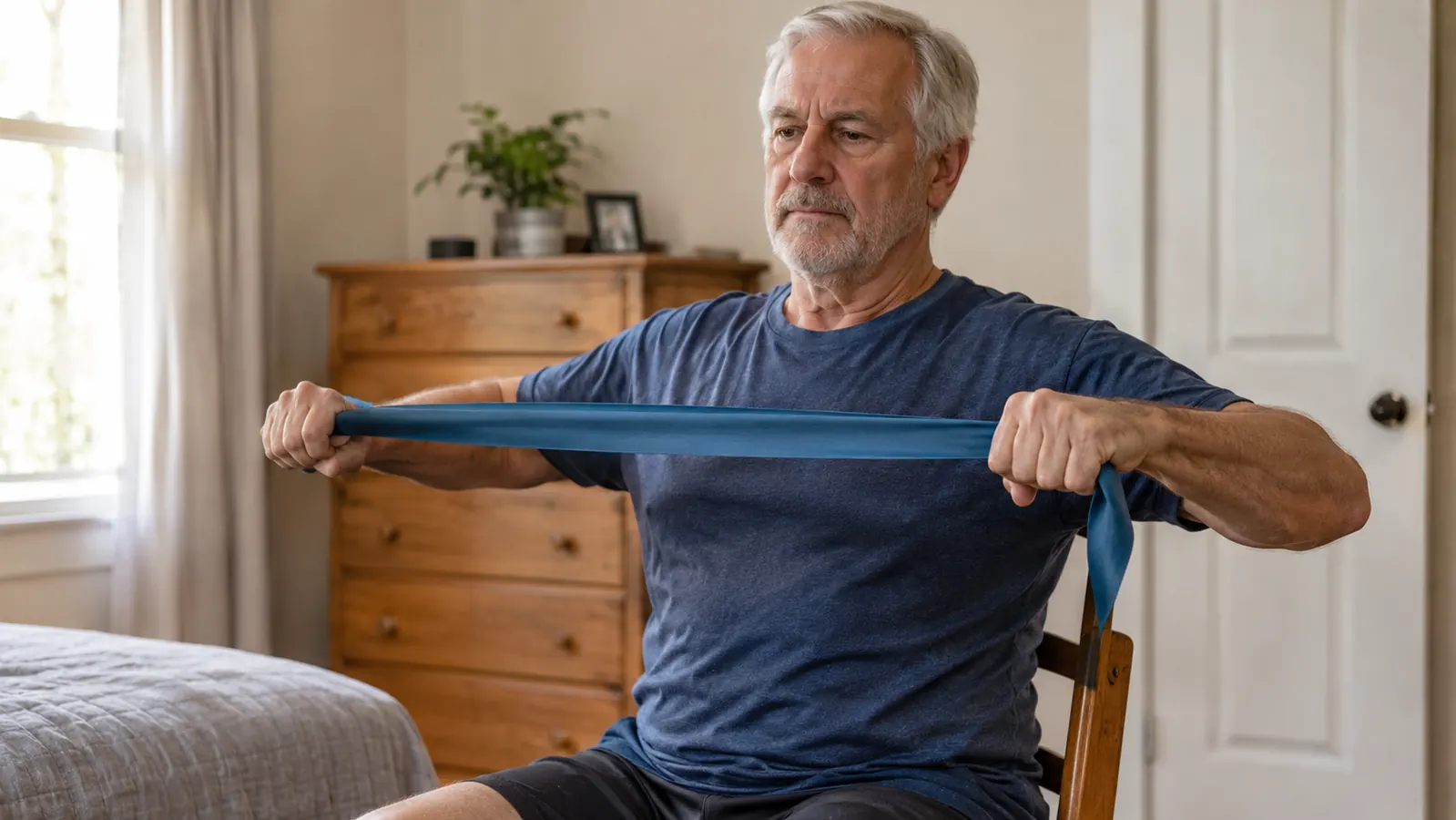
Three and a half years ago I hung a set of THERABAND flat bands on a hook behind my spare-bedroom door and told myself I would use them every morning. I have, more or less, and that alone puts them ahead of most of what I have bought for my health. But I want to give you the review I could not find back then. The one that tells you where this set runs out of road, because the product page is not going to mention it.
I am 68 now. I carried mail on a rural route outside Wilkes-Barre for 31 years, and four years ago I lost my footing on my own back porch steps with a bucket of potatoes in my hands. I did not fall. It scared me badly anyway. My doctor said my legs and my balance were the issue, not my heart, and a physical therapist's handout is what put these bands in my hands in the first place. I am not a trainer and I am not going to write like one. I am a man with a stiff right knee who wants to keep kneeling in the garden and carrying feed bags out to the shed.
What follows is not a list of features. You can read the listing for that. It is what three and a half years of pulling on these bands has taught me about where they help, where they quietly stop helping, and what I had to buy afterward to keep going.
The Quick Verdict
A sound first set for shoulders, chest and rows, and the simplest way I know to start moving after a scare. Just understand that the whole set is light, and you will outgrow the strongest band sooner than you expect.
Amazon Check Today's Price →Start With the Lightest Band and a Kitchen Chair
That is genuinely how this set is meant to be used. One band, one chair, twelve slow rows. I will tell you below exactly where it stops working, but the starting point is right here and it costs you nothing but a Tuesday morning.
Amazon Check Today's Price on Amazon →How I've Actually Used Them, Three and a Half Years In
I do my work in a sturdy kitchen chair in the spare bedroom I cleared out, with the band looped around the chair back for rows and around my own feet for chest presses. Seated rows, chest presses, and a shoulder movement where I hold the ends and pull them apart at chest height. Twenty-five to thirty minutes, five mornings a week, after coffee. The bands are the one part of that routine I have never had to think about, which is the highest compliment I can pay a piece of equipment.
The THERABAND set is three flat bands, each five feet long and four inches wide. They are rated at three different tensions. The yellow is the lightest at 3 to 4.3 pounds of resistance. The red is 3.7 to 5.5. The green, the strongest of the three, is 4.6 to 6.7. Those numbers are the whole story of this product, and I will come back to them more than once.
I started on the yellow because the handout said to start on the yellow. Within a few months I had moved to red for most movements and green for rows. Three and a half years later that is still roughly where I am, and that fact tells you something about how much room the set actually has in it.
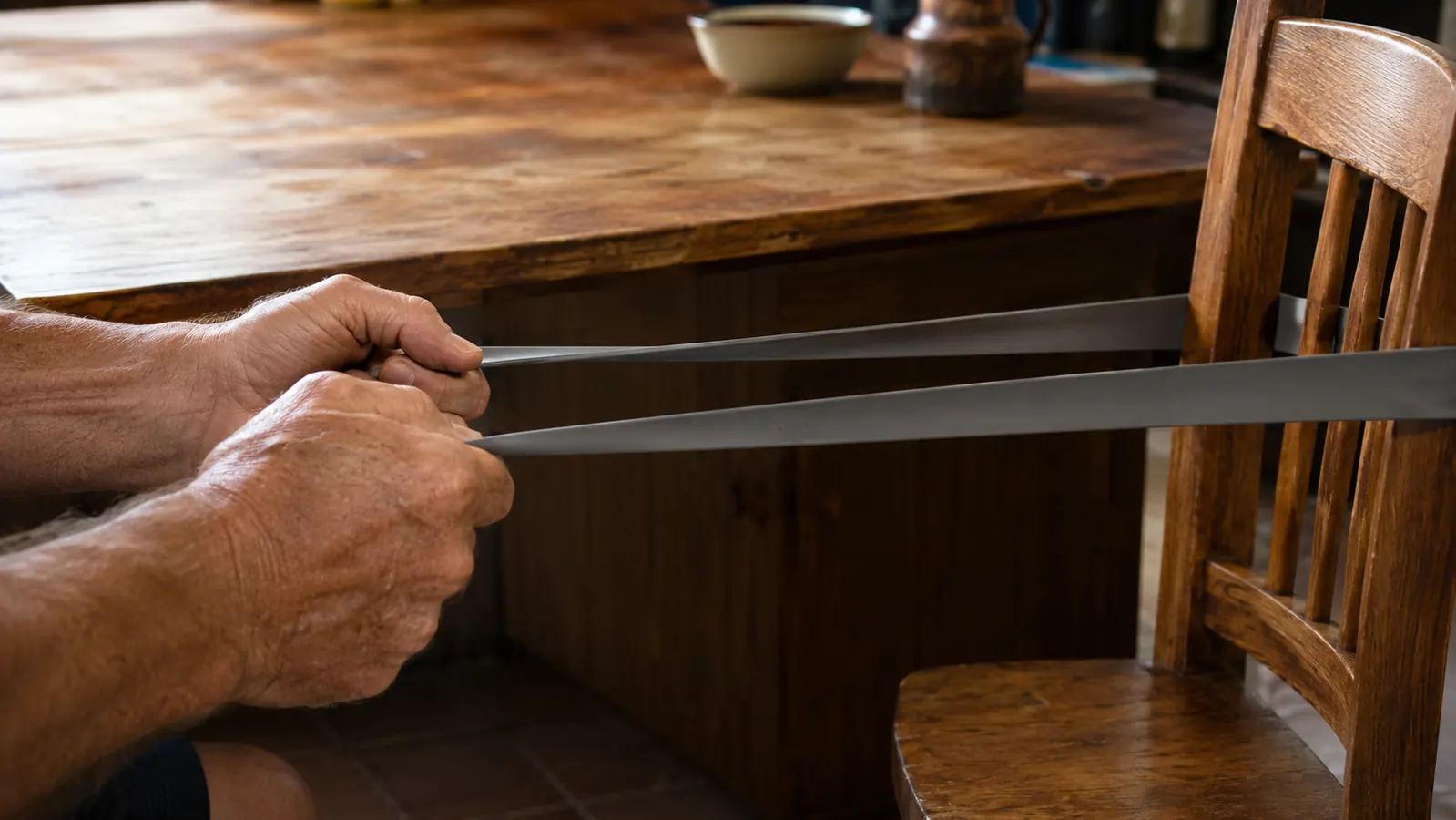
I anchor the band two ways and no others. Around the back of the kitchen chair for rows, and around the arches of my own feet for chest presses and shoulder work. That is the entire setup. No door anchor, no wall mount, nothing to install and nothing to adjust. It takes about ten seconds to get going in the morning, and that ten seconds is the reason I have kept at this when I have quit other things.
The green band tops out near 6.7 pounds of resistance. That is the ceiling of the entire set, and you will reach it faster than you think.
How the Three Tensions Actually Feel
The printed ratings are useful, but they do not tell you how a band feels when you are sitting in a chair with it. Here is what I found. The yellow band is barely there. For the first two weeks that is exactly right, because your shoulder is learning the movement and you are not trying to prove anything to anybody. By week four I was pulling it apart twenty times a set and not feeling a thing the next morning.
The red band is the workhorse of the three, and it is where I have spent most of the last three years. It has enough tension that twelve slow rows register in the middle of your back by the last few reps, and not so much that you strain something reaching for the next one. If I were buying again and could take only one band out of the bag, it would be the red.
The green band is the one people assume is the strong one, and relative to the other two it is. But it is the strongest of a light set. When I use it for rows I get a decent workout and I finish the set, and I have never once had to stop and shake out my arms the way I would after a genuinely heavy pull. That suits me fine at 68. It would not suit a man of 45.
What Nobody Tells You: The Whole Set Is Light
Here is the part the listing will not spell out for you. All three bands sit in the light range. The strongest one, the green, offers 4.6 to 6.7 pounds of tension. That is a very good amount of resistance for a shoulder that has not moved properly in years. It is not much resistance at all for a back that used to sling a mail sack over a shoulder for a living.
I noticed it first on rows. Seated rows with the green band felt like real work for maybe six weeks. Then they started to feel like a formality. I could do three sets of twelve without much effort, and there was no fourth band in the bag to move up to. You cannot add tension to a flat band except by shortening your grip on it, and that trick only buys you so much before the band is too short to use comfortably.
The other thing is how close together the three tensions sit. Yellow to green is a spread of less than four pounds at the top end. The jump from red to green is small enough that some mornings I was not certain I had changed anything at all. That is not a flaw exactly. It is just the honest shape of the product, and it matters if you are the sort of person who needs to feel a clear step up to believe you are progressing.
What the Bands Are Genuinely Good At
None of that makes them bad. It makes them a starting point, and as a starting point they are hard to beat. For shoulders especially, where the small muscles around the joint respond to light tension and complain about heavy tension, this set is close to ideal. I had a right shoulder that clicked and ached whenever I reached over my head for a shelf in the pantry. Six months of pulling a flat band apart at chest height, three mornings a week, quieted it down.
They are also practically weightless. The whole set is listed at 1.6 ounces. Mine lives on a hook behind a door and I forget it exists until I need it. When I drive two hours to my daughter's place, the bands go in the side pocket of a bag and I never notice they are there.
And they hold up. One band tore after about two years of near-daily pulling and the other two are still going strong. I replaced the torn one and kept working. For something that hangs on a hook and gets stretched every morning of its life, that is a fair run.
There is a second thing they are good at that I did not expect. They are quiet. Before all this I belonged to a gym, and I stopped going, and one reason was the noise and the fuss of it. Bands make no sound. They do not clank, they do not need a mat underneath, nothing has to be plugged in. Joan can read in the next room while I work, and I can do my whole routine at five in the morning without waking her.
What I Liked
- Light enough to start the morning after a scare, with no learning curve at all
- Three tensions cover shoulder, chest and row work for a beginner
- Five feet long and four inches wide gives you room to loop around a chair back or your own feet
- Practically weightless, so it travels and stores without a second thought
- Two of my three bands are still intact after three and a half years of daily use
Where It Falls Short
- The strongest band tops out near 6.7 pounds, so you will outgrow it
- The three tensions sit close together, so the steps between them are small
- No handles, so your grip gives out before your back does on long sets
- Flat bands slip and bunch against a bare floor
- Almost nothing here for legs, which need more load than this set offers
Where They Fall Short
Legs are the gap. After the porch-steps scare I wanted my legs stronger, and this set could not get me there. You can loop a band around your ankles and do side steps, and I did, but 6.7 pounds around the ankle is not a serious load for a man who weighs what I weigh. I ended up buying adjustable ankle weights two and a half years ago, and those are what actually built my legs back up. I wish someone had told me that on day one.
The missing handles cost me too. On a long set of rows, what quit first was my hands, not my back. The band bunches into your fists and by rep ten you are regripping more than you are pulling. I started keeping a light hand gripper in the chair's cup holder and working my grip separately, and that helped, but a band with handles would have solved the whole problem in one move.
And on a bare floor, the flat bands slide. Loop one around a chair leg on a wood floor and it will creep on you. I put a folded towel under the chair and that ended it, but it is the kind of small annoyance you should know about before you start rather than after.
There is one more limit worth naming. These bands give you tension in one direction, straight out from where you anchored them. That is fine for rows and presses. It is not fine for anything where you need resistance through a wide arc, and it is why I never got much out of using them for my hips. A person who knows what they are doing with bands can work around that. I could not, and I am not going to pretend otherwise.
My Yellow Band Tore After Two Years
Near-daily use for about two years, then one morning the yellow band split along an edge while I was pulling it apart. Nothing dramatic, no snap, just a tear that ran a couple of inches and made the band useless for anything but a gentle stretch. I replaced it. I did not think to look into a warranty, and I am not telling you the company owes anyone anything. I am telling you that a band under tension every day for two years does what rubber does.
What that taught me is to treat the bands as consumables rather than as tools that last forever. One of three failed in three and a half years of daily pulling. I keep that in my head now. When the red one eventually goes, I will replace it without a second thought, because the set has earned that much. I do check them before use now, holding each one up to the window light, which is a habit worth having with any band.
What I Would Tell Someone Buying This Today
Buy it as a starter set and plan on it being a starter set. That sounds like faint praise and it is not. Most people my age who decide to get stronger buy nothing at all, or they buy a machine that ends up in the basement under a bedsheet. This set takes up no room, needs no assembling, and will tell you inside a month whether you are the sort of person who will actually do the work. That is worth knowing about yourself.
If you already know you will stick with it, buy a set that includes a heavier band, or buy two of these and double them up. I have done the doubling and it works, though the band bunches where you fold it and you have to keep straightening it out. And if your legs are the problem rather than your shoulders, look at ankle weights first and come back to the THERABAND set afterward, which is the order I did it in and the order I would do it again.
Who This Is For
This set is for someone starting from a low place, which is exactly where I was. If you have a shoulder that aches when you reach overhead, or a back that is stiff every morning until you have been up and moving for an hour, or a doctor or therapist has told you to do some light resistance work and you do not want to join anything, then three flat bands and a kitchen chair will get you moving this week. It is also a good fit if you travel, or if you want something that lives behind a door and never needs dusting.
I would add this. If you are the sort of person who needs equipment to look like something, these bands will disappoint you. They are strips of rubber with no weight to them and they look it. What they do is get you moving on a Tuesday morning when your knee is stiff and the porch steps are icy, and that counts for more than looking like a gym.
Who Should Skip It
Skip it if you are already strong, or if you lift anything heavier than a bag of birdseed on a regular basis. You will do three sessions, feel nothing, and quit. Skip it if your main goal is leg strength, because this set will not get you there and you will need ankle weights or a step. And skip it if you need handles to hold on to, or if you already know your grip is your weak link, because you will spend more of the set fighting the band than working with it.
If a Stiff Shoulder and a Stiff Back Are the Problem, Start Here
Not the strongest set on the market. The one I actually stuck with for three and a half years, which turns out to matter more. Begin on the yellow, move to red when twelve rows feel easy, and know that green is the end of the line.
Amazon Check Today's Price on Amazon →