
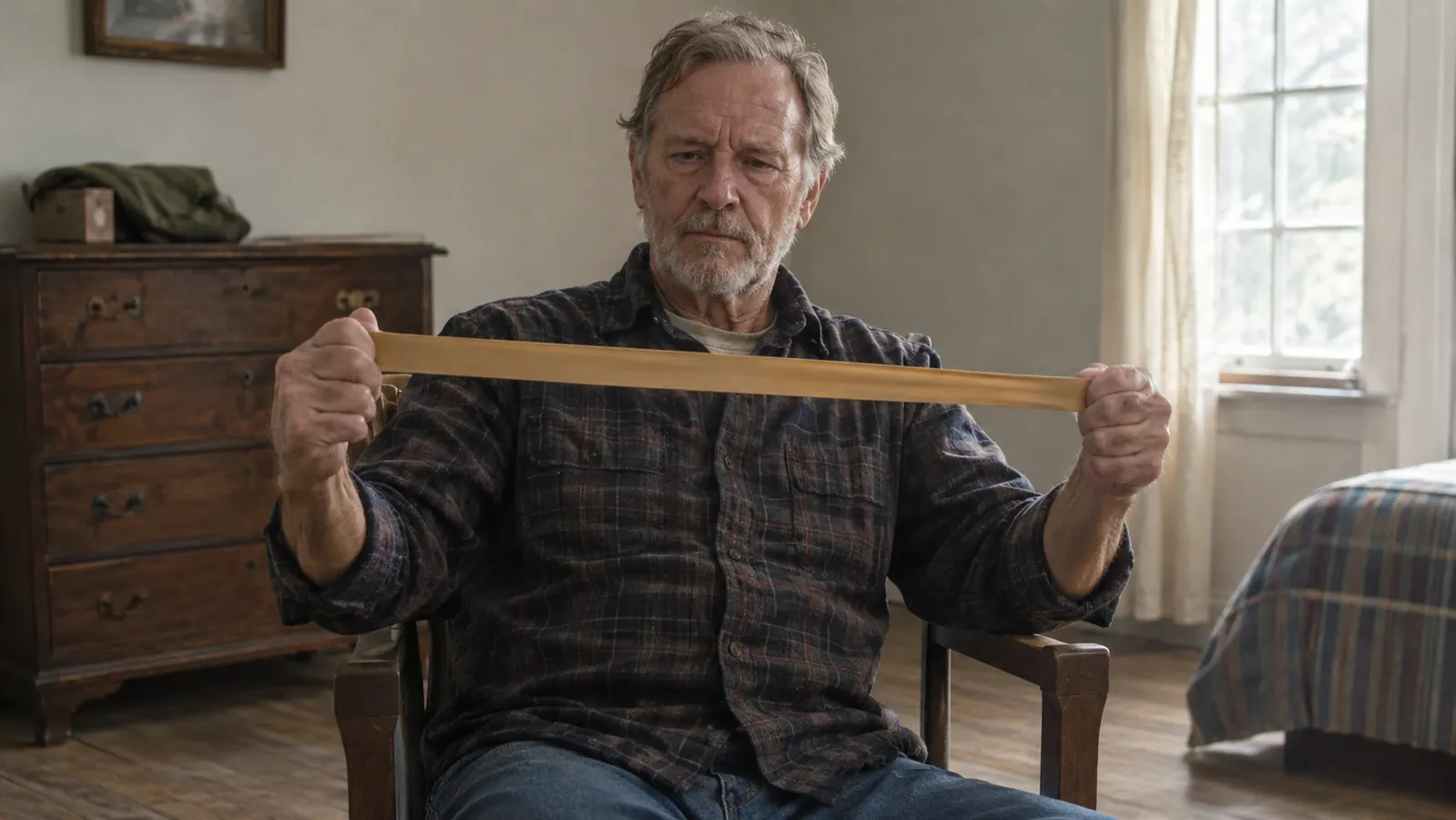
Three and a half years ago I was sitting in a kitchen chair in the spare bedroom upstairs, holding a strip of rubber that a physical therapist had drawn on a handout, and I could not make it do what the drawing showed. My right shoulder would not travel that far. My knee was stiff. I was 64, I had spent 31 years carrying mail out of a Jeep, and I had just learned that the reason I nearly went off my own back porch with a bucket of potatoes was not my heart. It was my legs and my balance. That is how the THERABAND resistance bands ended up on a hook behind that door.
I am not a trainer and I am not going to pretend to be one. What I can tell you is what happened in one spare bedroom over three and a half years, five mornings a week, with maybe ten of those minutes spent holding a band. If you are past 60 and starting from nothing, that is probably closer to your situation than any review written by a man with a pull-up bar bolted to his garage wall.
The Quick Verdict
Three flat bands, three light tensions, one hook behind a door. Nothing about them is exciting. But they have been part of nearly every morning for three and a half years, and the lightest one wore out before I did.
Amazon Check Today's Price →I bought these because the name was printed on my therapist's handout. Three and a half years later they are still hanging there.
I started on the lightest band and could not finish eight rows with it. That is the honest starting point for a lot of people past 60. If it is yours, start here instead of with something you have to load with plates.
Amazon Check Today's Price on Amazon →How I've Used It
My daughter Karen is a nurse and lives two hours away. She sent me a printed handout with about nine exercises on it, and six of them needed a band. I ordered the THERABAND set for one reason: that was the name at the top of the sheet. No comparison shopping, no reading reviews at midnight. If your physical therapist or your doctor hands you a similar sheet, you will probably see the same name printed on it, and that is worth knowing before you start looking at anything else.
The THERABAND set is three flat bands. Each one is 5 feet long and 4 inches wide, sold as three light tensions: yellow listed at 3 to 4.3 pounds, red at 3.7 to 5.5 pounds, and green at 4.6 to 6.7 pounds. I know how that reads to somebody who lifts. It is not much. It was more than enough for me on the first morning, and it was more than enough for most of the first year.
The first morning I unrolled all three across the bed and had to hold them up to the window to sort out which was which, because the only real difference is the color and the printing along the edge is small. I wrote three letters on the door frame in pencil above the hook, in the order I wanted to reach for them. That pencil is still there three and a half years later. It saves me maybe half a minute of squinting every morning, and over that many mornings a half minute is real time.
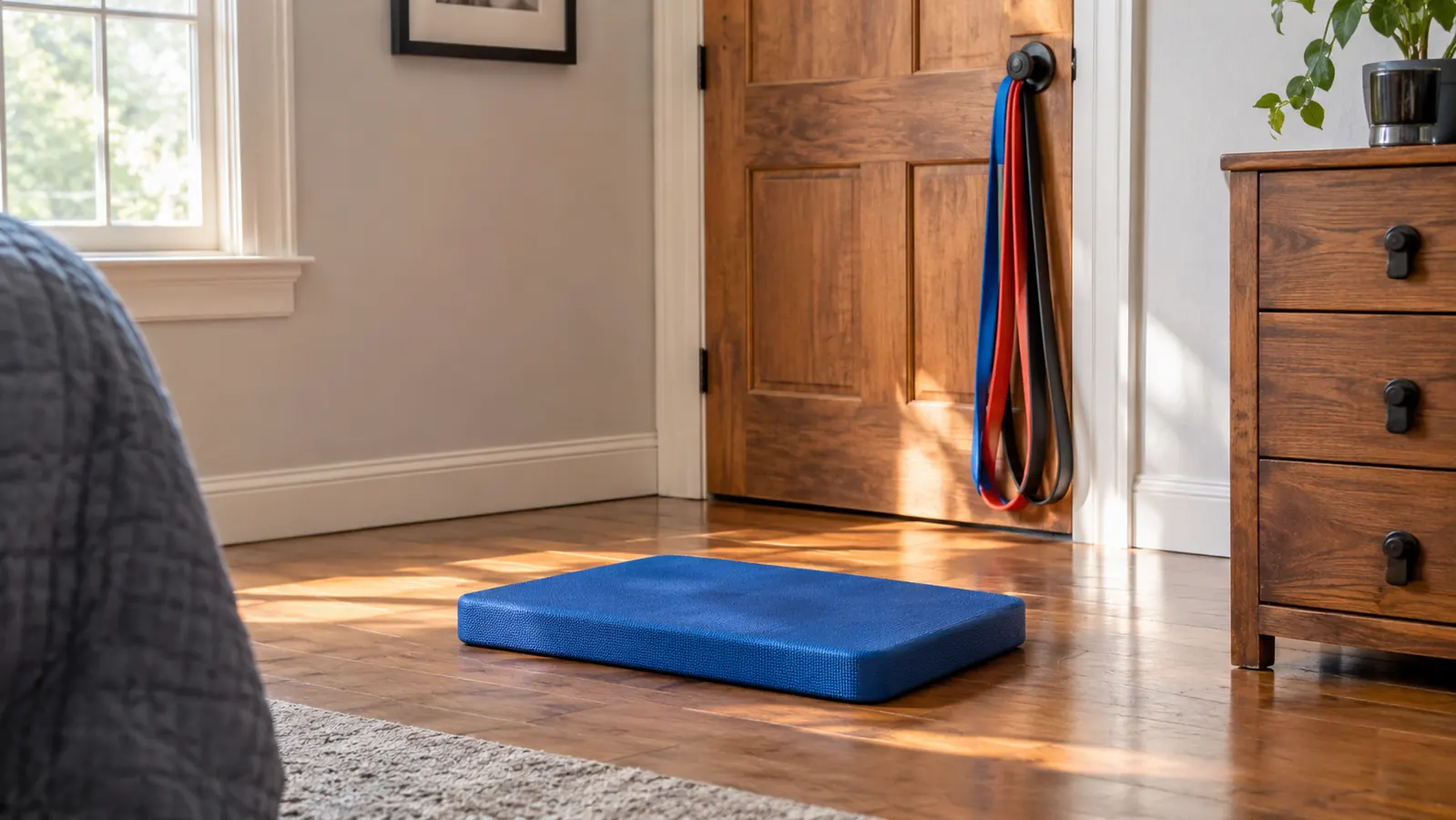
They hang on a hook behind the spare-bedroom door, all three looped over it together. I do not get them out of a case. I do not set anything up. I sit down in the sturdy kitchen chair I keep in that room, reach behind me, and the session has started in about four seconds. That sounds like a small thing to write down. It is the entire reason I am still doing this at 68.
What Three Light Tensions Actually Feel Like
I started on the yellow band and could not complete eight seated rows. Not eight good ones. Eight at all. The band would come back toward my chest and my shoulder would quit somewhere around the sixth. I did six for a while, then seven, then eight, and then I added a second set.
Now I use the red band for most movements and the green one for rows, where my back can handle more than my shoulder can. The step between one tension and the next is gentle, and that matters more than people admit. I have tried a friend's band set where the next one up felt like a completely different exercise, and that is how a person quits. Here the steps are small enough that you can actually take one.
About six months in I decided the red band had gotten easy and went straight to the green for everything, all at once, feeling pleased with myself. My back was fine with it. My right shoulder was not. By the end of the second week the clicking had come back and it ached when I reached for the cupboard. I dropped the shoulder movement back to red, kept green for rows only, and the ache cleared up in about ten days. That is the mistake I would warn anybody about. The bands are light enough that you can jump a step without noticing you have, and a shoulder complains later and more quietly than a knee does.
You also learn that the band is not the only thing setting the difficulty. A red band pulled out to full arm's length is a different exercise from the same red band with slack in it. For the first year I thought I was getting stronger when mostly I was standing further back from the chair. Both things count. You should know which one you are doing.
The first change I noticed was not strength. Around the fourth week my right shoulder stopped clicking when I reached up to the cupboard. It had clicked for years and I had assumed that was simply what a shoulder did at my age. It comes back once or twice a year now, usually after an afternoon of pruning and reaching overhead in the garden, and it settles again when I keep up with the rows.
One Band Tore, and What That Told Me
The yellow band split after about two years of near daily use. The tear started near one end, where I had been wrapping it around the back of the chair over and over. It did not snap while I was pulling on it. I found it one morning with a nick running most of the way through, and I threw it out and ordered a replacement.
I ordered that replacement on a Tuesday and it was on the hook before the weekend, so I did not miss a single session over it. What surprised me was the difference side by side. Held up next to the new one, the old band looked like a different piece of material at the end where I wrapped the chair, thin and cloudy and stretched out of shape. Hanging on the hook by itself it had looked perfectly fine for months. It only looked wrong next to a fresh one, and that is a lesson I have not forgotten.
That is the honest weakness of flat bands, and it is worth saying plainly. They are consumables. A thin sheet of material stretched thousands of times against the same spot is going to give out eventually. Before every session now I run each band through my hands and look for a nick, a thin patch, or a place that has gone cloudy. It takes ten seconds, and it is the difference between a band that fails quietly and one that lets go while you are holding it near your face.
The other two are still in service. Three and a half years, five mornings a week, one failure. I have owned kitchen gadgets that did worse and a couple that did better. I would call that fair.
The Moves I Do Now That I Could Not Do Then
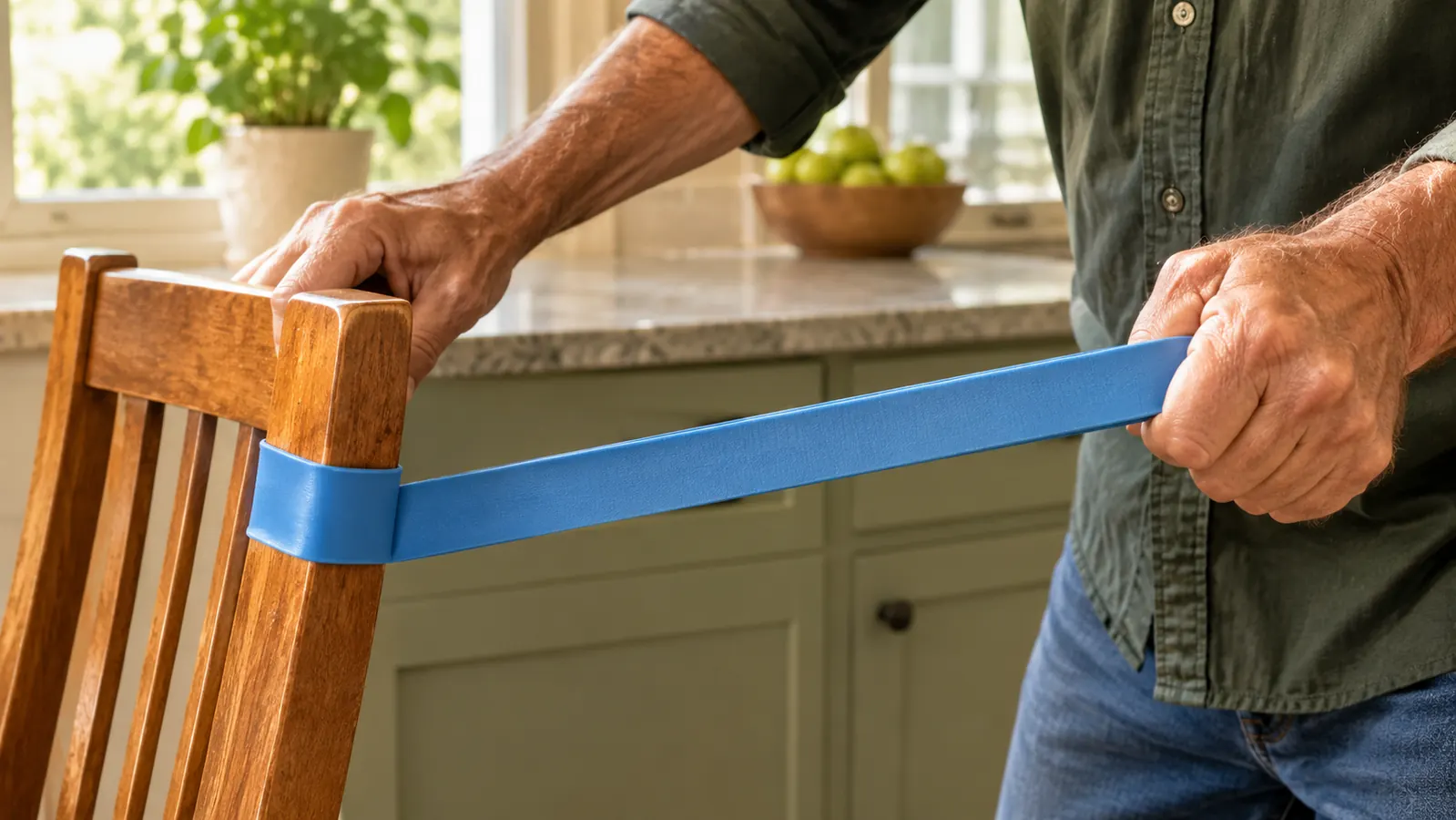
The band work is simple. Seated rows with the band looped around the back of the chair. A chest press with the band around the chair back and both hands pushing forward. A shoulder movement where I anchor the band under my foot and pull it up and across my body. Nothing on that list would impress anyone who trains seriously, and I do not care. They are the movements that match what I actually do in a garden, which is pull, push, and carry.
One thing I worked out by accident, and it took me the better part of a year. The band around the chair back works better if I loop it once and then sit down, so the anchor is already snug behind me before I start. Looping it while I am already seated means leaning forward and reaching back behind the chair, and that reaching-back movement is the one thing in my whole morning that ever tweaked my lower back. Small adjustment. Should have made it in the first month instead of the twelfth.
Last October I carried two five-gallon buckets of potatoes up the back steps without setting either one down. Four years ago I came off those same steps sideways with one bucket and had to grab the rail to stay up. I also get off the garden kneeler now without pushing off the ground with my knuckles, which sounds like a small thing until you have spent a morning on your knees pulling carrots out of wet soil.
The bands did not do all of that by themselves. The seated elliptical, the balance pad, the ankle weights, and about four years of showing up five mornings a week did it. But the bands are the piece that built the pulling and the pushing, and pulling and pushing is what carrying a bucket of potatoes actually is.
I will also say what they have not done. My grip is still the first thing to go. Pulling carrots and twisting the lid off a jar were the two things that pushed me to buy a hand grip set about a year ago, and I still use it most evenings in front of the news. A flat band around a chair back will not fix your hands.
How They Fit With the Rest of My Morning
My morning runs in the same order almost every day. Fifteen to twenty minutes on the seated elliptical while the coffee finishes, then about ten minutes with a band in the kitchen chair, then a few minutes standing on the foam pad with one hand on the dresser. When the weather is decent the middle part moves out to the back porch, and the bands come with me because they weigh almost nothing.
In July and August I do those same ten minutes in a straight-backed chair out on that porch, facing the garden, and it is a better view than a wall. When the mornings turn cold in October I am back inside without a single change to the routine, which is the reason I have not missed many of them. Nothing has to be carried down a flight of stairs and nothing has to be plugged in.
If I had to give up everything in that room except one piece, I would keep the bands. The elliptical is bigger and the pad earns its place in the garden, but the bands are the only thing that works my upper body at all, and my upper body is what lifts and carries. Three bands on a hook is not much of a home gym. It has been enough of one for me.
One practical note for anybody working in a small space. I exercise in a spare bedroom that also holds a dresser, a small desk, a seated elliptical, and a basket of ankle weights. The bands take up four inches of a door hook. That is the entire footprint. Joan uses them too, mostly the lighter one, mostly for her shoulders, and she has never once had to move furniture out of her way to do it.
What I Liked
- Three tensions with small steps between them, so moving from one to the next is realistic for somebody starting from nothing.
- Each band is 5 feet long and 4 inches wide, enough length to anchor around a chair back or under a foot without fighting it.
- The whole set hangs on one hook and starts in about four seconds, which is why I have kept at it for three and a half years.
- It was the name on my physical therapist's handout, so I did not have to guess at what to buy.
- Three and a half years of near daily use and only one band has needed replacing.
Where It Falls Short
- Light tensions only. The heaviest band in the set will feel like nothing to anyone who already lifts.
- Flat bands wear out. My lightest one split near the end after about two years of near daily use.
- The set is the bands and nothing else. No handles, no door anchor, no printed progression.
- You have to find your own anchor points and judge your own form, which is not obvious at the start.
The lightest band split after about two years of near daily use. I threw it out, ordered another, and kept going. That is most of the review, honestly.
Who This Is For
This is for the person who has been handed a sheet of exercises by a physical therapist or a doctor and needs the band that sheet calls for. It is for someone starting from zero at 60 or 70 who cannot knock out eight rows with the lightest tension, because that was exactly where I stood. It suits a small house or a spare bedroom where a bench is never going to fit. And it suits somebody who will actually use a thing that hangs on a hook and takes four seconds to start, because that is the whole advantage it has over a gym you have to drive to.
Who Should Skip It
If you already train with weights, the heaviest band here will feel like a warmup and nothing more, and you will be disappointed. If you want handles, a door anchor, or a printed program that tells you when to move up, this set includes none of those. It is three bands and that is the whole list, so you will be working out your own anchor points. And if you are the kind of person who will not spend ten seconds checking a band for nicks before you pull on it, buy tube bands with a sleeve around them instead. Whatever you decide, check with your doctor or a physical therapist before you start, the same as I did.
The band on the handout is the band on the hook behind my door.
Start on the lightest one. Do fewer repetitions than you think you should. Check it for nicks before every session. That is the entire method, and it has held up for three and a half years and one torn band.
Amazon Check Today's Price on Amazon →