
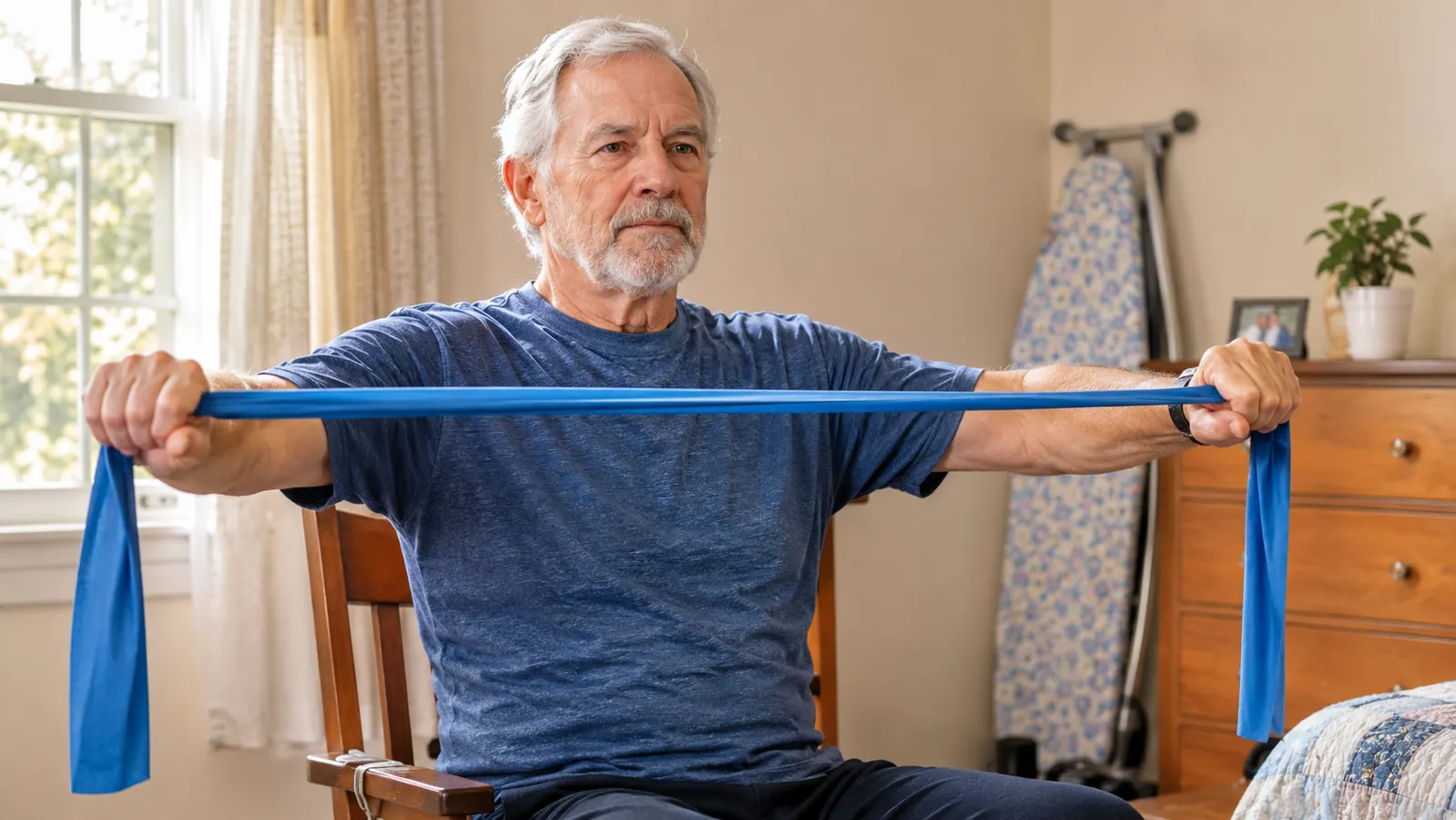
Short answer first, because I know why you clicked. If you are past 60, working out in a spare bedroom or a kitchen chair, and your hands still close around a strap without arguing, the flat THERABAND bands are the better tool for the job. They go lighter than most tube sets will sell you, you can choke up an inch at a time to fine tune the pull, and the whole set folds into a drawer when you are done. If your grip is the problem, if a jar lid has become a project, then tube bands with handles are the answer and it is not close. A handle you can hold beats a band you cannot.
I am not a trainer and I am not going to pretend to be one. I am 68, I carried mail on a rural route for 31 years, and I have a right knee that has been stiff since about 2019. I bought a set of THERABAND flat bands three and a half years ago off a physical therapist's handout, and I have used them five mornings a week since. Twice in that time I borrowed a neighbor's tube set with handles for a week, to see whether I was missing something. I was not missing much, but I was missing a little, and that little is the honest case for the other side.
| THERABAND Flat Bands | Tube Bands With Handles | |
|---|---|---|
| Grip | You close your fist on a flat band 4 inches wide. Nothing to hold and nothing to squeeze. | A molded handle in each hand, so the grip is a handle rather than a pinch. |
| Lightest tension | Three levels starting around 3 lbs, light enough for a bad knee morning. | Most tube sets start heavier, and a single tube is often more than a light flat band. |
| Top end resistance | About 6.7 lbs at the heaviest. Enough for shoulders, not enough to load the legs heavy. | Stack or swap tubes and you can go far heavier than any flat band. |
| Fine tuning | Choke up on the band an inch at a time. The tension changes as your hand moves. | You change tension by swapping or adding a whole tube. |
| Anchoring | Stand on it, shut it in a door, loop it around a porch post. No hardware. | Usually wants a door anchor or a fixed loop you rig yourself. |
| Extras in the box | Three bands and a folded sheet of instructions. That is all. | Many tube sets ship with a door anchor, ankle straps and a carry bag. |
| Comfort against the skin | The wide band sits flat on the palm and forearm instead of rolling into a cord. | Bare tubing can dig into the back of the arm on a curl. |
| Storage | The set weighs 1.6 ounces and folds flat. Mine hangs on a hook. | Handles take up room and do not fold. |
| How it fails | Mine went soft and frayed at the edge before it let go. Warning first. | A tube can let go near the handle all at once. Tube sets vary widely. |
| Best for | Seated rows, chest presses, shoulder work, light daily tension. | Anyone who needs a handle to hold, or heavier pulling. |
Where THERABAND Flat Bands Win
The plain fact is that a flat band can be made lighter than any tube set I have seen on a shelf. My set lists three tensions: 3 to 4.3 pounds, 3.7 to 5.5 pounds, and 4.6 to 6.7 pounds. Those numbers sound like nothing at all. They are not nothing when your arm is straight out at shoulder height and you are pulling the band apart for ten slow repetitions, because a band gets heavier the further you stretch it. On a morning when the knee is complaining, I want the lightest thing in the house, and the flat bands give me that.
Take a morning in February of this year. It was 14 degrees out, the porch steps had a skin of ice on them, and my right knee had that hot spot below the cap that tells me to take it easy. I did not skip the session. I unclipped the yellow band from the hook, sat down in the kitchen chair, did two sets of ten chest presses and one set of seated rows, and I was finished in eleven minutes. Nothing about it was heroic. That is the whole point. The light band let me do something on a day when a heavier tool would have handed me an excuse to do nothing, and a habit survives on those days, not on the good ones.
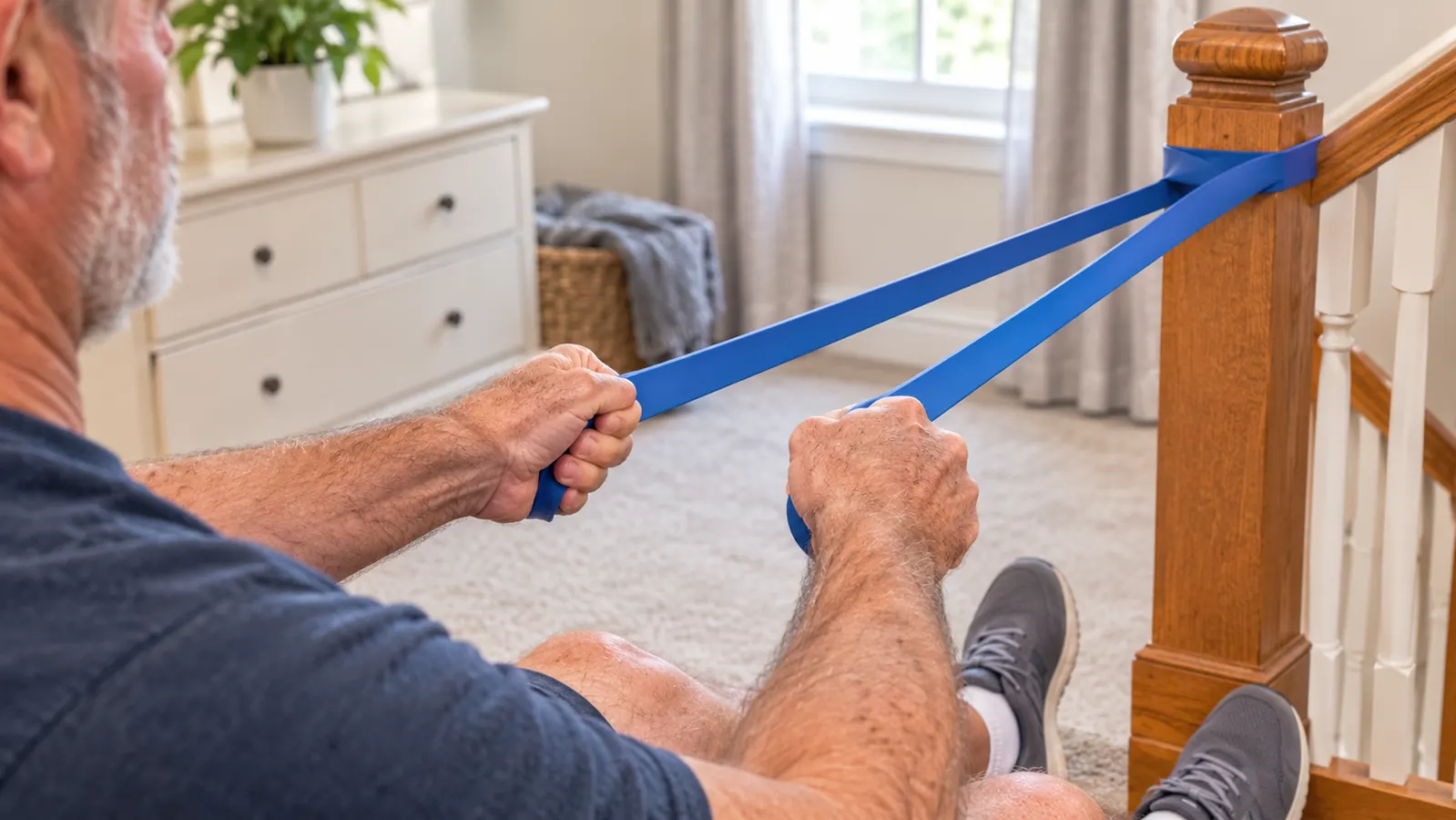
Anchoring is the other half of it. The bands are 5 feet long and 4 inches wide, so I can stand on any part of one, shut it in a door, or loop it around the newel post at the top of the stairs. There is no hardware to lose and nothing to install. Seated rows happen with the band around that post. Chest presses happen with the band behind my back. Neither setup required another purchase.
Where Tube Bands With Handles Win
I will say plainly what the handles did for me. My grip is fine for the first two sets. By the fourth, my fingers were tired of clamping down on a flat strap, and the handle took that away entirely. If your hands are worse than mine, if the knuckles ache before you have finished your coffee, the handle is the whole argument. You are far more likely to keep doing an exercise you can actually hold on to, and an exercise you keep doing beats a better exercise you quit.
The second win is load. A tube set stacks or swaps tubes, and you can get considerably heavier resistance than the 6.7 pounds my heaviest flat band offers. That is irrelevant for shoulder work. It matters if you ever want to load your legs seriously, and it is why the therapy office has both kinds hanging on the wall. Tube sets also tend to come with more in the box: a door anchor, ankle straps, a bag. The flat set is three bands and a folded sheet of instructions.
There is a smaller thing too, and I will not pretend it does not count. The tube set looked like exercise equipment. The flat bands look like a scrap of rubber hanging on a hook, and Joan laughed at the hook the day I put it up. But if you are the sort of person who needs the tool to look like a tool before you will pick it up, that has real value, and a borrowed week with a proper looking set did make me feel more purposeful than a strip of rubber ever has.
The set that fits in a drawer and a chair by the window
Three tensions from about 3 to 6.7 pounds. Five feet long, four inches wide, and light enough to hang on a hook behind a door. This is what I have used five mornings a week for three and a half years.
Amazon Check Today's Price on Amazon →What the Numbers on the Package Actually Tell You
The tension numbers on a band are not the same as the numbers on a dumbbell, and this trips people up. A 5 pound dumbbell is 5 pounds for the whole repetition. A band rated 3 to 4.3 pounds is rated at a certain amount of stretch, and it gets harder the further you pull it. That is why the lightest band in the set was plenty for my first month, and why I still reach for it on the mornings when the knee is angry.
When my set arrived I did something that sounds fussy and turned out to be the most useful ten minutes of the whole purchase. I stood on the end of the red band, pulled the other end up to shoulder height with my arm straight, and put a small piece of masking tape on the door frame where my hand landed. Then I stretched it further and put a second piece of tape where my hand landed there. Two marks, about four inches apart. Three and a half years later I can still glance at that frame and see whether I am working at the same distance I was in the spring, which beats guessing from how the band feels on any given morning. Rubber goes soft with age. Tape on a door frame does not.
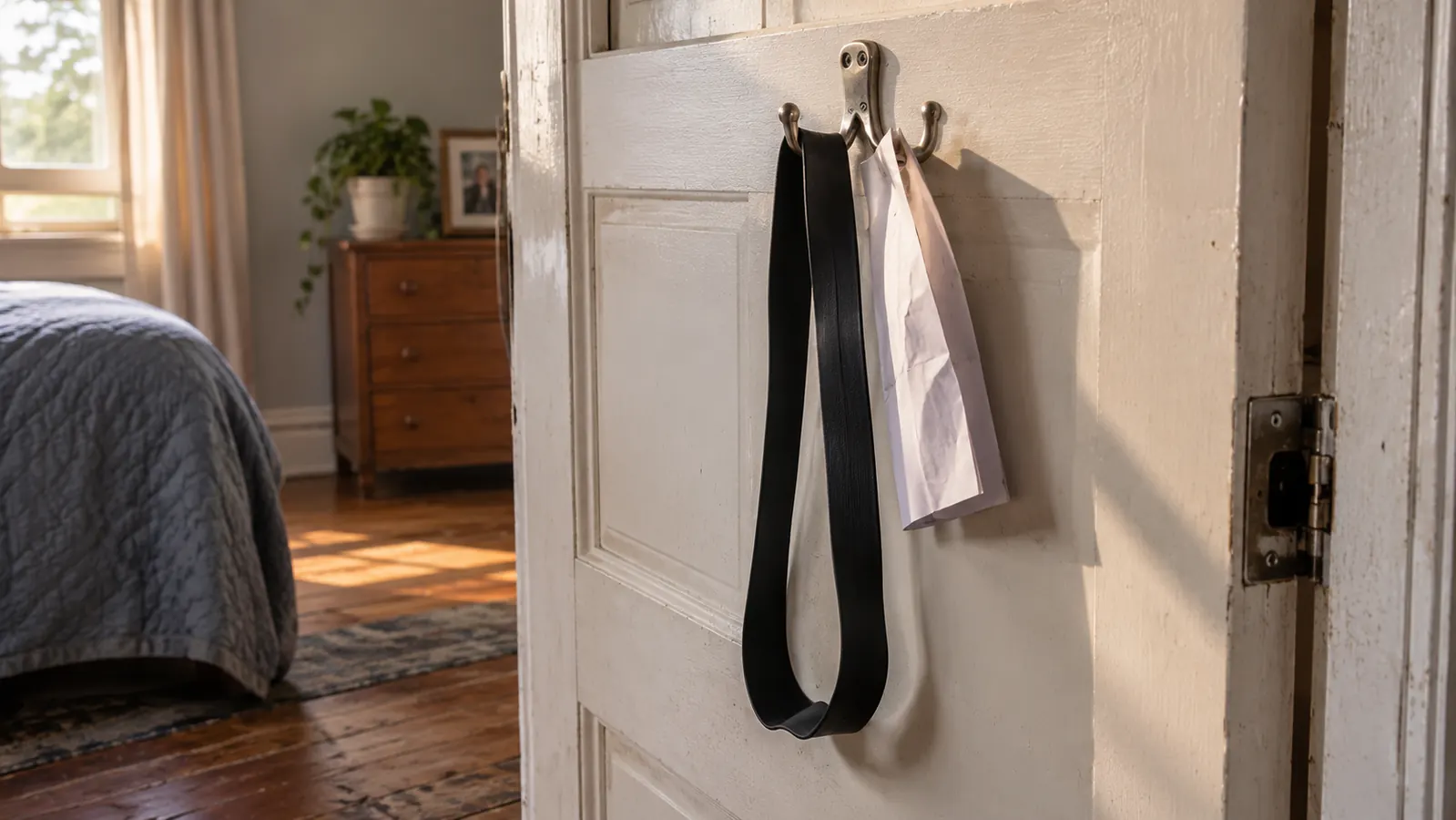
The dimensions matter more than they look. Five feet long means you can loop it, stand on it, and still have room to work. Four inches wide means it sits flat against your palm and forearm instead of rolling into a cord, and that width is the reason it does not bite. The listing puts the thickness at a quarter of a centimeter and the weight at 1.6 ounces, which is about the weight of a letter. Mine hangs on a hook behind the spare bedroom door and I forget it is there until I need it.
Three resistance levels is not a lot, and I want to be honest about that before you buy. It is enough for shoulders, chest and seated rows. It is not enough to load a squat the way a heavier band or a machine would. If your goal is heavy leg work, this is the wrong purchase and I would rather tell you now than have you find out in a month.
Three and a half years, five mornings a week, one torn band. That is the entire repair record.
Three and a Half Years, One Torn Band
The set has held up better than I expected. One band tore after roughly two years of near daily use, at the spot where I had been looping it around the same door hinge, and I replaced it. The other two are still going. I count that as fair wear rather than a defect, because I was asking one strip of rubber to do the same job in the same spot several hundred times.
The yellow band gave out in the fall of my second year with the set, and I remember the timing because it happened two days before I had to drive Karen's boxes to the post office in town. The edge went first. It started looking furred, like the cuff of an old shirt, and then a nick opened in the middle of that fur and I retired it that same morning. The replacement has lasted since, because I now move the loop a few inches up or down the band between sessions instead of parking it on the same hinge. Same strip of rubber, longer life, one small change in how I handle it.
What I like about how a flat band fails is that it gives you warning. Tube bands can let go near the handle all at once, which I have seen happen to a neighbor and did not enjoy watching. That is not a reason to avoid tube bands. It is a reason to look over whatever you buy before each session, which you should be doing anyway. Hold it up to the window, run your thumb along both edges, and retire anything with a nick in it.
How the Handles Felt in My Own Hands
The week I spent with the tube set taught me something useful about my own routine. The handles made the first set easier and the last set sloppier, because I stopped paying attention to how I was holding the band and started paying attention to the handle instead. With the flat band I have to think about my grip, which sounds like a drawback and is actually the point. My hands are part of what I am training, and the flat band makes them work.
One more observation from that week. The tube set came with a door anchor, and I wedged it at the top of the door frame in the spare bedroom and did rows facing the door. It worked fine. It also meant that door could not be shut for the rest of the morning, because the anchor was jammed in the frame. In a house where one person is doing the ironing that is nothing. In a house where somebody else wants into that room, it is a small daily annoyance, and small daily annoyances are how morning routines quietly die.
The other thing I noticed is that the tube dug into the back of my arm on curls in a way the flat band never does. That may have been the particular set I borrowed and not tube bands in general, so take it as one man's week rather than a verdict. But it is why I gave the set back and kept using what I already had in the spare bedroom.
Who Should Buy Which
Buy the THERABAND flat bands if you want to work light, work often, and work in a small space. If the aim is shoulders that do not ache when you reach for a shelf, a back that loosens up in the morning, and arms that can still carry a bucket of potatoes up the porch steps, the light tensions are exactly right. They pack into nothing, they anchor to anything, and you do not need another piece of equipment to use them.
Buy tube bands with handles if your grip is the limiting factor, or if you want to load your legs heavier than 6.7 pounds. Buy them if you like the idea of a door anchor and ankle straps arriving in the box. And if you are not sure, ask your doctor or your physical therapist before you buy anything, which is what I did. Mine told me to start light and stay light for a month. That was the best advice in the whole conversation, and it is the reason the lightest band in the set still earns its hook behind the door.
Start lighter than you think you need to
The lightest band carried my whole first month. Three and a half years later it still gets used on the bad knee mornings. That is a fair return on a strip of rubber.
Amazon Check Today's Price on Amazon →