
There is a version of this review that says ankle weights are a simple piece of gear, so buy whichever pair is cheapest and get on with your morning. I have read a few of those. They tend to be written by people who wore the weights for a week and then put them in a closet. I have worn this pair for about two and a half years, most mornings, in a spare bedroom upstairs. I am 68 and retired after 31 years carrying mail on a rural route. I started exercising at home because my right knee stiffened up and I lost my footing on my own back porch steps carrying a bucket of potatoes.
That scare happened at 64. My doctor told me my legs and my balance were the problem, not my heart. My daughter Karen, who is a nurse and lives two hours away, nudged me toward a seated elliptical first, and I used that for about a year and a half before the knee felt strong enough for anything strapped to it. The Sportneer adjustable ankle weights came next. So this is not a first-week impression and it is not a sponsored write-up. It is what I know now that I did not know when I ordered, including the parts of these weights that irritate me and the parts of the listing I would ignore.
The Quick Verdict
A genuinely useful pair for seated and standing-at-home leg work, and a poor choice for walking. The sand packets need reseating more often than the listing admits.
Amazon Check Today's Price →Two pounds to ten, one pair, no shelf of fixed weights
Each ankle goes from 1 to 5 lb by pulling sand packets out of the pockets, so one pair covers what would otherwise be five separate purchases. That is the whole reason I bought them.
Amazon Check Today's Price on Amazon →How I Ended Up With a Pair of These
I did not buy ankle weights because a program told me to. I bought them because the resistance bands I use for seated rows and chest presses do nothing for the muscles that straighten the knee, and the seated elliptical only takes you so far before your legs stop noticing it. My knee needed load in small amounts, in a range I could control, while I was sitting down and could stop the moment it complained. Two pounds strapped just above the shoe does that, and nothing else in my house did.
Before I ordered anything, I tried to build that load out of what was already in the house. I looped a flat band around the leg of the kitchen chair and hooked my foot through it for the extensions, which pulled at an angle and left the outside of my knee sore for two days afterward. I tried gripping a five pound bag of rice between my feet, which lasted about four reps before my arch cramped and the bag split across the rug. Neither was dangerous, exactly. Both were the kind of workaround that makes you quietly stop doing the movement, and I know myself well enough to see that coming. That is when I looked up the Sportneer pair, mostly because it was the one listing that said plainly what the adjustment range was instead of making me guess.
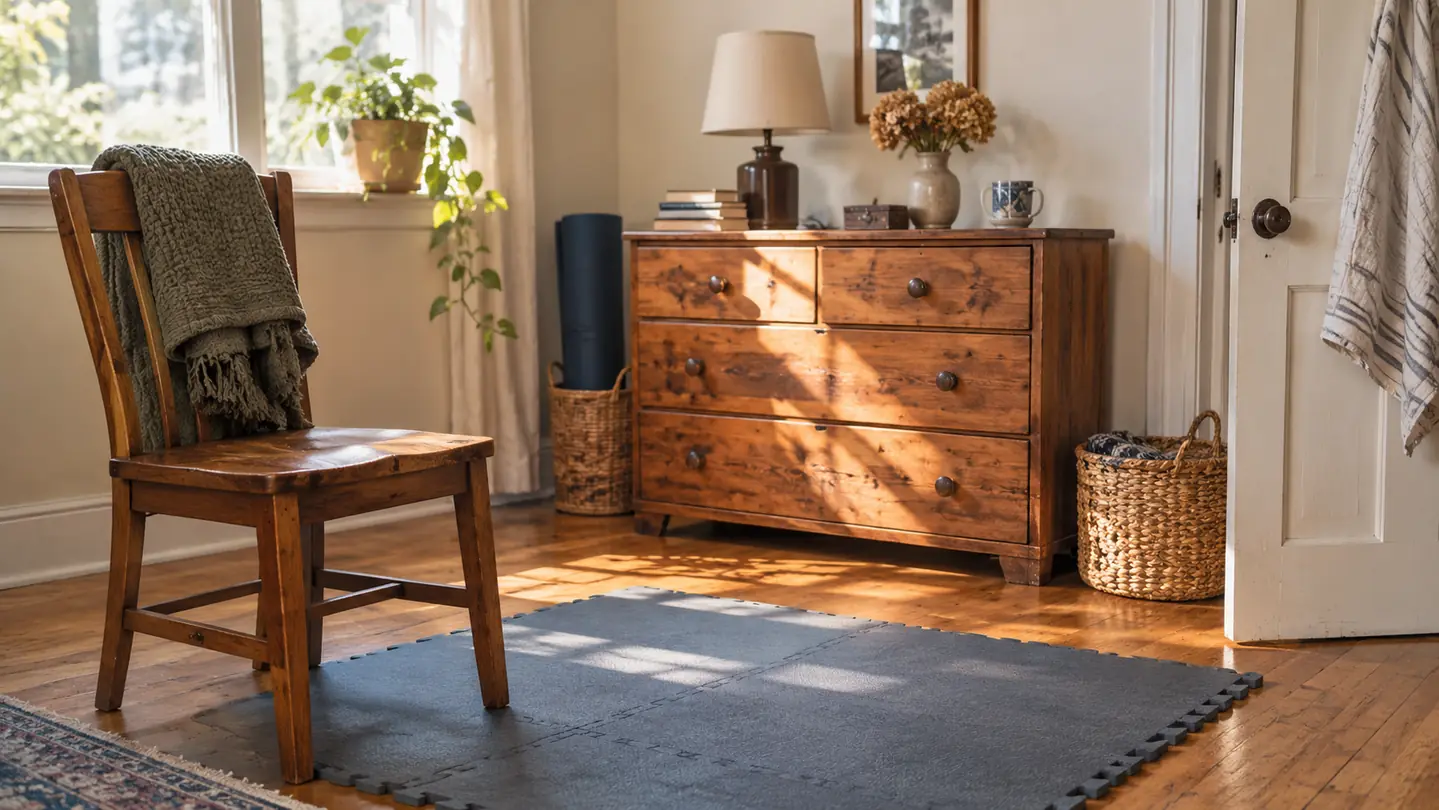
The pair lives in a basket by the spare-bedroom door, next to the balance pad. I started at 2 lb per ankle and stayed there for months, and I mean months, not weeks. I use 4 lb per ankle now. I have never put 5 lb on and I am in no hurry to. That is the part I want to be clear about up front, because the largest number on the box is not the number anyone our age should start with.
I also want to be clear about what these are not. I have never worn them walking outdoors. I have never run in them. I do not wear them on the porch steps or while I am standing on the balance pad. All three of those are bad ideas for someone 68 with a stiff knee, and the listing's list of recommended uses, which includes walking and running, reads like it was written for people decades younger. It probably was.
How I've Actually Used Them
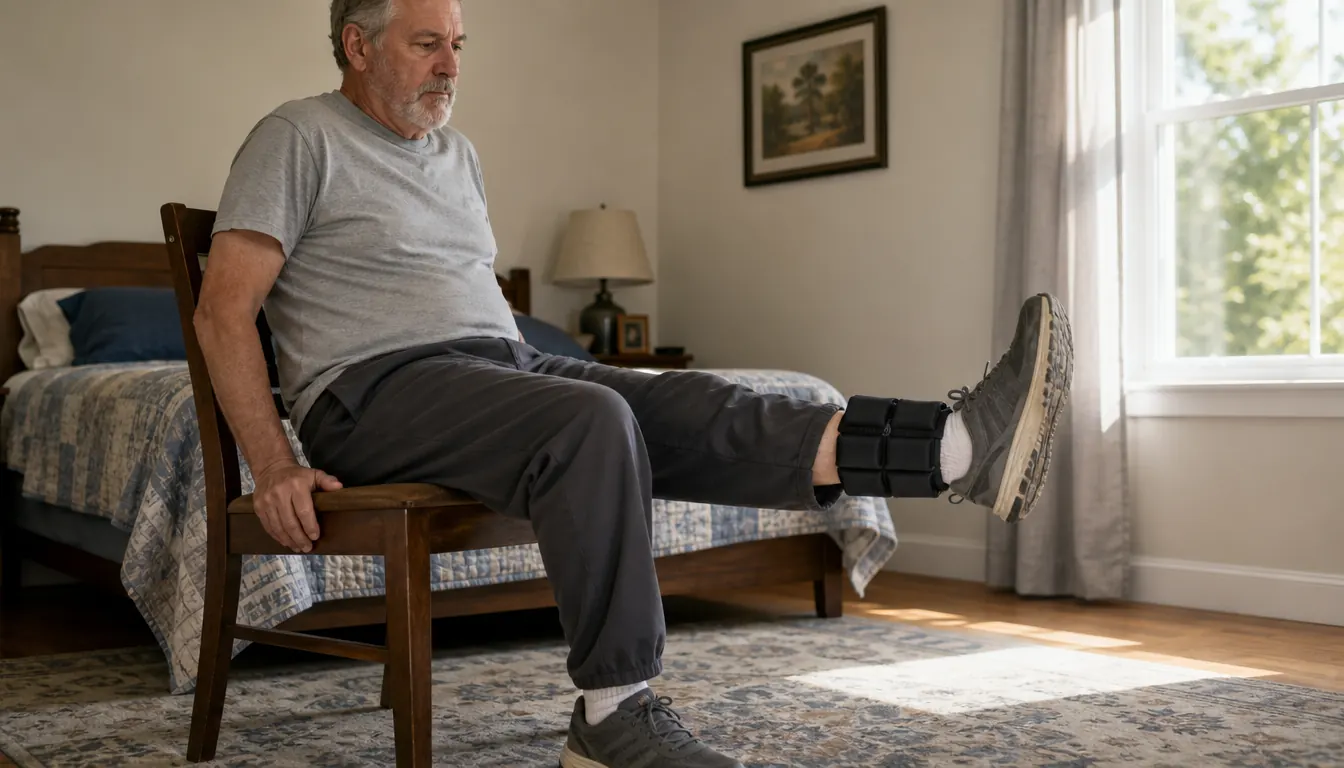
Three movements, most mornings, five days a week, inside a routine that runs 25 to 30 minutes. Seated leg extensions in a kitchen chair: I sit, straighten one leg slowly, hold for a beat, lower it under control. Standing side leg lifts with my left hand on the dresser. Marching in place, lifting the knee to about hip height, again with a hand on the dresser, because I am not foolish.
That is the whole program. No app, no timer, no printed plan taped to the wall. The weights are a way to make three plain movements harder without driving anywhere or buying a machine. My knee tolerates the seated extensions better than it tolerates stairs, and it has tolerated them for two and a half years without a flare, which is the most useful sentence in this review.
Adding the third pound, and later the fourth, was not a decision I made in a moment. I keep a note on the inside cover of a seed catalogue, which is where anything important in this house ends up, and I wrote the date next to each change. Two pounds went on in late winter of that first year. Three pounds waited until the following spring, after a stretch of mornings where the last three reps at two pounds felt like nothing at all. Four pounds waited another year. The test never changed: if the leg came down under control instead of dropping, and the knee felt the same the next morning as it had the day before, I kept the load. If either one failed, I went back a pound for a week and tried again.
Joan uses them now and then for the same side leg lifts, at 2 lb, and hands them back. She prefers the bands and the balance pad. That is fine. Not everything in a house has to be everyone's favorite, and a pair of weights that two people can use at different settings is better value than two pairs of fixed ones.
What Nobody Tells You About the Adjustment
The adjustment is the entire product, so it deserves better than a bullet point. Each ankle weight is a fabric shell with pockets, and each pocket holds a small sand packet. Pull packets out and the weight drops by about a pound at a time. Put them back and it climbs. Each single weight goes from 1 to 5 lb, so the pair runs from 2 to 10 lb. The shell is neoprene with reinforced stitching and a sturdy outer trim, and it closes with hook and loop.
Here is what the listing does not say. The packets are not labeled. They are identical, and when you pull two out to drop from 4 lb to 2 lb you will not remember which pocket they came from. It does not change the total, but it changes how the weight hangs. Load all of them on one side of the shell and the thing sits crooked, rotates while you lift, and rubs. I spread mine evenly now and run a finger under the strap before the first rep. That habit took about a month to build and I wish I had built it in week one.
The second thing nobody mentions is the fit. The listing gives 7.5 to 12.5 inches for the ankle, and that is a real boundary, not a suggestion. My ankles sit comfortably inside that range with strap tail left over. If you are built very small through the ankle, or if you plan to wear these over a thick pant leg, measure first. The listing tells you to check the fit before buying, and it is not being coy about it. It is telling you that returns happen.
Two pounds took me two and a half years to earn. Anyone who tells you to start at the top of the range is not doing you a favor.
Where They Help, and Where They Don't
They help most in seated leg extensions. That is the movement where the load matters and where the knee is safest. They help with standing side leg lifts, where two pounds on the working ankle turns a movement that had stopped doing anything into one you can feel by rep six. They help with marching in place if you are holding something sturdy. All three are unglamorous and all three are the reason I can kneel in the garden again without making a noise on the way down.
The clearest place any of it showed up was the garden, which is the reason I do this at all. Pulling beets means kneeling, and getting up off a kneeler with a bucket in one hand used to take me two tries and a hand on the fence post. It still takes a hand on the fence post. But it takes one try now, and my legs do the work instead of my arms hauling on whatever is nearby. Same with a bucket of potatoes off the back steps. Same with the porch steps themselves, which I climb without the rail most days and with it on the mornings my knee is stiff. None of that happened because of a pair of weights. It happened because I kept straightening a leg against a small load five mornings a week for two and a half years.
They do not help with balance work and they make it worse. Standing on a foam pad with weights on your ankles is a good way to end up on the floor, and I say that as a man who has been on the floor. They do not belong on the porch steps. They do not belong on a walk around the block. If you want weight for walking, get something that sits on your torso instead, and even then talk to your doctor first.
I am not a trainer and I am not a physical therapist. The listing mentions physical therapy and rehab as uses, and I believe that, but the person who decides whether these belong in your rehab is your physical therapist, not me and not a product page. Mine signed off on the seated extensions before I added any weight. That conversation is worth having, and it costs you nothing but a phone call.

The Annoyances, Honestly
The hook and loop closure grabs socks. It grabs the cuff of a sweatpant. It grabbed the edge of the rug once when I set one down and I spent a minute getting it free. At the start of a set, with a knee that does not bend all the way, that is friction you do not need. I put them on sitting down now, against a bare ankle, and that fixed most of it.
One morning last fall I put a weight on over a wool sock without thinking about it, and the hook side of the closure caught the knit and pulled a thread the length of my thumb before I felt it. The sock survived and so did I. The point is that the closure is aggressive and it does not care what it grabs. I keep a pair of thin socks set aside for exercise now, and I wear the weights over bare skin or over those and nothing else. If you wear heavy socks all winter, expect to lose one to this, or expect to slow down and be careful, which is what I do.
Putting them on and taking them off takes two hands and a few seconds, which sounds trivial until you are switching legs across three sets. Twenty minutes of that and you have spent two or three minutes fumbling with straps. It is not a reason to skip these. It is a reason to know what your morning will feel like before you order.
The other annoyance is the size of a step. A pound at 2 lb is a small change. A pound at 5 lb is not. Near the top of the range, moving from 4 to 5 lb feels like more than a pound, and there is nothing between them. That is the tradeoff for one pair covering 2 to 10 lb, and I would make it again, but nobody should be surprised by it in week six.
Two and a Half Years Later
Here is the durability report, which is the part I wanted to read before I bought. The stitching on both Sportneer shells is intact. The outer trim has not separated anywhere. None of the sand packets has split or leaked. The hook and loop still grabs hard enough that I have to peel it, not pull it. The neoprene is creased at the fold where it bends over the front of the ankle and it has gone slightly shiny across the top, which is what neoprene does after a couple of years of daily handling.
I have never put the packets on a kitchen scale to confirm the numbers on the box, and I would not trust the result if I did. What I can tell you is that when I pull one packet out, the difference is what a pound feels like at the end of a leg, which is more than it sounds like when you read it on a page. The shells have been dropped on the floor, sat in the basket underneath a bag of carrots for a week, and carried downstairs in one hand more often than I can count. Nothing has cracked or come apart. The one place I check is the stitching along the top edge, where the strap folds back on itself every single time you fasten it, and that is still tight.
I wipe the shells with a damp cloth every few weeks and let them air out. I do not know what the manufacturer recommends for cleaning, so I am not going to tell you what to do beyond that. What I can tell you is that two and a half years of near-daily use has not produced a single failure, and I expected at least one. I bought these thinking they were a stepping stone to something better. They turned out to be the something better.
What I Liked
- Adjusts in one-pound steps from 1 to 5 lb per ankle, so one pair covers what would otherwise be five separate purchases
- Neoprene shell with reinforced stitching and hook and loop closure held up through two and a half years of near-daily use
- Fits ankles from 7.5 to 12.5 inches, with strap tail to spare in the middle of that range
- Sand packets come all the way out, so you can start light and add load over months instead of weeks
Where It Falls Short
- Packets are unlabeled and sit crooked if you do not spread them evenly through the pockets
- Hook and loop grabs socks, pant cuffs and rug edges if you are not paying attention
- Not for walking or running, whatever the recommended uses on the listing say
- One-pound jumps feel much bigger near the top of the range than at the bottom
Who This Is For
This is for someone exercising at home, sitting down or standing with a hand on something solid, who needs to add load in small increments without buying a rack of fixed weights. It suits knees and hips that want strengthening through a short range of motion. It suits anyone who started with bands, found that bands stopped being enough for leg work, and does not want a gym membership to bridge the gap.
It also suits a household with two people at different levels. Joan at 2 lb and me at 4 lb, out of the same pair, is exactly what adjustable weights are for.
Who Should Skip It
Skip it if you want weight for walking or running. Skip it if your ankle falls outside 7.5 to 12.5 inches. Skip it if you are looking for a balance tool, because it is the opposite of one. Skip it if nobody has looked at your knee or hip and told you which movements are safe for you yet. And skip it if you want gear you never have to think about, because the packets need reseating, the straps need attention, and the whole thing is a small amount of fiddling every morning.
Start at two pounds and leave the other eight in the basket
That is what I did and it worked. The pair covers 2 to 10 lb one pound at a time, so the day you are ready for more, you already own it.
Amazon Check Today's Price on Amazon →