
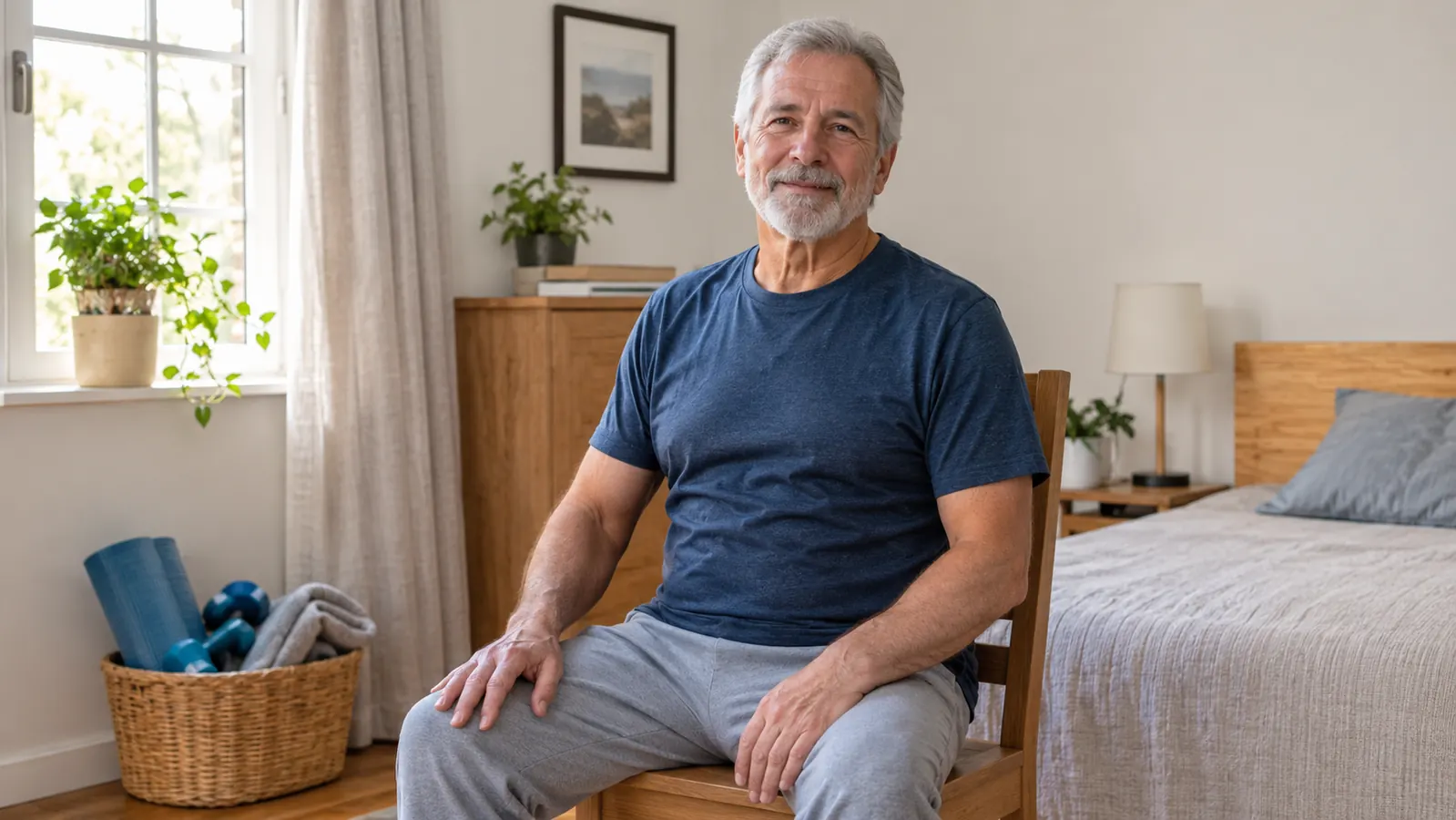
Six weeks after I nearly went off the back porch steps with a bucket of potatoes, I stood in the spare bedroom holding a pair of light hand dumbbells and wondering why they felt wrong. My hands were doing the work. My legs, which were the actual problem, were just standing there holding the rest of me up. My doctor had been clear about that part. He said my legs and my balance were the issue, not my heart. Karen, who is a nurse and lives two hours away, sent me a link to a seated elliptical. Nobody sent me anything about what to hold in my hands, because holding things in my hands was never what scared me. That was four years ago, and it took me another year and a half to say it out loud. The pair of Sportneer adjustable ankle weights in the basket by the spare-bedroom door came later, and they fixed something the dumbbells never touched.
Short answer: for legs, hips and balance, the Sportneer pair does more for me than a hand dumbbell ever did. For arms, shoulders and grip, dumbbells are better and I will not pretend otherwise. If you are past 60 and starting from nothing, the leg work is the more urgent job, so I would buy the ankle weights first and add light dumbbells later if you still want them. I am not a trainer and I am not selling anything. I am a 68 year old retired mail carrier with a stiff right knee and about two and a half years of use on the Sportneer pair. Ask your doctor or a physical therapist before you start either one.
| Sportneer Ankle Weights | Hand Dumbbells | |
|---|---|---|
| How you add load | Removable weights take each side from 1 to 5 lb, the pair from 2 to 10 lb | You pick up a heavier pair |
| Smallest step up | 1 lb at a time, per side | Whatever the next pair on the rack weighs |
| Seated leg extensions | Straps on, hands stay in your lap | Cannot load the ankle at all |
| Hands during the set | Nothing to grip, the strap does the holding | A closed hand for the whole set |
| Upper body pressing | Awkward sitting on the wrist | What they were built for |
| Top end of the load | 5 lb per side, then you are out of room | As heavy as you care to buy |
| Changing weight mid-set | Stop and pull a weight out | Set one down, pick another up |
| Storage | One pair, one basket | A rack of pairs takes floor space |
| Fit | Fits ankles and wrists 7.5 to 12.5 inches | Your hand is your hand |
| Balance drills | Worn while you keep a hand on the dresser | Occupies the hand you need for support |
| Best for | Legs, hips and seated work | Grip, arms and shoulders |
Where Sportneer Ankle Weights Win
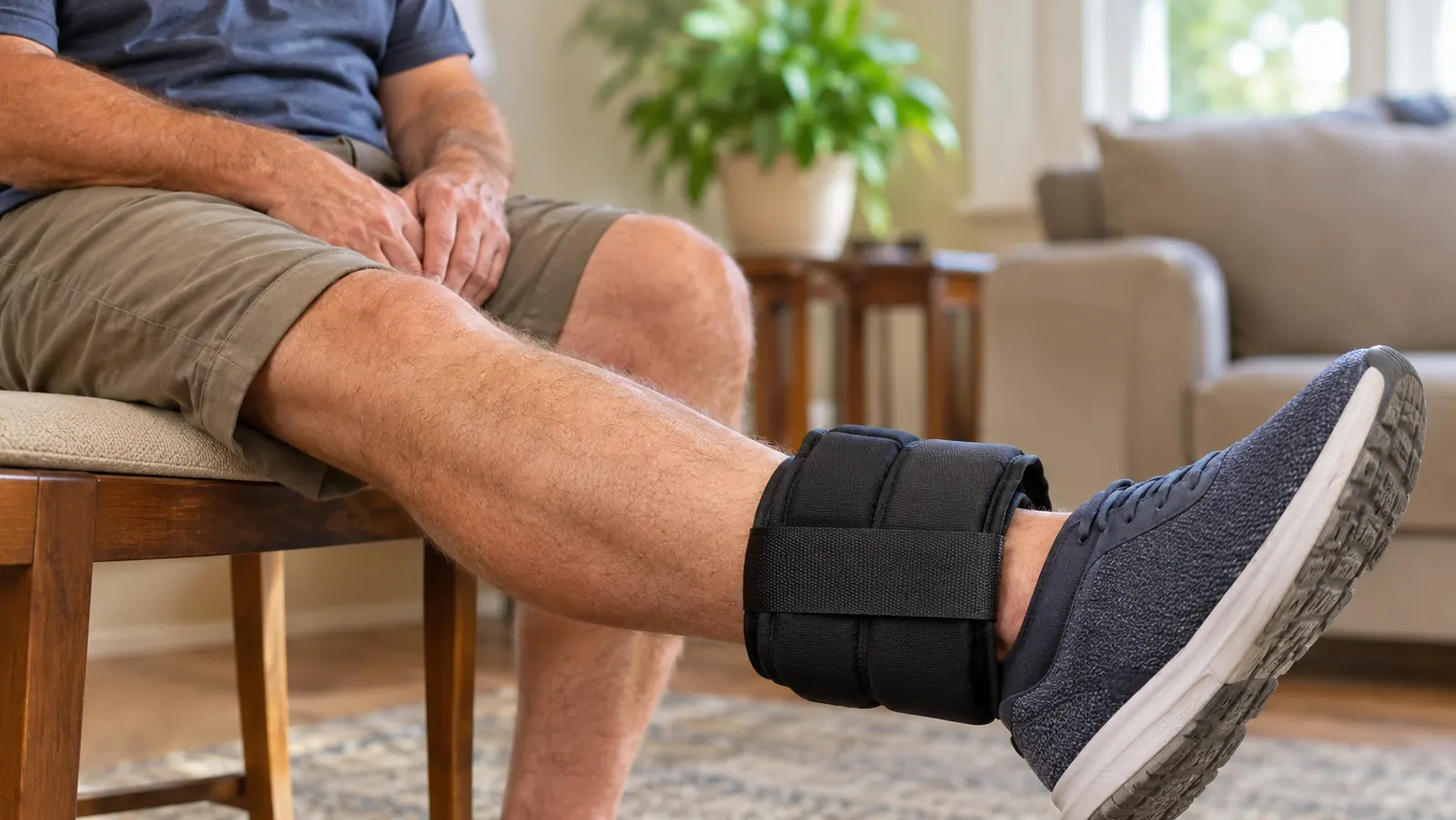
The porch steps scared me because my legs had gone quiet. Not weak exactly, just silent. They stopped telling me where they were. So the first thing I needed was a way to put a load on them without also asking my hands and my back to carry it. That is the whole trick of an ankle weight and it is why the Sportneer pair earned its place. I sit in a sturdy kitchen chair, strap one on each ankle, and extend the lower leg until it is straight, then lower it slow, ten times a side. Standing side leg lifts come next with one hand on the dresser. Marching in place finishes it. Twenty minutes, no bending over, nothing to balance on that I did not choose to balance on.
What makes that workable is the size of the steps. Each weight adjusts from 1 to 5 lb and the pair from 2 to 10 lb, with removable weights inside so you can go up a pound at a time per side. I started at 2 lb per ankle in the fall, on a morning when the porch was too wet to work on, and I stayed there the better part of four months. Not because I was being careful. Because 2 lb was enough to make the tenth rep of a leg extension slow down and start to shake. The jump to 3 lb came the following spring, and I knew it was time because the last three reps had stopped being work and turned into bookkeeping, me counting without feeling anything. I use 4 now. Two pounds over two and a half years sounds like nothing until you remember that a two pound change on a grumpy knee is the difference between a set you finish and a set you quit in the middle. A dumbbell does not offer that. You go from holding nothing to holding whatever the pair weighs, and then the next pair up is a bigger jump than your knee wants on a Tuesday.
The second thing the strap buys you is your hands. On a balance drill, my right hand stays on the dresser and my left hand stays empty. With a dumbbell, both hands are full and the only thing holding me upright is my own legs, which is exactly the thing I am trying to train and not the thing I want to bet a fall on. Mine close with hook and loop, the outside is a neoprene shell over dense filling with reinforced stitching, and the fit range is 7.5 to 12.5 inches of ankle. Measure your own ankle before you order. Mine sits at about 9 inches and there is strap left over.
One pair covers more than the legs, since the listing puts the wrist in the target area too, and it lists rehab and physical therapy among the uses. I have strapped one on a wrist for a slow side raise and it works, though it sits differently than a dumbbell and I would not press overhead with it. As of this writing the product carries a 4.5 average across 22,781 ratings, which is the kind of number that tells you the strap has held up for a lot of people and not just me.
Where Hand Dumbbells Win
A dumbbell makes your hand do the holding, and for the arms that is the point. My grip gave out on me two summers ago, on a Saturday, pulling carrots out of ground that had dried harder than I expected. I got the first dozen out by hand and then my right hand simply let go on the next one, and I sat back on the garden kneeler with dirt on my knees feeling foolish. Then it happened again on a jar lid in the kitchen, and Joan opened it without a word, which was worse. That is a real problem with a real answer, but it is not the same answer as the ankle weights. For chest presses and rows I use flat resistance bands looped around a chair. A dumbbell does roughly the same job with one difference that matters: your hand has to close around it and stay closed for the whole set. Some days that is exactly the training you want. Most days for me it is the thing that ends the set early, and the arm work never gets done. What I added instead was a set of hand grippers, one in the cup holder of the recliner and one in the truck, worked in short sets during the evening news.
Dumbbells also do not run out of room. My Sportneer pair tops out at 5 lb per side, and once your legs are past that you have to look elsewhere. A dumbbell goes as heavy as your shoulder and your patience allow, and there is nothing to count, no strap to line up, no weights to slide in or out. You pick it up and you put it down. For somebody who wants one piece of equipment and no fiddling, that simplicity is worth more than everything I said above. It also stores on a rack that grows every time you buy a heavier pair, which is the trade you make. My neighbor keeps four pairs of his on a shelf in his garage, and he uses them all, because the jump from one pair to the next never stopped him the way a stubborn strap can.
Start with the load your legs can feel, not the one your hands can hold
The Sportneer pair adjusts from 1 to 5 lb per side, straps on in a few seconds, and leaves both hands free for the dresser. It is the first piece of equipment I would buy again if I had to start over.
Amazon Check Today's Price on Amazon →
What My Week Actually Looks Like
Five mornings a week, after coffee, for 25 to 30 minutes. Upstairs in the spare bedroom I cleared out, or on the back porch when the weather is decent. The ankle weights come out on three of those mornings, Monday, Wednesday and Friday, which I settled on because it leaves a day of something else between them and my knee stops grumbling by about the third week. The flat bands come out on two. The balance pad sits flat on the floor next to the dresser and I stand on it for a few minutes every single day, sometimes just while I am waiting for the coffee to finish. Three minutes, hand on the dresser, feet together, then one foot in front of the other. The seated elliptical gets fifteen to twenty minutes on the rainy ones, level four or five, and I have never once opened the app for it. The whole week takes me about two and a half hours spread across five mornings, which is less time than I spent walking my mail route on a single Monday.
I did try stacking all of it into one longer session at the start, weights and bands and balance work back to back, and I quit inside a week. Splitting it is not discipline. It is the only version I kept doing. If you take one thing from this article, take that, and then take the part where I say to ask your doctor first.
My hands were getting stronger. The legs that nearly put me down the porch steps were doing nothing at all.
What I Liked
- Adjusts in 1 lb steps per side, so the jump between settings stays small
- Hands stay free, which matters for balance work and for holding a dresser
- One pair covers ankle and wrist work
- Fits ankles 7.5 to 12.5 inches and closes with hook and loop
- Takes up the space of a small basket
Where It Falls Short
- Tops out at 5 lb per side, so it is not a forever tool for the legs
- Changing the weight means stopping to pull a weight out
- The strap has to fit, so measure your ankle before you order
- Clumsy on the wrist for anything you press overhead
Who Should Buy Which
Buy the Sportneer ankle weights if the problem is your legs, your hips or your balance. If you have a knee that complains on stairs, if you have stopped carrying things because your legs feel unsteady, or if a doctor or physical therapist has told you to work on leg strength, this is the more useful of the two. It also suits anyone who needs their hands free while they work, which is most people over 60 doing standing drills in a house with furniture to hold onto. It is what I would buy first, and I say that as a man who spent thirty one years walking a mail route and assumed the walking was enough.
Buy the dumbbells if the arms and shoulders are the goal, if your grip needs the work, or if you already have the leg side handled with bands or a machine. Buy them too if you know yourself well enough to know that a strap you have to adjust will end up in a drawer, because a dumbbell you actually pick up beats an ankle weight you do not. If you cannot decide, buy the ankle weights first, use them for a month, and then decide whether the arms are worth a second purchase. There is no prize for owning both on day one. Here is the test I would use if I were starting over. Stand in your kitchen, hold the counter with one hand, lift one foot six inches off the floor and hold it for a count of ten. Then try it again without the counter. If the second try is the one that makes your stomach tighten, your legs are the job and the ankle weights are the tool. If both feel easy and the thing that actually bothers you is opening jars and carrying grocery bags in from the truck, then it is grippers or dumbbells you want, and the ankle weights can wait a year.
Two pounds per ankle was enough to start. It still is.
The Sportneer pair goes from 2 lb to 10 lb for the pair as your legs allow, and it stores in a basket by the door so you actually use it. Mine has held up for two and a half years of mornings. Check the fit range against your own ankle first.
Amazon Check Today's Price on Amazon →