
The first thing nobody tells you about a balance pad is that the pad does not do the work. You do. All the ProsourceFit balance pad does is make standing still a little less certain, and that uncertainty is the entire point of it. I bought mine about three years ago, the first winter after I started working with resistance bands in the spare bedroom, and I have stood on it most mornings since.
I am 68. I carried mail on a rural route for 31 years, I live in a two-story farmhouse outside Wilkes-Barre with my wife Joan, and my right knee is stiff from old wear that never got bad enough to operate on. I am not a trainer and I will not pretend a piece of foam rebuilt me. What follows is the version I wish I had read before I bought it: what the pad has done, what it plainly has not, the two weeks I would handle differently, and why it now spends most of the summer out in the garden instead of the bedroom.
The Quick Verdict
A simple foam tool that makes balance practice possible in a spare bedroom, on two conditions: you keep one hand near something solid, and you are willing to be bad at it for a couple of weeks.
Amazon Check Today's Price →The foam pad I stand on before I have finished my coffee
ProsourceFit's pad is 15.5 inches long, 12.75 inches wide and 2.25 inches thick, weighs 12 ounces, and wipes clean with a damp cloth. Mine is three years old and has not torn, cracked, or gone soft in the middle.
Amazon Check Today's Price on Amazon →How I've Used It, Morning by Morning
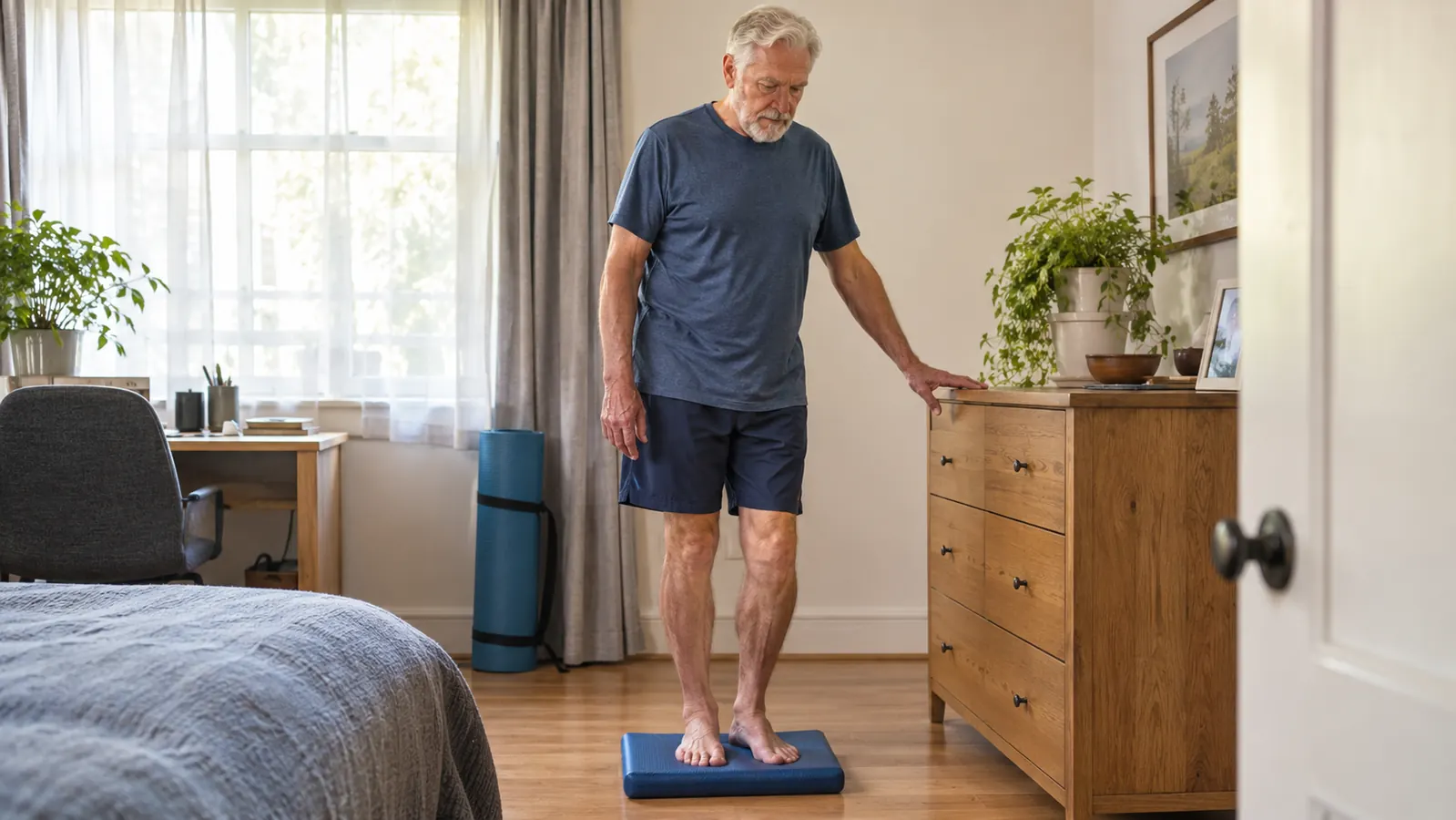
The pad lives flat on the spare bedroom floor, about an arm's length from a low dresser. That distance is deliberate. I step onto it barefoot, put my fingertips on the dresser top, and stand there. Then I shift my weight onto one foot and count to ten, come back to center, and go to the other side. Some mornings I stand with my feet close together, which is harder than it sounds, and some mornings I stand on one foot and just try to keep my breathing even. Four or five minutes, then the bands. That is the whole routine, and it has not changed much in three years except that the counting has gotten slower.
Getting the order right took a while. For the first month I did the balance work after the bands, when my legs were already tired, and it went badly. Standing on foam on legs that have just finished seated rows is a different exercise, and not a good one. Karen suggested flipping it, so balance comes first, before the coffee is even finished, and that is how it has run ever since. Four or five minutes on the pad, then a kitchen chair and the red band for rows and presses, then the ankle weights on the days I use them, then fifteen minutes on the seated elliptical while the coffee goes cold. Twenty-five to thirty minutes, five mornings a week, and I have missed whole weeks in the summer when the garden wanted me at six in the morning instead. The routine survives the misses. That is the test I apply to everything now.
Joan is 66 and uses it less often than I do, usually in the kitchen with one hand on the counter while she waits for the kettle. She has better balance than I do and does not enjoy being reminded of it, so she keeps it short. When our daughter Karen visits, she is a nurse and she will watch me for thirty seconds and then tell me my hips are drifting. The pad makes that obvious. On a flat floor you can cheat and never know it.
What has actually changed is small and specific. I put my socks on standing up now, which I could not do three winters ago without sitting on the edge of the bed. I carry a basket of laundry up the cellar stairs with one hand on the rail instead of two hands and a stop halfway. I still use the rail on the porch steps, but I use it, I do not lean on it. Nobody would call that a transformation. It is the difference between dreading the stairs and not thinking about them.
What the Pad Actually Is, and What It Is Not
Here is the plain description. It is a slab of thermoplastic elastomer foam, the dense and slightly rubbery kind rather than the crumbly packing foam, measuring 15.5 inches long by 12.75 inches wide by 2.25 inches thick and weighing 12 ounces. ProsourceFit calls the surface non-slip and sweat-proof, and after three years of bare feet and a few humid Augusts I would agree with both. It has never once slid on the bare wood floor of that spare bedroom, including the mornings I stepped onto it with feet still damp from the shower. It wipes down. It carries a limited lifetime warranty, which I have never had to test, so I can only tell you that the thing itself has held up.
The listing suggests lunges, squats, planks, and crunches on it, and I do not doubt that younger people do all of that. My uses are narrower: standing balance, and kneeling in the garden. What the pad is not, and this matters, is a machine. There are no springs, no ball underneath, nothing that tips or swivels, nothing to adjust and nothing to plug in. It is a soft, unstable surface and nothing more. If your balance is bad enough that you cannot stand safely with a hand on a dresser, this is not the tool that fixes it, and no foam on the market is.
What Nobody Tells You Before You Buy One
The first thing is that the pad is the easy part. Standing on a soft surface for four minutes is not exercise in any sense a person would recognize from a gym. The work is in what you do while you are up there: letting go of the dresser for two seconds, turning your head, reaching for a shelf. If you buy this and stand on it while watching the news, you will get almost nothing from it and you will decide the pad is no good. It is not the pad. It is that nobody explained what the four minutes are for.
The pad gives you nothing to aim at, either. There is no display on it and nothing that counts your time, so the counting is mine to do and mine to forget. On the mornings I forget, I drift off into thinking about the truck or the gutters and stand there a while doing nothing in particular. Those are wasted mornings. Counting out loud sounds ridiculous in an empty room, and it works better than counting in my head, because I cannot count out loud and daydream at the same time.
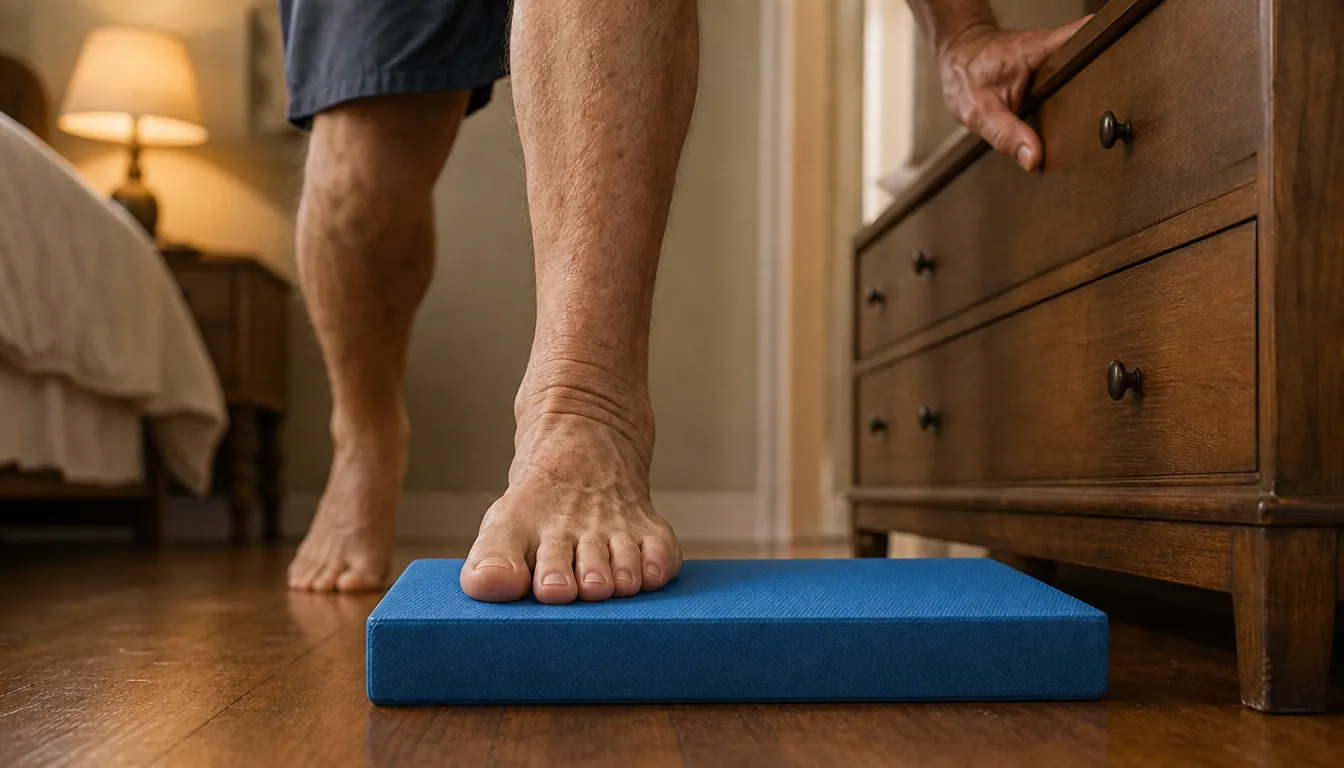
The second thing is that stepping onto 2.25 inches of foam is its own skill, and it is the part that scared me. For the first two weeks I did not trust the near edge of it. I put a hand on the dresser before my foot left the floor, every single time, and I am glad I did. If you have a knee that does not bend far or a hip that complains, spend the first week practising getting on and off with shoes on and no balance work at all. That was Karen's advice and it was good advice. It is also the advice no product page will give you, because getting on and off is not the part anyone wants to sell.
I would also do those first days in shoes. Bare feet on foam is the standard advice and I understand why, but bare feet made me feel every wobble twice and it raised the stakes in my head more than the situation deserved. So I spent a week in a pair of old walking shoes with the laces done up, stepping on and stepping off, ten times in a row, hand on the dresser, no counting and no one-foot work. It looked silly. It also meant that when I finally did go barefoot, the step up no longer frightened me, so I could pay attention to my balance instead of my landing. Two weeks, roughly, before anything I would call balance practice happened at all.
The third thing is that progress is not steady and it is not impressive. There were weeks when one foot felt solid and the other felt like it belonged to someone else. There were mornings I got four seconds and quit. Three years in, I still put a hand out. I have never stood on it with my eyes closed for more than a few seconds and I have stopped treating that as a failure. The pad does not keep score. You have to decide what counts, and mine is whether I can get up off the garden kneeler without pushing off with my hands.
The Garden Kneeler I Did Not Expect
I bought this for balance. My favorite use is kneeling. The garden behind the house is mostly potatoes, carrots, beets, butternut, and acorn squash, and there is a lot of time spent down at ground level with a trowel and a bucket. Two and a quarter inches of foam is a considerable improvement over a board or the dirt. It does not cut into the knees, it does not slide out from under me when I lean to reach a beet, and at 12 ounces I carry it out with one hand along with everything else.
Take a morning in late September. I had two rows of beets to pull and the ground was still wet from rain the night before, which is the worst condition for kneeling, because wet dirt packs into everything. I carried the pad out in one hand with the bucket in the other, set it down along the row, and worked my way down it for the better part of an hour, shuffling the pad every eight or ten feet as I went. When I finished I stood up out of the kneel without putting a hand down, which two years earlier would have meant rolling onto a hip first and grabbing the fence post. That is what I mean when I say the garden is where the balance work pays me back. It is not a fitness result. It is not having to crawl to the fence post to get upright again.
It comes back inside dirty. That is the honest trade. I knock the soil off, wipe it with a damp rag, and stand it on edge against the dresser to dry, and by the next morning it is fine. The foam has not held a stain so far and it has not started crumbling at the corners. If you only ever wanted a kneeling pad, buy a kneeling pad, because it will be thicker and shaped for the job. I like that one object does both. It means the ProsourceFit pad is never folded away in a closet where I will forget about it until spring.

Where It Falls Short
After three years and a great deal of kneeling, the middle of mine has softened slightly compared with the edges. Not enough to matter for standing, but if you press a thumb into it you can tell where my knees go. Foam does that. Anyone who tells you a foam pad looks and feels new after years of daily use is either not using it or not looking at it. The limited lifetime warranty may well cover a replacement, but I have not tested that, and I would rather tell you what mine actually looks like than speculate.
The size is right for standing and wrong for anything else. At 15.5 by 12.75 inches it holds my feet with room to spare, but the moment I try something that involves stepping rather than standing, the pad runs out of surface. Squats and lunges, both of which the listing mentions, are for people who can do a squat in the first place. I cannot get low on a good day and I am not going to try it on foam.
The other complaints are ordinary ones. It sits on the floor, which makes it a thing to trip over, so mine leans against the dresser between uses rather than lying flat in a walkway. It offers less challenge than a firmer pad or a wobble board, and if you are already steady on your feet you will outgrow it inside a month. And it does nothing about strength. My legs got stronger from the seated elliptical and the ankle weights. The pad only taught me to use what those two built. Expecting more than that from a piece of foam is how people end up leaving a review saying it did not work.
If I were starting over I would think harder about what I actually wanted. A wobble board gives you a moving surface and a much steeper challenge, and it is also the thing most likely to put a 68-year-old on the floor in week one. A firmer half-foam pad is a middle step. Soft foam is the friendliest of the three, and friendly was what I needed at 65 with a bad knee and a bad attitude about exercising at home. Three years on I could probably handle something firmer. I have not bothered, because I am not training for anything except a garden.
What I Liked
- Non-slip surface holds a bare foot, even in a humid August
- Wipes clean with a damp rag after garden use
- 15.5 by 12.75 inches leaves room for both feet
- Weighs 12 ounces, so it travels from the bedroom to the garden in one hand
- Doubles as a kneeling pad, which is how I use it most in summer
- Low 2.25 inch height means a small step up, not a climb
Where It Falls Short
- The middle softens after years of kneeling
- It is a trip hazard if you leave it flat in a walkway
- Less of a challenge than a firmer pad or a wobble board
- Does nothing for strength on its own
- Does nothing at all if you stand on it passively
Three winters ago I could not put a sock on standing up. Last week I did it without thinking about it. That is the only scorecard I keep.
Who This Is For
This is for someone in their sixties or seventies who has been told, by a doctor or a physical therapist or a grown daughter who worries, that balance is worth working on, and who wants to do it at home in a spare bedroom without buying a machine. It suits a person who will put in three to five minutes most days and who has a dresser, a counter, or a sturdy chair within reach. It suits a gardener, for the kneeling alone. And it suits a couple, because it is small and flat and two people can use the same one without adjusting anything, which is more than I can say for most of what I have bought.
Who Should Skip It
Skip it if you are looking for a workout, because this is not one. Skip it if your balance is bad enough that you wobble standing at the kitchen sink, because a soft surface will not help that and you need a professional assessment first, not a purchase. Skip it if you want a real challenge and can already stand on one foot while tying a shoe, because you will be bored by the second week. And skip it if you will not keep something solid within arm's reach, because the pad is not dangerous, but confidence on it with nothing to grab is how people get hurt. Whichever group you land in, run it past your doctor before you start, the way I did.
The one piece of equipment that has never been put away
It is flat, it weighs 12 ounces, it goes from the bedroom floor to the garden and back, and it has outlasted a set of resistance bands. If you are going to work on balance at home, this is the least complicated way I know to start.
Amazon Check Today's Price on Amazon →