
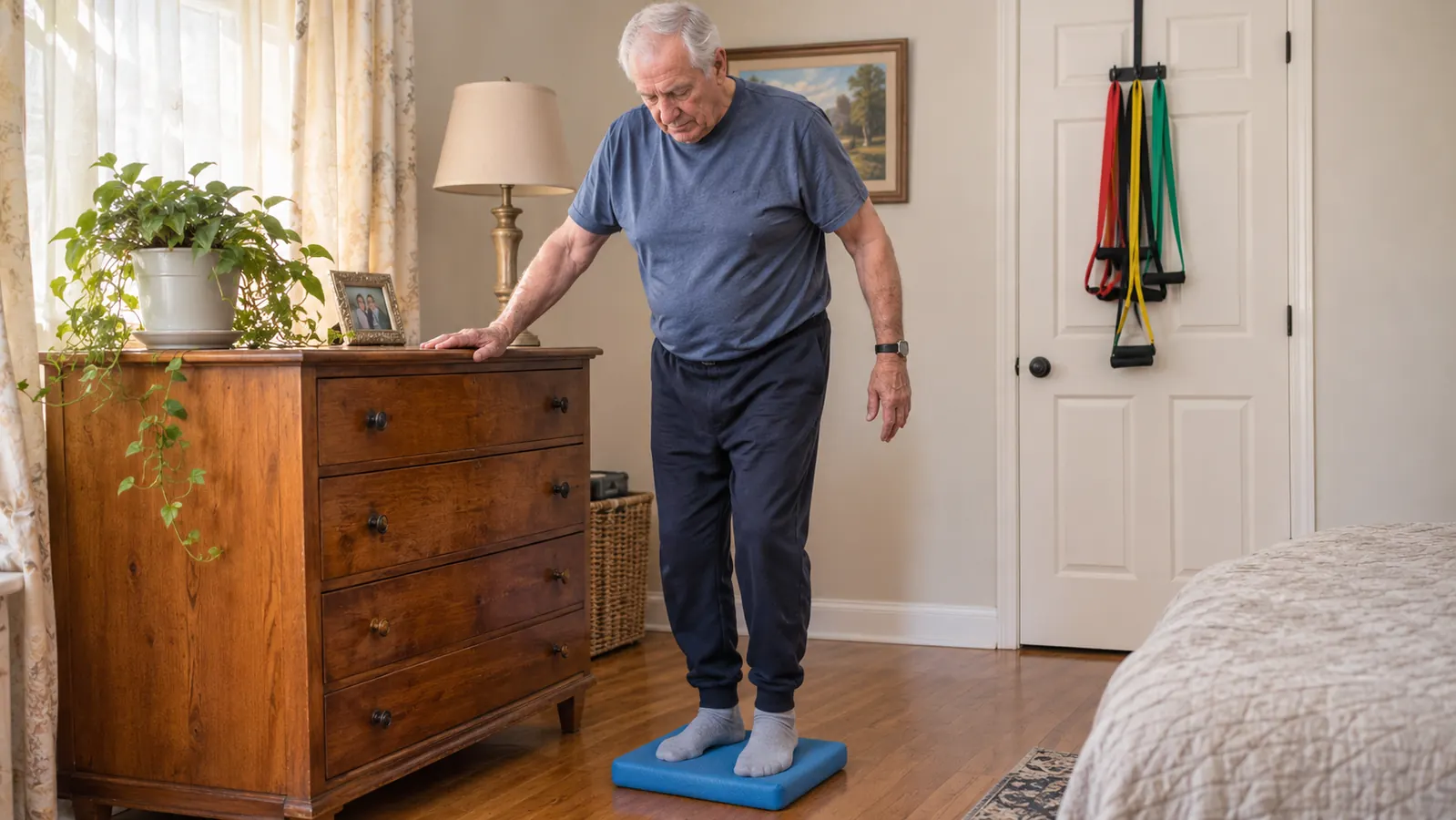
Three winters ago I stood in the spare bedroom upstairs with both hands flat on a dresser and lifted my right foot one inch off the floor. That was the entire exercise. I held it about four seconds before I set the foot back down and told myself the carpet was probably uneven.
The thing under my foot that first morning was a ProsourceFit balance pad. It is a slab of foam, 15.5 inches long, 12.75 inches wide and 2.25 inches thick, and it has lived on that floor beside the dresser for about three years. I bought it the winter after the resistance bands, on a suggestion from my daughter Karen, who is a nurse and who has nudged me into most of the equipment in that room. I am not a trainer. I am a sixty-eight-year-old retired rural mail carrier with a stiff right knee, a tight lower back in the mornings, and a vegetable garden that expects things from me.
The Quick Verdict
A plain piece of foam that turned balance from something I hoped I had into something I could practice. The garden kneeling alone earns its place on the floor.
Amazon Check Today's Price →Four Seconds on One Foot Became Something Longer
TPE foam, 2.25 inches thick, 15.5 by 12.75 inches, sweat-proof and slip-resistant on a wood floor. It is not a machine, it does not count anything for you, and it will not do the work. That is exactly why it worked for me.
Amazon Check Today's Price on Amazon →How I've Used It
It sits flat on the floor between the dresser and the wall. I step onto it in my socks most mornings, five days a week, as part of the same twenty-five to thirty minute routine I have kept since I was sixty-four. I do not stay on it long. Three or four minutes is plenty. I put one hand on the dresser top and I do three things in order: stand still with both feet and feel the foam give under my weight, shift slowly from heel to toe and side to side, and then stand on one foot and count.
The counting mattered more than I expected. The first month I counted to four and put the foot down. I do not have a number for where I am now, because somewhere along the way I stopped counting and started listening to the clock in the hall, and then I stopped doing that too. What I can tell you is that I can stand on one foot on that foam long enough to get bored, and I can do it on the right leg, the one above the stiff knee, which for two years I could not do on a flat floor.
Joan uses it too. She is sixty-six and steadier than I am, and she does the same standing work while I finish with the ankle weights. In summer the pad goes out to the garden with me, and that is the use I would argue about. Two and a quarter inches of foam between my knees and the dirt is the difference between kneeling in a beet row for twenty minutes and not kneeling at all.
One note on setup, because it is the whole thing. The pad is useless to me without something to grab. The dresser is chest high and it does not move. In the garden it is the fence post or the wheelbarrow handle. If you are going to stand on an unstable surface, get your hand on something solid before you lift a foot. That is not advice I read somewhere. That is the rule I set the morning I wobbled and caught the dresser edge with two fingers.

What the Foam Actually Does Under Your Feet
A foam pad works by taking away the firm, flat, predictable ground your feet are used to. The ProsourceFit listing calls it an unstable surface for balance and core work, which is accurate and sounds more dramatic than it is. In practice, standing on it means the small muscles in your feet and ankles are making corrections the entire time, and your body is learning to catch itself. On a hard floor you can stand on one foot with your ankle locked and cheat your way through it. On foam you cannot.
It is made of TPE, thermoplastic elastomer, which is why it does not slide out from under me on the wood floor and why a damp cloth takes the dust off. I have never had the pad slip. I have had my foot slip off the edge of it, which is a different problem and entirely my own fault.
It measures 15.5 by 12.75 inches, and I did not think about the size until I had used it a month. It is wide enough for both feet side by side with room left over, and long enough to put one foot forward and one back without either hanging off. The listing mentions lunges and squats on it. I do not do either, on account of the knee, and I would not suggest you start there at sixty-eight. Standing still is harder than it sounds.
The pad did not hand me better balance. It handed me a place to practice it, which was the part I had been skipping for two years.
What I Tried Before the Pad
Before the pad I did my standing work on the floor, which mostly meant I did not do it. I tried a folded bath towel, which slid. I tried standing on one foot while holding the kitchen counter, which lasted about a week before I decided I was too busy. The reason the pad stuck, I think, is that it lives in the room where I exercise and it is one obvious object with one obvious purpose. There is no setup and nothing to plug in.
I thought about a wobble board and decided against it. From what I understand they are a bigger challenge, built for people who already have a base of balance to work from, and I did not. The ProsourceFit pad is the gentler first step. If you are further along than I was, a board may suit you better, but I would not begin there with a knee that does not fully bend before coffee.
The First Winter, Honestly
I want to be careful here, because I have read enough of these to know when someone is selling me a story. My balance improved and I cannot prove the pad did it. What I can tell you is what changed in that room. The first month I could not take my hand off the dresser. By February I was lifting it for a count of five. By spring I was standing on one foot with two fingers on the dresser, mostly for insurance.
The other change is harder to describe. On a flat floor I could fool myself. I could lock my knees, grip with my toes and call that balance. Foam does not allow the trick. It made the weakness obvious in a way a floor never did, and once it was obvious I could work on it. That is worth more to me than any particular exercise.
There was a morning in March, and I remember it because the driveway was still ice, when I stood on that pad and reached down to pick up a sock without holding anything. I did not think about it until I was standing back up. Two years earlier that same movement would have had me grabbing for the dresser. That is not a dramatic story and I am not going to dress it up. It is the kind of thing you notice and then keep to yourself.
What did not change: the knee is still stiff in the mornings, the lower back still complains when I get out of bed, and I still take the porch steps one at a time with a hand on the rail. Nobody should read this and think a piece of foam repairs a joint. What it did was make the stairs less interesting, in the sense that I no longer think about them.
Where It Paid Off Most: The Garden
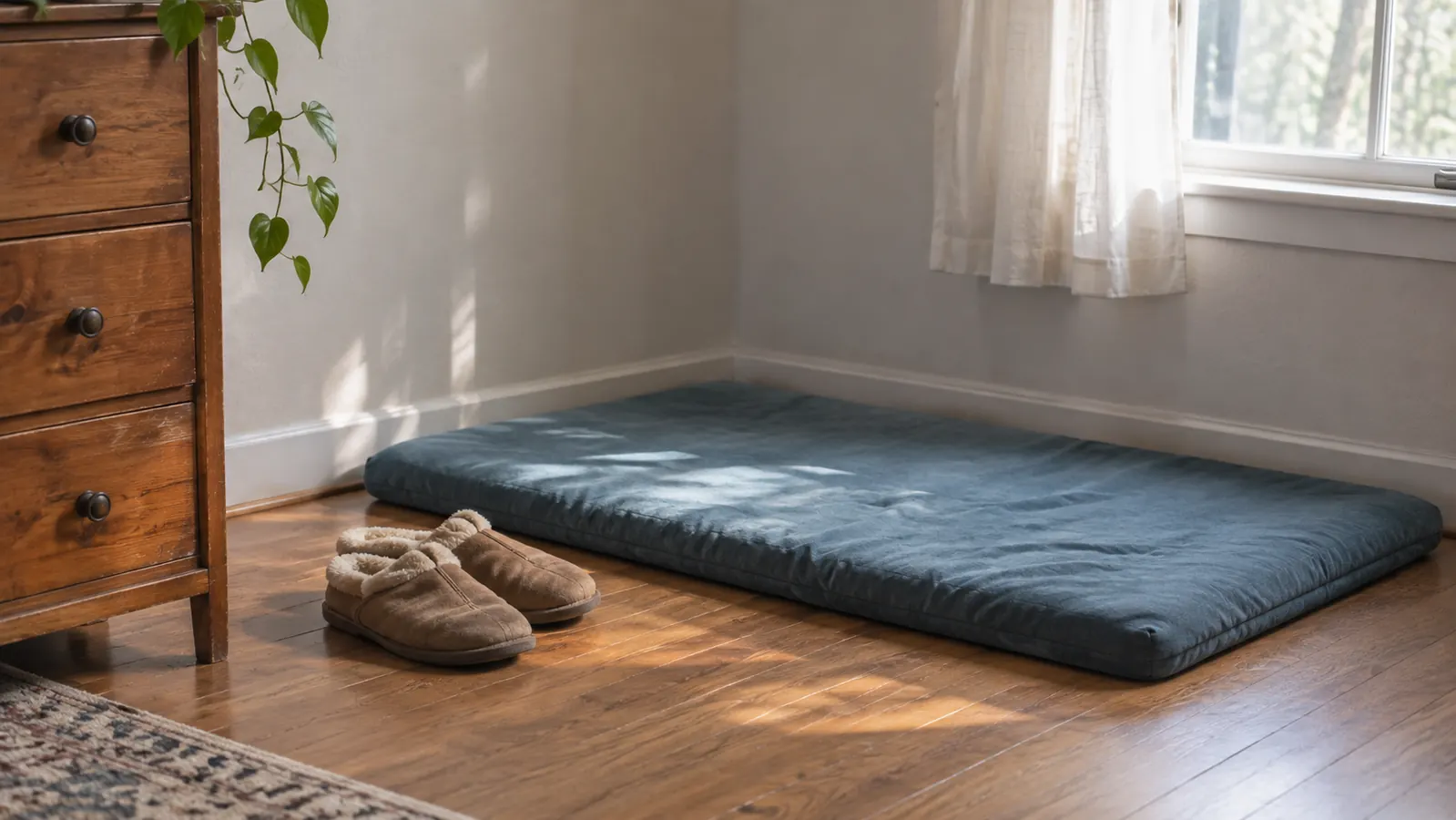
The garden is behind the house and it is mostly root vegetables and squash, and the work is kneeling, lifting and carrying. The pad goes out there from about May to October and it stays by whichever bed I am working in. I kneel on it to thin carrots, pull beets and set squash vines back where they belong. The foam does not mind mud and a hose takes care of it.
Getting up is the part that counts, not kneeling. For a couple of years I did my garden work sitting on an overturned bucket because I did not trust my knees to bring me back up. Now I kneel, work, and stand, and the pad marks where my feet go when I push off. That sounds like a small thing. It is the difference between finishing a row and quitting halfway through it.
The other place it shows up is the porch steps, and I will say plainly that the pad is not on the steps and never has been. What I noticed last fall was that carrying a bucket of potatoes up those same steps, I was watching the bucket and not my feet. You do not get there from a foam pad alone. But the foam pad is where the practice happened.
What I Don't Like About It
Two and a quarter inches is a step up. On a morning when the knee is stiff, that first step onto the pad is a small negotiation, and there have been mornings I did the standing work on the floor instead. It is a minor complaint and it is honest.
The bigger complaint is that it does not progress. It is one piece of foam with one firmness, and after three years my body has learned it. I can stand on that pad and hold a conversation. That means it is time for something harder, and there is nothing to adjust, no way to make it less stable, no next step built in.
The last one is housekeeping. It lives on the floor of a room I walk through and it is in the way about once a week. It collects dust and lint on the surface, so I wipe it with a damp rag every other week, thirty seconds of work I resent more than I should. The foam itself has not cracked, dented or gone soft in three years, and it carries a limited lifetime warranty, so durability is not a worry I have.
What I Liked
- Gave me a way to practice standing on one foot that a flat floor never did
- Stays put on a wood floor and wipes clean with a damp cloth
- 15.5 by 12.75 inches fits both feet with room to move
- Doubles as a garden kneeler, the use I would replace it for first
- Three years in, no cracking, denting or softening
Where It Falls Short
- One firmness, so there is no way to make it harder as you improve
- 2.25 inches is a step up on a morning when the knee is stiff
- It lives on the floor and gets underfoot
- Useless without something sturdy within arm's reach
Who This Is For
This is for someone who has been told by a doctor, a physical therapist or a daughter who is a nurse that their balance needs work, and who has no idea what that looks like in a spare bedroom. It is for the person who can stand on one foot for four seconds and would like to do better. It is also for a gardener with bad knees who wants to kneel in a beet row without paying for it the next day. The ProsourceFit pad is an unglamorous place to start, and starting is the part most people skip.
Who Should Skip It
Skip it if you cannot get down to the floor and back up without help, or if you have been told you are at risk of falling. A foam pad is the wrong tool for that until someone qualified has worked with you. Skip it if you want a machine that does the work and reports a number back. Skip it if you want progression, because one slab of foam has none to offer. And check with your doctor or a physical therapist before you start standing on unstable surfaces. I mean that plainly, not as a formality.
Three Years on the Floor Beside the Dresser
If your balance needs work and you would rather practice it than hope for it, this is the simplest thing I have found. Put your hand on something solid and give it four minutes a morning.
Amazon Check Today's Price on Amazon →