
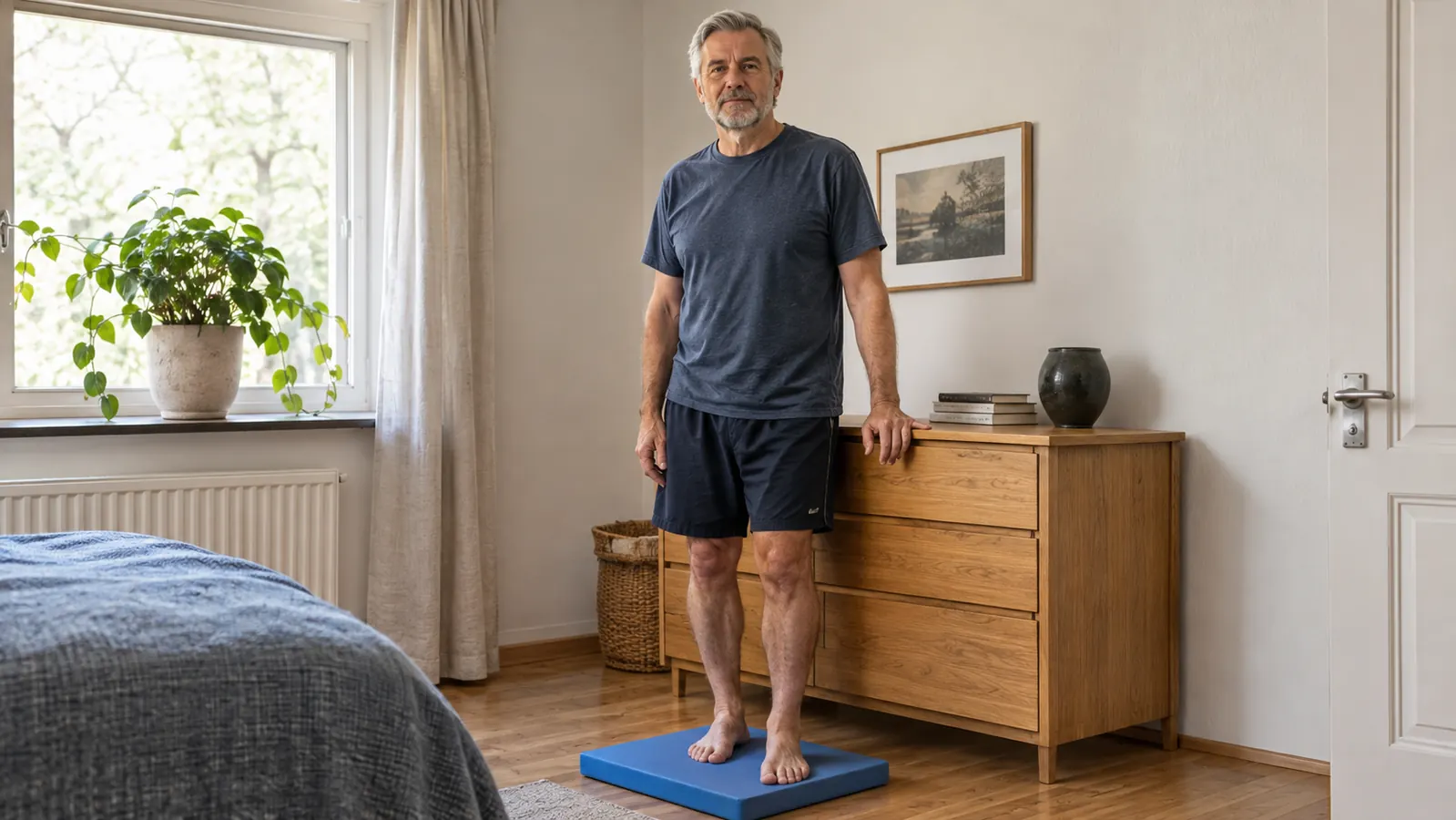
Two pieces of equipment, both sold as balance trainers, and they do not ask the same thing of you. I have had the ProsourceFit balance pad on the floor of my spare bedroom for about three years. I have stood on a wobble board twice, both times at a neighbor's house, and both times I was glad the kitchen counter was within arm's reach. I am 68, I have a stiff right knee from old wear, and I am not a trainer. This is what I noticed comparing the two.
The short answer: if you are past 60, if you exercise alone at home, and if you are starting from scratch, the flat foam pad is the one that will get used. A wobble board is a real tool and it is the harder one. It asks for quick ankle reactions and it does not forgive a bad morning. Most people my age who buy a board use it for two weeks and then lean it against a wall. Most people my age who buy the pad keep stepping onto it, because stepping onto it costs nothing.
| ProsourceFit Balance Pad | Wobble Board | |
|---|---|---|
| What you stand on | A flat foam pad, 15.5 x 12.75 x 2.25 inches, lying still on the floor | A rigid deck balanced on a pivot that tilts with your weight |
| Getting on and off | Step on from standing, no handhold needed | The deck leans the moment both feet are down |
| How hard it pushes you | Small, steady corrections from the ankles and knees | Fast corrections, mostly ankles, no forgiveness |
| Cushioning | TPE foam gives under the foot | Hard deck, every jolt goes up the leg |
| Learning curve | Usable on the first morning | Weeks before it stops feeling like a fight |
| Kneeling and garden work | Works as a knee pad on wet ground | Hard deck, and it tips when you lean on it |
| Foot and ankle demand | Gentle enough to repeat every single day | Sharp and tiring at first, builds faster |
| Storage | Flat against a wall or under a dresser, 12 ounces | Needs clear floor space so it does not tip |
| Cleaning | TPE is sweat-proof and wipes with a damp cloth | Depends on the deck material and grip tape |
| Warranty | Limited lifetime warranty from ProsourceFit | Set by the maker, varies widely |
| Best for | Adults 60 and up building basic steadiness at home | Steady ankles that want a harder challenge |
What Each One Actually Is
The ProsourceFit balance pad is a foam rectangle. Mine measures 15.5 inches long, 12.75 inches wide and 2.25 inches thick, and it weighs 12 ounces, about the same as a hardcover book. The material is TPE, a closed-cell foam that does not soak up sweat, and the surface is textured so a bare foot does not slide off it. It lies flat on the floor. Nothing underneath moves.
Standing on it, the foam gives a little under each foot. That give is the whole exercise. Your ankles and the small muscles around your knees make constant tiny corrections to keep you level, and because the pad is flat and low, none of those corrections is urgent. I can stand on mine and look out the window. I could not do that on a board.
A wobble board is a rigid deck with a pivot under the middle, either a rocker shape or a single ball, depending on the maker. The deck tilts in every direction and it does not come back level on its own. Shift your weight a quarter inch and the board takes that quarter inch and runs with it. Keeping the edges off the floor is a skill, and the skill lives mostly in your ankles.
So the difference is not quality. It is temperament. One is a soft, low, forgiving surface that asks for small corrections. The other is a hard, moving deck that asks for fast ones.
Both are sold as balance trainers and both show up in physical therapy offices, which is part of why the choice gets confusing. The difference is how much of the work you have to do yourself. A pad does some of it for you by staying where you put it. A board does none of it, not for one second.
Where ProsourceFit Balance Pad Wins
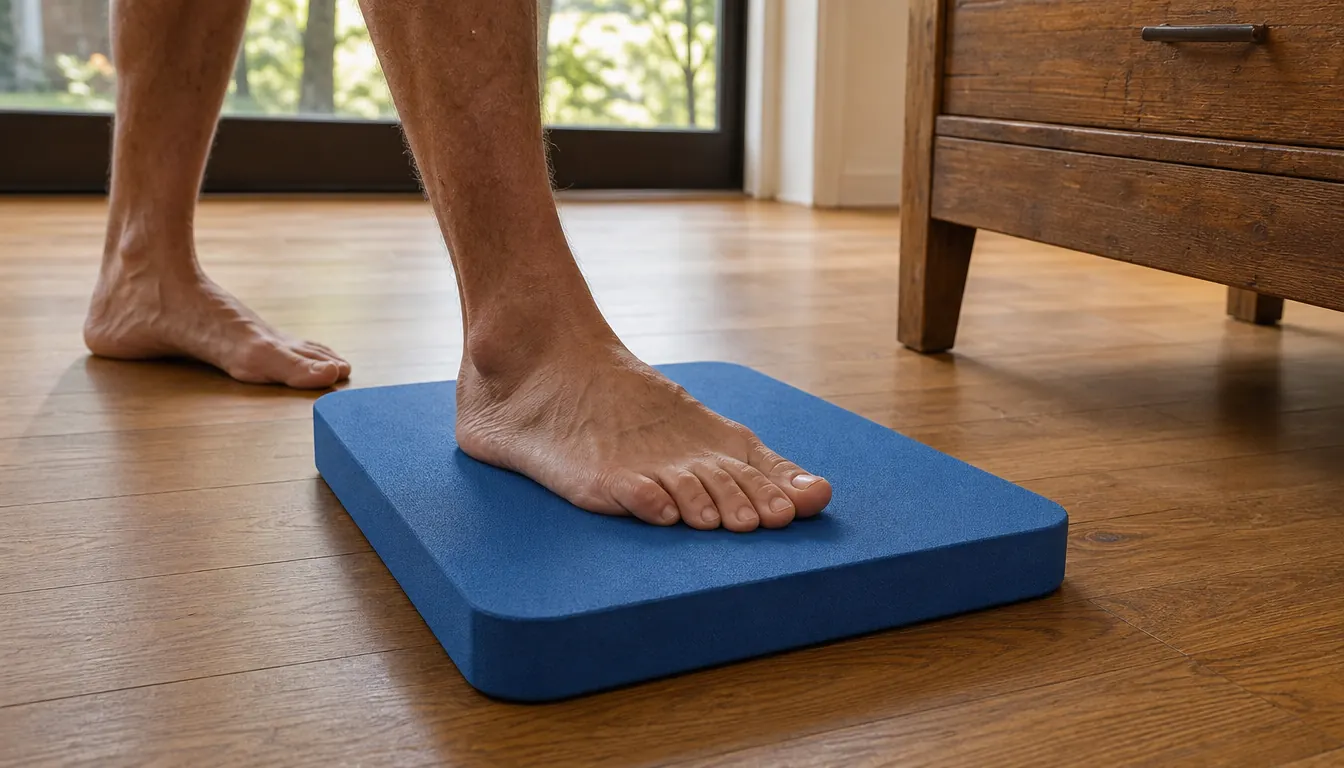
Getting on and off, first. This is the part nobody puts in a product listing and it is the part that decides whether the thing gets used at all. My pad is 2.25 inches tall and the top is flat, so I step onto it the way I step onto a rug. On a wobble board, the instant both feet are down the deck is already leaning toward one corner. You need a hand on something solid to mount it, and you need that hand for a good while after.
Underfoot, the foam is kind. A hard deck sends every jolt straight up through the heel. My right knee has old wear in it, and it tells me about hard floors by the end of the day. Three winters of standing on that pad and my knee has never once complained about it.
The size is worth a mention too. At 15.5 by 12.75 inches the pad is big enough for both feet with room to shift, and wide enough that I can put one foot forward for a shallow lunge without stepping off the edge. A board is a much smaller target, and when you miss it you are standing on the floor wondering what just happened.
Then there is the dull practical side, which at my age is most of the decision. The pad wipes clean with a damp cloth because the TPE does not hold sweat. It stores flat against a wall or slides under the dresser out of the way. And ProsourceFit backs it with a limited lifetime warranty, which for a piece of foam is more than I expected. Mine has been walked on, kneeled on and carried between the spare bedroom and the back door for three years, and it has not torn or gone flat.
Where a Wobble Board Wins
It is simply the harder exercise, and I am not going to pretend otherwise. The pad asks for small corrections. A board asks for fast ones, and it asks for them from the ankles, which are usually what fail first when a person my age catches a toe on a step in the dark. If ankle reaction is the specific thing you want to train, a board trains it harder and sooner than the pad ever will.
A board also does not get easy on you. Three years in, my pad is noticeably friendlier than it was the first month. Some of that is me improving and some of it is that foam is foam. A board keeps offering the same fight every single time you step up. And if a physical therapist has handed you ankle work to do at home, a board is likely close to what they had in mind when they wrote it down.
Three years on the floor and it still does both jobs
The ProsourceFit balance pad is 15.5 by 12.75 inches and 2.25 inches thick, flat enough to step onto without grabbing anything. Check today's price on Amazon and read the reviews from people using it the same way I do.
Amazon Check Today's Price on Amazon →How I Use Mine, Morning by Morning
My routine runs about 25 to 30 minutes, five mornings a week, after coffee, in the spare bedroom upstairs. The pad gets a few minutes of that. It lives flat on the floor next to a dresser I can put a hand on. The first winter I kept both hands on the dresser the whole time. Now I start with one hand and sometimes finish with none, which sounds like very little until you remember why I started.
What I do is dull and that is the point. Both feet on the pad, shoulder width, one hand on the dresser, eyes on the window instead of the floor, counting slow to sixty. Then I bring my feet closer together and count again. Some mornings I do the seated rows with the red band first and step back onto the pad for one more minute before I go downstairs.
Joan uses it too. She keeps a hand on the door frame and does the same thing, and she is quicker than I am to admit when her balance has gotten sloppy. Two people, one pad, no adjustment needed, which is more than I can say for the ankle weights in the basket by the door.
The pad is flat and 2.25 inches tall. That sounds like nothing, and it is the reason I step onto it most mornings instead of leaving it in the closet.

The Part I Did Not Expect
I bought it for balance and my favorite use turned out to be kneeling. The garden behind the house is mostly potatoes, carrots and beets, with butternut and acorn squash in the back rows, and I am down on my knees in it more than I am standing on a foam pad in a bedroom. Wet ground in May is cold and it is hard. The pad is 15.5 by 12.75 inches, enough to get both knees on if I am careful, and it keeps me out of the mud.
That double duty matters more than it sounds. Every piece of equipment in this house has to earn its floor space. The pad earns its space twice, once in February when I am standing on it beside the dresser and once in July when I am pulling carrots on my knees. In summer it lives by the back door. In winter it comes back upstairs.
What Neither One Will Do
Neither piece of equipment fixes a balance problem by itself. I know that sounds like a disclaimer, and it is also true. Standing on foam for two minutes does not undo thirty-one years of walking a mail route and it does not make a wet porch step less slippery. What it did for me was make the corrections automatic, so that when my heel came down wrong on the steps in November my leg knew what to do before I had time to think about it. That took months. It did not take days.
Neither one replaces walking, either. I walk every day. The pad, the bands and the seated elliptical are what I do so that walking stays easy, not the other way around. And neither one is going to tell you anything while you are on it. No screen, no count, no beep. If you need a number to chase, you will have to keep your own.
Who Should Buy Which
Buy the ProsourceFit balance pad if you are starting from nothing, if you have had a scare on stairs or on a porch step, if hard floors bother your knees, if you work out alone with nothing but a dresser or a kitchen counter to hold onto, or if you want one thing that also works as a kneeler. That covers most people past 60 who read a comparison like this one. The pad will not impress anybody, and it will still be on your floor in three years.
Buy a wobble board instead if your ankles are already steady, if a physical therapist has given you specific ankle work, if you have worn out a pad and want more of a fight, or if you have a solid rail or a counter at hip height and somebody nearby. It is a good tool. It is not a first tool, and buying it first is how it ends up leaning against the garage wall.
If I had unlimited floor space and unlimited patience I would say buy both, and use the pad on the mornings your knee is cranky and the board on the mornings you feel sure of yourself. Nothing about my house works that way. One pad, one spot beside the dresser, and that is the equipment I actually reach for.
Before You Start
I am not a trainer and this is not medical advice. My doctor is the one who told me, after I lost my footing on the back porch steps with a bucket of potatoes, that my legs and my balance were the issue and not my heart. He also told me to check with a physical therapist before I got ambitious. Do that. Then start smaller than you think you need to. Barefoot or in socks with grip, a solid handhold within reach, and short sessions. Sixty seconds of standing still is real work the first week.
One more thing and then I will get off it. Do not make the mistake I made my first week, which was to try it with the television on. Balance work needs your eyes and your attention, not a screen. I do mine before the news now, not during it.
The flat one is the one that gets used
15.5 by 12.75 inches, 2.25 inches thick, 12 ounces of TPE foam that lies flat on the floor. Nothing to assemble, nothing to charge, nothing to adjust. Ours has done both jobs for three years. Check today's price on Amazon.
Amazon Check Today's Price on Amazon →