
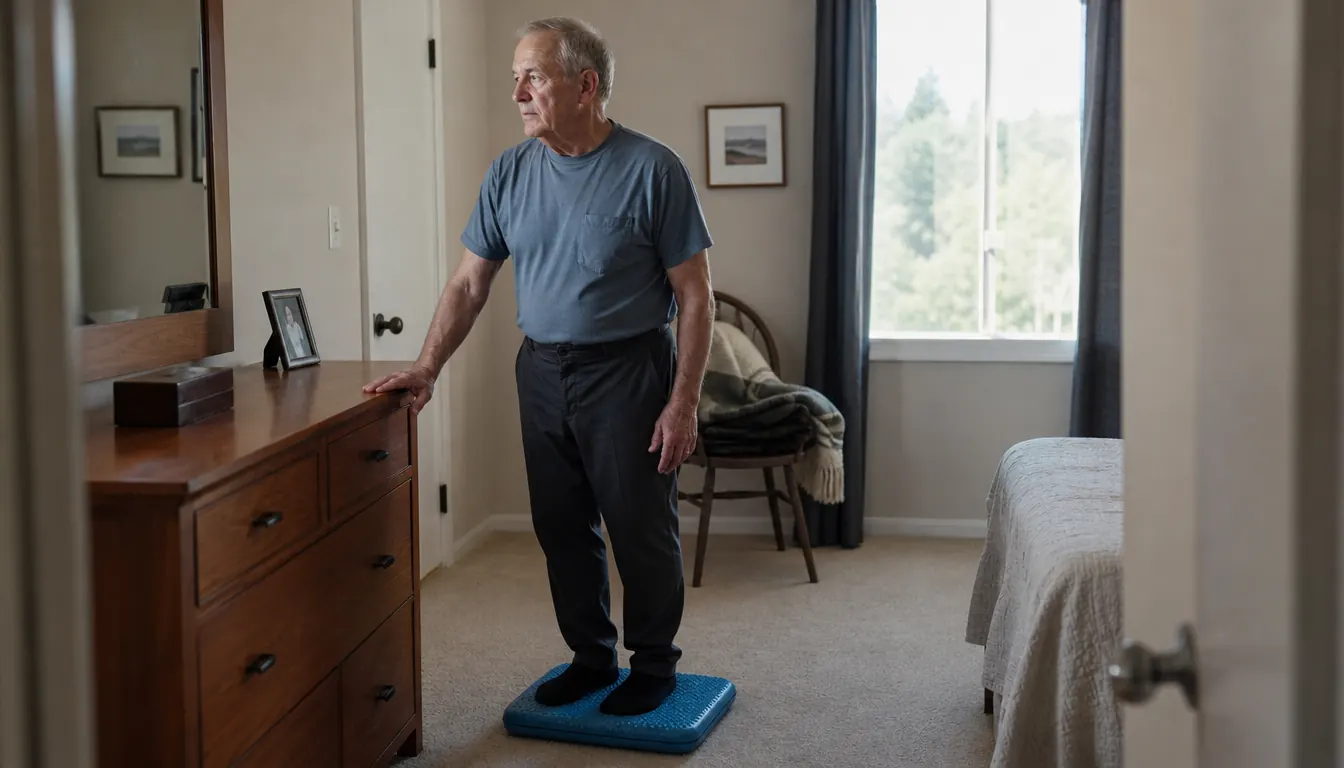
The back porch steps at my house are seven risers and a small landing, and for thirty-one years I went up and down them with a mail bag on my shoulder and never once thought about where my feet were landing. Then one October afternoon at 64 I came down them with a bucket of potatoes in my right hand, caught the edge of the second step with the toe of my boot, and did a shuffle dance that ended with me still upright and my heart going like a caught rabbit. I did not fall. That is the only reason the story is funny instead of the other thing. My doctor listened to my heart, told me it was fine, and said the trouble was in my legs and my balance. Nobody had said that to me out loud before.
Three years ago I bought a ProsourceFit balance pad to work on it. It is a slab of foam, 15.5 inches long, 12.75 inches wide and 2.25 inches thick, twelve ounces, made of a non-slip TPE material that wipes clean with a damp rag. That is the entire product. Nothing to plug in, nothing to adjust, nothing to charge, no display to squint at. It lives flat on the spare bedroom floor next to the dresser I can grab, and I stand on it for a few minutes most mornings. Joan uses it too, and in summer it sits out by the garden as a kneeler. It is the least complicated piece of equipment I own and it is the one that changed how I take those porch steps.
The Simplest Thing in My Exercise Room Is the One I Reach For First
A ProsourceFit balance pad: 15.5 by 12.75 inches of non-slip foam, 2.25 inches thick, twelve ounces, covered by a limited lifetime warranty. No batteries, no setup, nothing to program.
Amazon See the ProsourceFit Balance Pad on Amazon →The Five Steps I Actually Do
Step 1: Get the All-Clear and Pick a Spot Where a Wobble Is Not a Fall
Karen is a nurse and she is the one who nudged me into all of this, so I will pass along what she told me: talk to your doctor or a physical therapist before you start standing on an unstable surface. I am not a trainer and I am not going to pretend to be one. My doctor is the one who said my legs were the problem, and a stiff right knee is the reason I do everything slowly. If you have had a hip replaced, or you get lightheaded, or your feet are numb, get a professional's opinion first. That is not a line I am tacking onto the end. It is the first step, and skipping it means you are guessing.
The spot matters as much as the pad. Mine is on the spare bedroom floor beside a heavy dresser, close enough that I can rest my fingertips on the top without leaning over. On the porch I use the rail post. The floor should be firm and dry, not a throw rug that slides when you shift your weight. Wear flat shoes or go barefoot. Do not do this in socks on a wood floor, and do not do it on a wet porch.
Clear the space behind you. If you do go over, you want to sit down on carpet or floor, not crack an elbow on the corner of a cedar chest. I moved a laundry basket out of the way three years ago and it has never come back.
Step 2: Learn to Get On and Off It Before You Stand On It
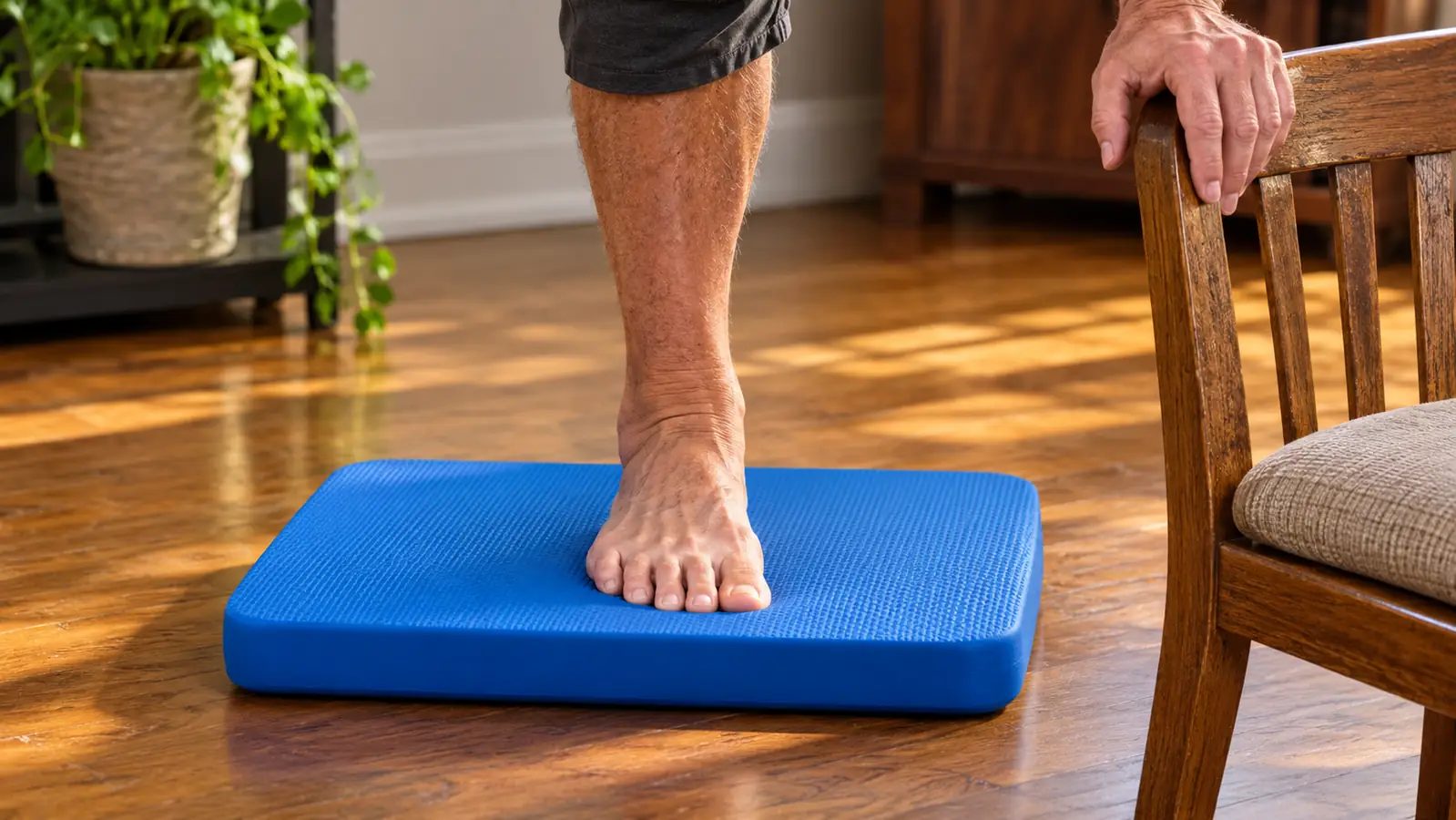
The ProsourceFit pad is 2.25 inches thick, which is lower than any porch step I have ever met. It does not feel low the first time. Foam gives, so your foot keeps looking for the floor a half second after it lands. That half second is the entire point, and it is also the reason you learn to mount the thing while holding on to something.
I step up with the right foot first, bring the left up beside it, stand still, then step down with the left first and the right after. Five times that way, then five times leading with the left. Hand on the dresser the whole time. Slow. My count is three up and three down, which sounds foolish until you catch yourself rushing.
Pay attention to which foot finds the middle of the pad and which one lands half on the edge. For me it was the right foot, my bad-knee side, every single time. That is information you cannot get in a doctor's office, and it is the reason the pad is worth the trouble.
Step 3: Stand and Hold, With a Hand on Something Solid
Both feet on the pad, about hip width, hand on the dresser. I started at fifteen seconds and now I do thirty, three times, with a rest between. Standing there, the ankles do the work. You will feel small corrections running up the outside of your lower leg. That is your balance system doing its job instead of letting a flat floor do it for you.
When thirty seconds stops being interesting, take weight off the hand. Two fingers. Then one finger. Then hover the hand an inch above the dresser without touching it. Hovering is the goal. I have never seen a reason to fold my arms and prove something to an empty room. The dresser is right there and it does not care.
Then add the head. Look straight ahead for ten seconds, then turn slowly and look at the closet door on your left, then the window on your right, then back to center. Turning your head takes away some of what your inner ear was using to keep you steady, which is exactly what happens when you turn to say something to somebody while you are standing on a step.
Step 4: Rehearse the Step, Then Go Take the Real Ones
This is the part that ties the pad to the porch. Stand on the floor beside the pad with your hand on the dresser and step up onto it, pause with both feet on, then step back down. That is the shape of a stair. It is not the height of one. A porch riser is six or seven inches and the pad is a little over two, so treat the pad as rehearsal and the porch as the performance. I would rather tell you that plainly than let you think a foam mat is the same thing as a stair tread.
Do five with the right leg leading and five with the left, and lead with the weaker side first while you are fresh. Then, and this is the part I put off for a month, go do the actual steps. Once a day. Hand on the rail. Whole foot on the tread, not the ball of the foot, and nothing in your hands. I had been hauling buckets up those steps my whole life and it took me a while to admit I should climb them empty-handed for a season.
What surprised me was not that the steps got easier. It was that I stopped thinking about them. For about two years I climbed those steps like a man defusing something. Now I climb them. That is a small thing to write down and it was not small to me.
Step 5: Make It Harder in Small Increments, and Quit While You Are Still Tidy
Every couple of weeks, add one thing. Feet closer together instead of hip width. Head turns while you stand. One finger instead of the whole hand. Standing on one leg with the hand still on the dresser, and only after your doctor or therapist has watched you do it. One change at a time, and give it two weeks before you add the next.
The rule I use is that three good repetitions beat twenty sloppy ones. If you grab the dresser twice in a row, you went too far. Back up to the version you could do calmly and stay there another week. There is no prize for finishing the progressions, and there is a real cost to hurrying them.
One warning I will give plainly, because I have watched people do it. Do not wear ankle weights while you are standing on the pad. Mine stay in a basket by the door and I only use them seated, for leg extensions. And do not put the pad on the porch steps to make them softer or wider. It is a piece of foam for a flat floor. That is what it is for.
What Else Helps
The pad is one piece of a routine, not the whole of it. The reason my steps got easier is that I also made my legs stronger, and I did most of that sitting down. There is a small seated elliptical under the desk in the spare bedroom and a set of flat resistance bands on a hook behind the door. Fifteen or twenty minutes on the elliptical and a few sets of rows and presses with the bands, five mornings a week, plus the ankle weights for seated leg extensions. That is the whole program. Twenty-five or thirty minutes, after coffee, before the day gets away from me.
Two more things that cost almost nothing. Use the rail on those steps, every single time, and do not let anybody tell you that leaning on a rail means you failed at something. And fix the lighting. Half the near-misses I have had on that porch happened at dusk with my hands full. A brighter bulb over the back door did more for me than any single exercise on this list.
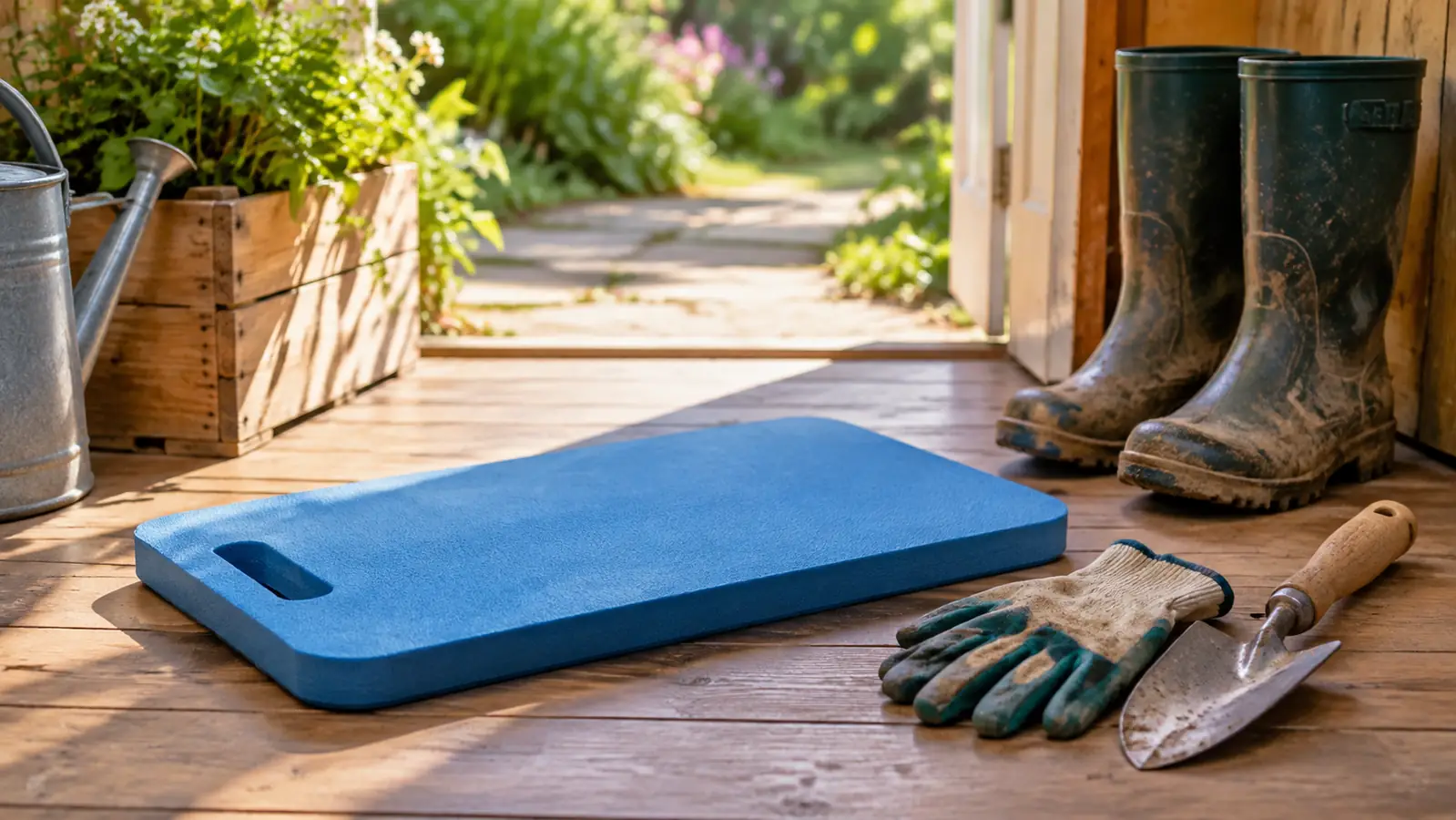
Grip turned out to be part of this too, which surprised me. The year I could not twist a jar lid or pull carrots out of dry soil without both hands, I added a hand gripper and kept one in the cup holder of my recliner. Short sets during the evening news. And the ProsourceFit pad, in summer, lives out by the garden and I kneel on it. Two inches of foam between my knees and the ground is the difference between weeding for an hour and quitting after twenty minutes. Joan uses it for the same thing, and she is not gentle with it.
The pad never taught me to climb my porch steps. It taught me to notice what my right foot was doing before it landed.
If Your Back Steps Make You Think Twice, Start on the Floor
The ProsourceFit balance pad is 15.5 by 12.75 inches and 2.25 inches thick, twelve ounces, non-slip TPE that wipes clean, with a limited lifetime warranty. Mine has sat on the floor beside my dresser for three years and has not worn out.
Amazon Check Today's Price on Amazon →