

Late September is when I dig the main potato crop, and for a few years that one week told me more about my body than any appointment did. Not the number on a scale. Just me down on my knees in the dirt behind the house, filling a bucket and then standing back up with it. At 64 I lost my footing on the back porch steps carrying one of those buckets. I did not fall and nothing was broken, but I stood on that step with my heart going and understood that my legs had quietly stopped keeping up with my garden.
What I did about it was not clever. I bought a set of flat THERABAND resistance bands off a handout a physical therapist gave me, hung the three of them on a hook behind the spare bedroom door, and worked out which handful of movements actually matched the work the garden asks for. That was three and a half years ago. I am 68 now, I am not a trainer and I have no business writing a program for anybody else. What I can tell you is what I did, in what order, and what changed. Last October I carried two buckets up those same porch steps and did not think about it until I was standing in the kitchen with them.
Three flat bands, five feet long, and about six pounds of pull at the heaviest
The THERABAND set I started with is still the set I use. Yellow, red and green, each band five feet long and four inches wide, with the lightest pulling at roughly 3 pounds and the heaviest at roughly 6.7. That sounds like nothing. Do a slow row for fifteen reps and then tell me that again.
Amazon Check Today's Price on Amazon →Step 1: Find the Movement Your Garden Keeps Asking For
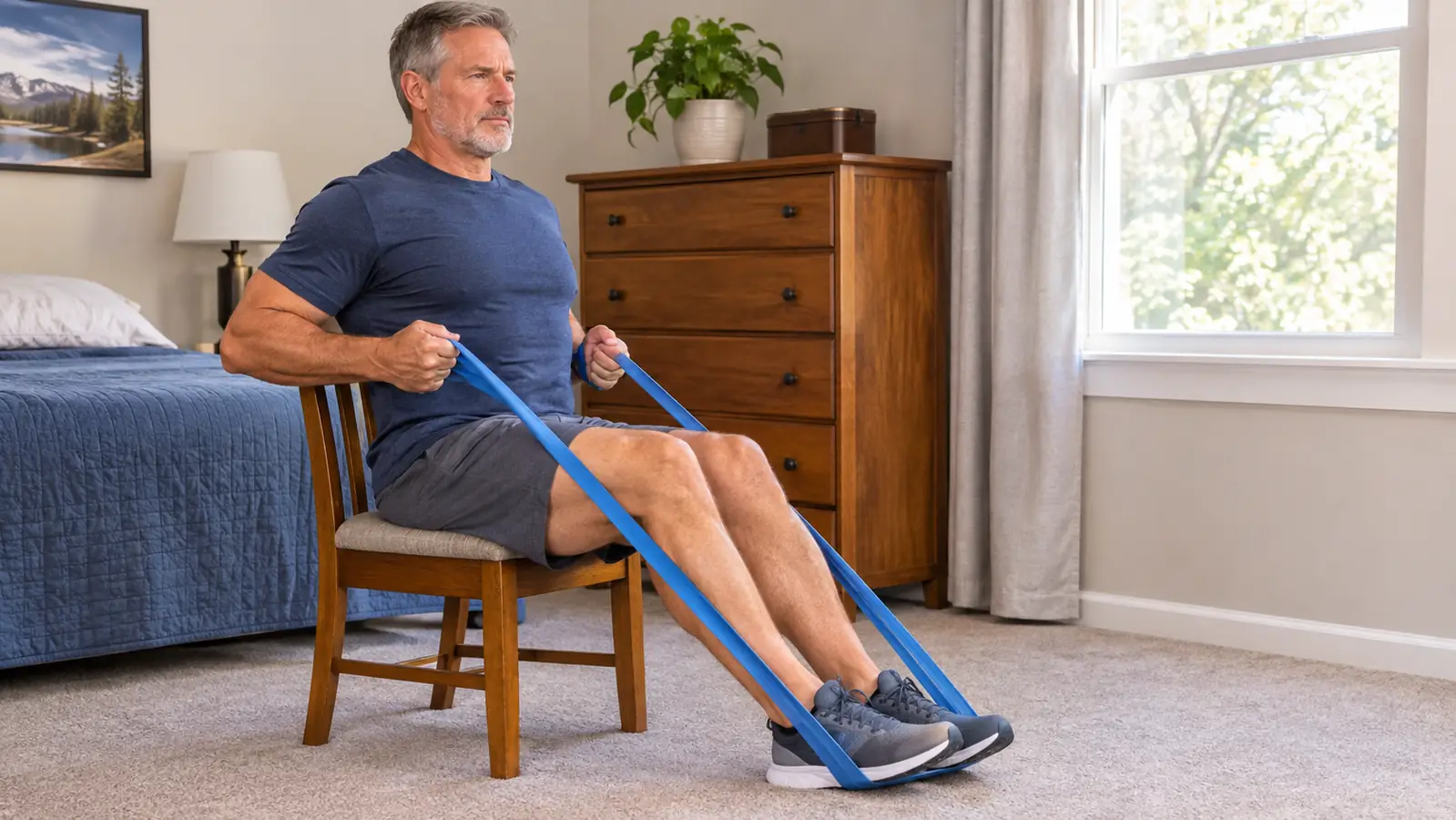
The garden is mostly a pulling job. You haul a hose across the yard, you drag a tarp of leaves, you pull carrots and beets out of damp soil, you yank at a weed that has decided to stay put. So the first band movement I learned was the seated row, because it copies that pull and puts nothing at all on my knees. I sit toward the front of a straight kitchen chair, loop the band around the balls of both feet with my knees bent, take an end in each hand, and pull the band back to my ribs with my elbows close to my sides. Ten slow reps, rest, two more sets.
The first morning I used the yellow band and thought the whole business was a waste of a good cup of coffee. Yellow gives you somewhere between 3 and 4.3 pounds of resistance depending on how far you stretch it. By the tenth rep my upper back was talking to me. That is the trick with these flat bands. The tension feels light at the start and it does not let go at the end, so the last few inches are where the work hides.
I stayed at one set of ten for the first two weeks and did not push it. Then two sets, then three. Sometime in the second month I noticed I was pulling a carrot with one hand and holding a trowel in the other instead of getting down on both knees to do it, and that is the sort of improvement nobody hands you a medal for.
Step 2: Add the Push and the Reach
The other half of garden work is pushing and reaching. A loaded wheelbarrow up the slope behind the house. A full watering can lifted to shoulder height without spilling it down my leg. Reaching over my head to cut a butternut off the trellis before the first frost gets it.
For the press, I run the middle of the band around the back of the chair at shoulder blade height, hold an end in each hand, and push forward until my arms are straight, then let it come back slowly. For the reach, I hold the band out in front of me at chest height with straight arms and pull it apart until it touches my chest, then open it again. Ten of each. The pull-apart is the one movement where the green band finally made sense to me, because it is the only place I wanted more tension than red could give.
I do these on the same mornings as the rows, which makes a full session about twenty-five minutes. I am not going to sell you on splitting your week into a complicated schedule. The whole reason this has lasted three and a half years is that I can do all of it in one spot before Joan finishes her breakfast and starts asking me what I have broken now.
Step 3: Practice the Stand-Up, Because the Stand-Up Is the Job
Standing up out of a chair with something heavy in your hands is the exact movement of lifting a bucket of potatoes, and it is the movement that scared me on the porch steps. So I trained it directly instead of hoping it would come along. I put both feet on the middle of the band, held the ends up at my shoulders, stood up out of the kitchen chair, and sat back down slowly. Eight times, rest, eight more.
The sitting down is half of it. Anybody can drop into a chair. Letting yourself down under control is what builds the part of the leg that catches you when your heel slides on a wet step.
My right knee has old wear in it and no surgery, and the doctor's only comment was that the muscles around it had been on vacation for a decade. This is the movement that brought them back to work. I started on yellow, moved to red after about six weeks, and have never needed anything heavier than green. Three mornings a week is plenty. On a morning when the knee is stiff and swollen I skip it entirely and do the seated row instead, and I would tell you to do the same rather than fight through it.
I never got past the green band. Green for rows, red for everything else, and last October I carried two buckets up the porch steps and did not think about it until I was standing in the kitchen.
Step 4: Train the Sideways Strength Nobody Thinks About
Nobody trains sideways. Then you stand on loose soil on the slope behind the house with a bucket in one hand and find out that sideways is exactly what keeps you upright.
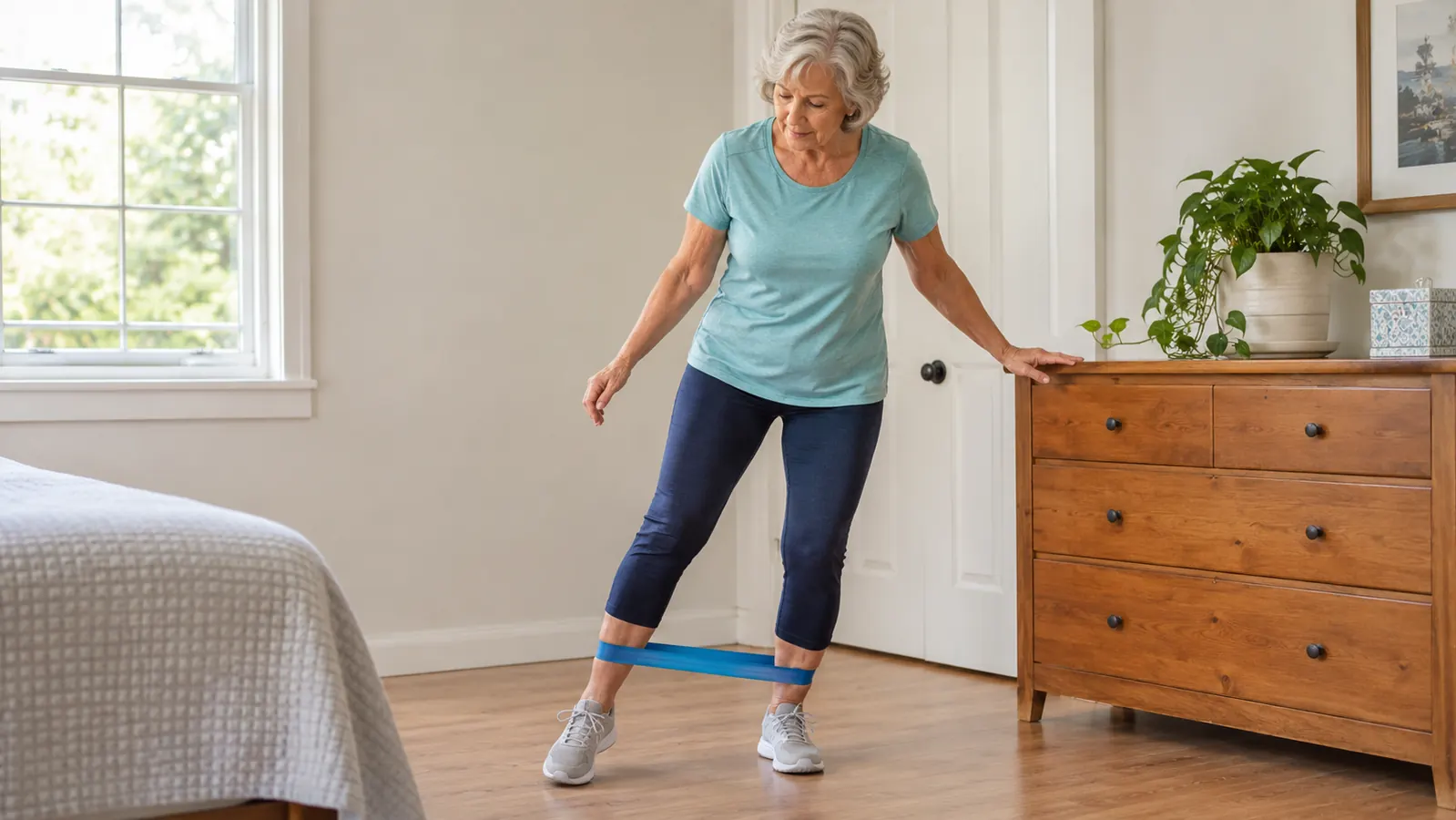
I loop the band around my ankles, stand beside the dresser with one hand resting on it, and step sideways ten steps one direction and ten back. The band keeps pulling the ankles together the whole time, so the outside of the hip has to work to keep the feet apart. It looks like nothing from the doorway. It is not nothing, and it is the closest thing I have found to the moment that scared me on the steps.
I do it in bare feet on the bedroom floor, three minutes at most, and I keep that hand on the dresser until the day comes when I do not need to. So far I still need to, and I have made my peace with that.
Step 5: Put It on a Schedule and Move Up a Colour, Not a Weight
Mine is a morning thing. Coffee, then twenty-five to thirty minutes in the spare bedroom, five days a week. Rows, presses and pull-aparts one day. Stand-ups and side steps the next. Then the whole set again. That is not a scientific program. It is a program I actually do, and a program you actually do beats a better one you skip.
Progress with the THERABAND bands is a colour, not a number on a plate. Yellow first, then red, then green, and the tension range is printed on each band so you know what you are getting before you pull on it. I used yellow for about six weeks, red for most movements after that, and green only for rows. One yellow band tore after about two years of near-daily use and I replaced it. That is the only failure in three and a half years of pulling on them.
Two rules, and then I will get out of your way. If a movement hurts in a sharp, catching way, stop and ask somebody who knows more than I do, which means your doctor or a physical therapist, not a retired mail carrier on the internet. And do not hold your breath while you pull. I caught myself doing it for the first month and had to say it out loud to break the habit.
A Word on the Bands Themselves
The THERABAND set is three flat bands, five feet long and four inches wide, and each one weighs almost nothing, about 1.6 ounces. They come as a set of three resistance levels, and the lightest of them is rated as light tension, which is exactly why they worked for me and exactly why a younger man would find them useless. They do not have handles, they do not have a door anchor, and they do not click into anything. You loop them, you hold them, or you stand on them.
That simplicity is the point. When I started, a machine with a stack of weights in the basement would have been a place to hang laundry within a month. Three flat bands on a hook behind a door are always in the way, in the good sense. I keep them looped together so I can grab the right colour without thinking about it, and I have taken them to Karen's house two hours away in a coat pocket. There is no excuse not to use something you cannot misplace.
What Else Helps
The bands are the backbone of this, but they are not the whole story. The thing that helped my knees most in the garden was a foam balance pad that lives flat on the spare bedroom floor, because in summer it doubles as my kneeler. I kneel on it to pull beets instead of on the ground, and I can get up off it without the grunt I used to make. In the winter it goes back to being a balance tool, with one hand on the dresser and both feet on the foam for a couple of minutes each morning, and Joan uses it too.
The other addition was a pair of adjustable ankle weights for seated leg extensions and side leg lifts, which I started two and a half years ago once the knee felt steady enough to load. I began at 2 pounds per ankle and use 4 now. On the wet mornings I do not want to be outdoors, a seated elliptical under the desk gets the blood moving before the bands, and it is the reason the routine survived the first winter. The THERABAND work still comes first, because it is the part that maps onto digging and carrying. None of this is complicated. All of it is in one room.
The last piece is grip, which nobody warns you about. My hands gave out pulling carrots and twisting a jar lid, so I keep a set of hand grippers in the cup holder of the recliner and work through short sets during the evening news. That does not build a garden. It just means I can open the jar and pull the root without asking Joan for help, and at 68 that counts for more than it sounds like. If you want a second opinion on the bands themselves, and on how they held up over years rather than weeks, I have written about that separately.
Start on the yellow band and give it six weeks before you decide anything
Three flat THERABAND bands, five feet long and four inches wide, light enough to hang on a hook behind a door. That is the entire setup I used to get from one bucket on the porch steps to two, and I am still using the same three bands.
Amazon Check Today's Price on Amazon →