
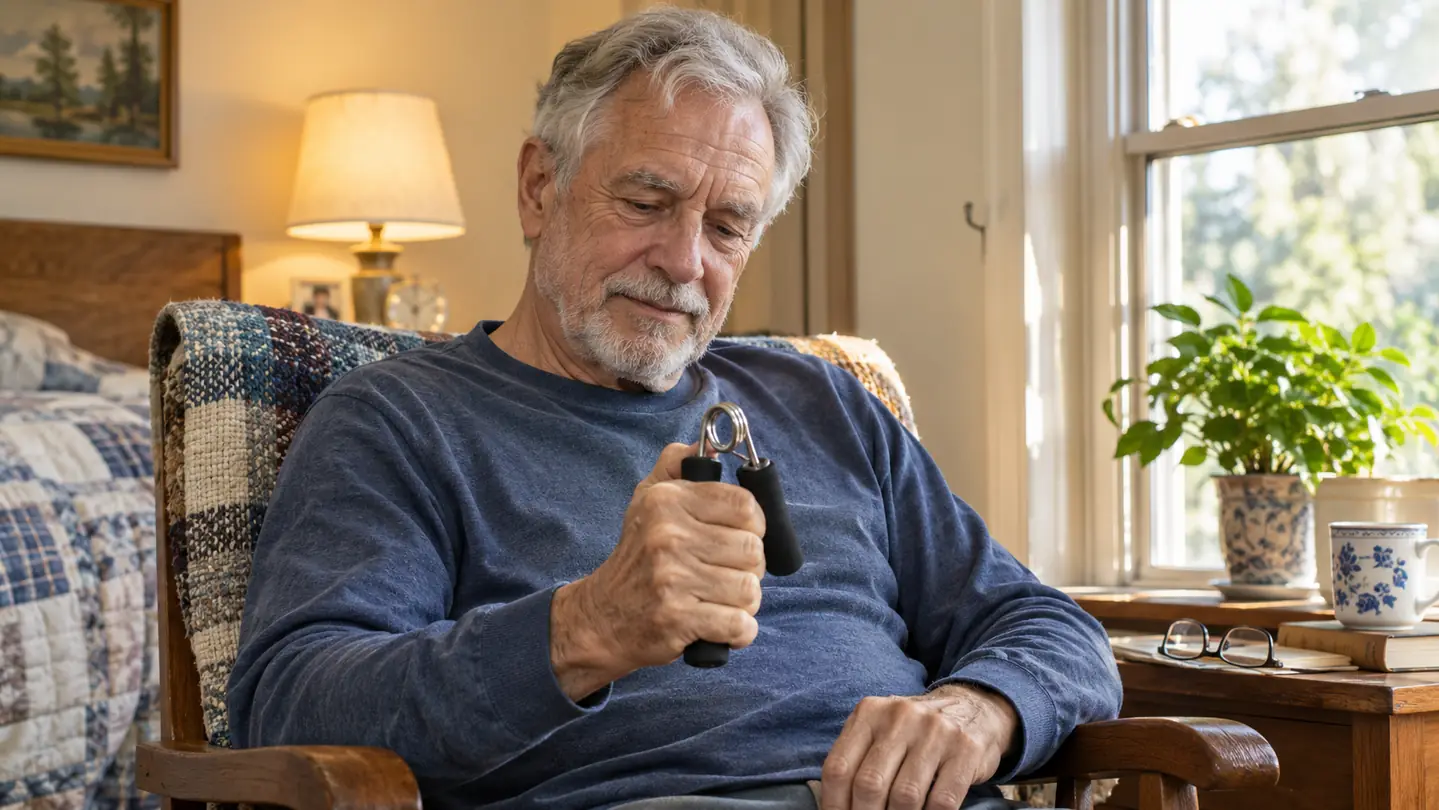
I bought the Pnrskter hand grip strengthener about a year ago because a row of carrots beat me. I was kneeling in the garden behind the house, pulling with both hands, and my right hand opened before the carrot did. The carrot stayed in the ground. I stayed there looking at my palm like it belonged to somebody else. Two days later I could not twist the lid off a jar of beets Joan had canned. That was the part that bothered me. I am 68, I carried mail for 31 years, and I am not interested in being the fellow who needs help with a jar.
So I ordered the Pnrskter set, which is three hand grippers and three finger stretchers with six resistances from 6.6 lbs to 50 lbs. The whole set is listed at 3.2 ounces and about 7 by 5 by 2 inches, so it does not take up space. The listing carries 4.4 stars across more than 29,000 ratings, which is about right in my experience. I have used it for a year now, mostly in short sets while the evening news is on. This is the honest version, including the parts I would not put in a product description.
The Quick Verdict
A simple, well-chosen set that fixed the exact problem I had, but only because I ignored half of it and left the rest in a cup holder where I could not forget it.
Amazon Check Today's Price →The Tool That Got My Hands Back
If your grip is quitting before your garden work is done, start with the lightest gripper and give it six weeks. The Pnrskter set is small enough to live beside your chair, which is the only reason I stuck with it.
Amazon Check Today's Price on Amazon →What Nobody Tells You About a Six-Piece Grip Set
The box says six resistances. That sounds like six tools. It is not. It is three grippers and three finger stretchers, and they train opposite halves of the same job. The grippers build closing strength. The stretchers pull your fingers open. If you only use the grippers, which is what most people do, you are working one side of the hand and ignoring the other.
The second thing nobody tells you is that the resistance labels are not a tidy ladder. I started on the lightest gripper and stayed there for two weeks. The middle gripper took me about six weeks to close cleanly with my right hand, and longer with my left. A year later the middle ones still feel like work. The heaviest gripper, the 50 lb one, is not a tool I use. It is a test I fail.
The third thing is that the finger stretchers feel wrong at first. You are opening your hand against resistance instead of closing it. It is the opposite of every grip exercise I had ever seen. I ignored them for the first month. Then my right hand started feeling tight in the web between the thumb and index finger after a long weeding session, and I started using the stretchers for a few minutes at the end of each set. That tightness mostly went away.
How I've Used It for a Year
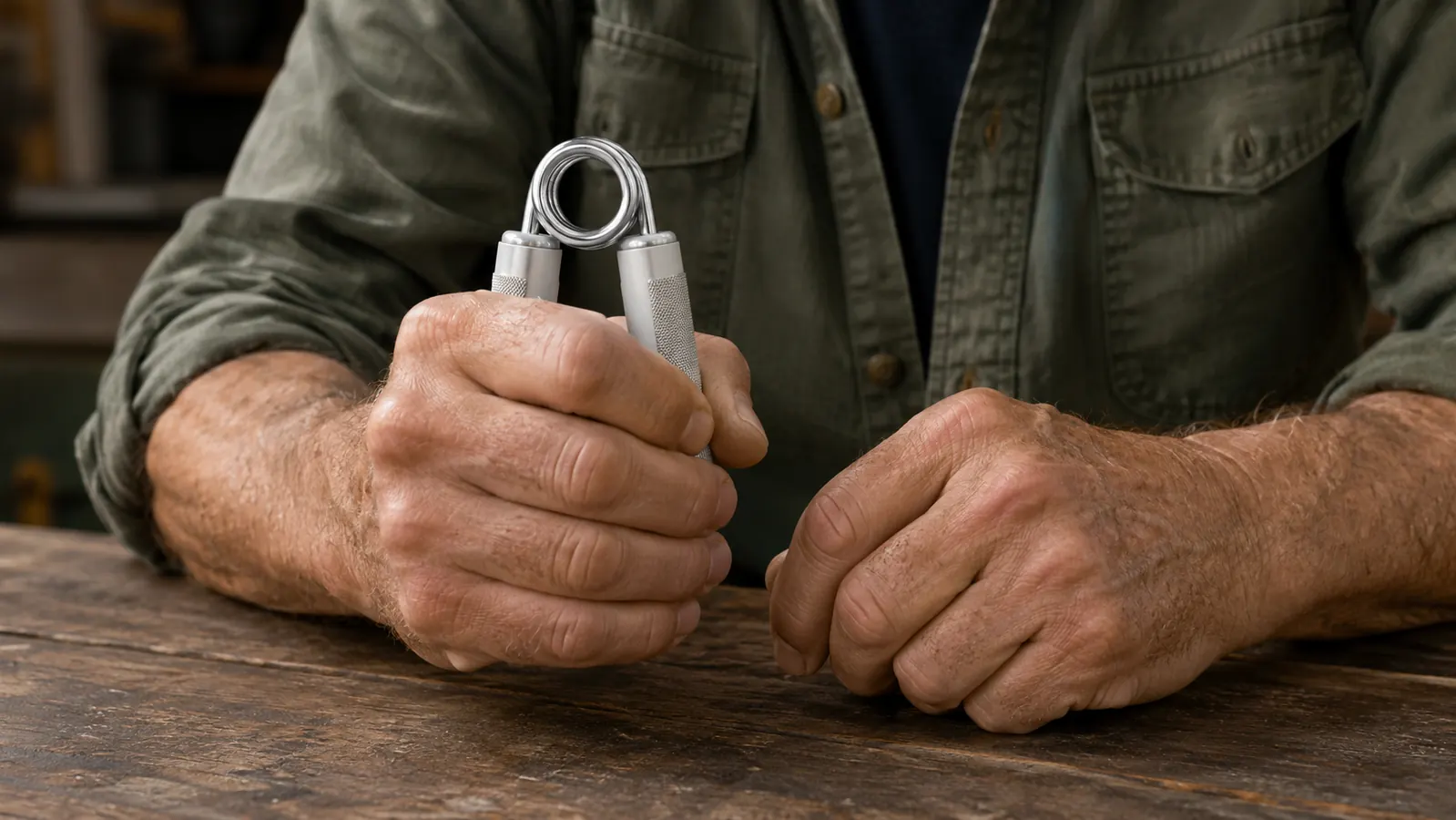
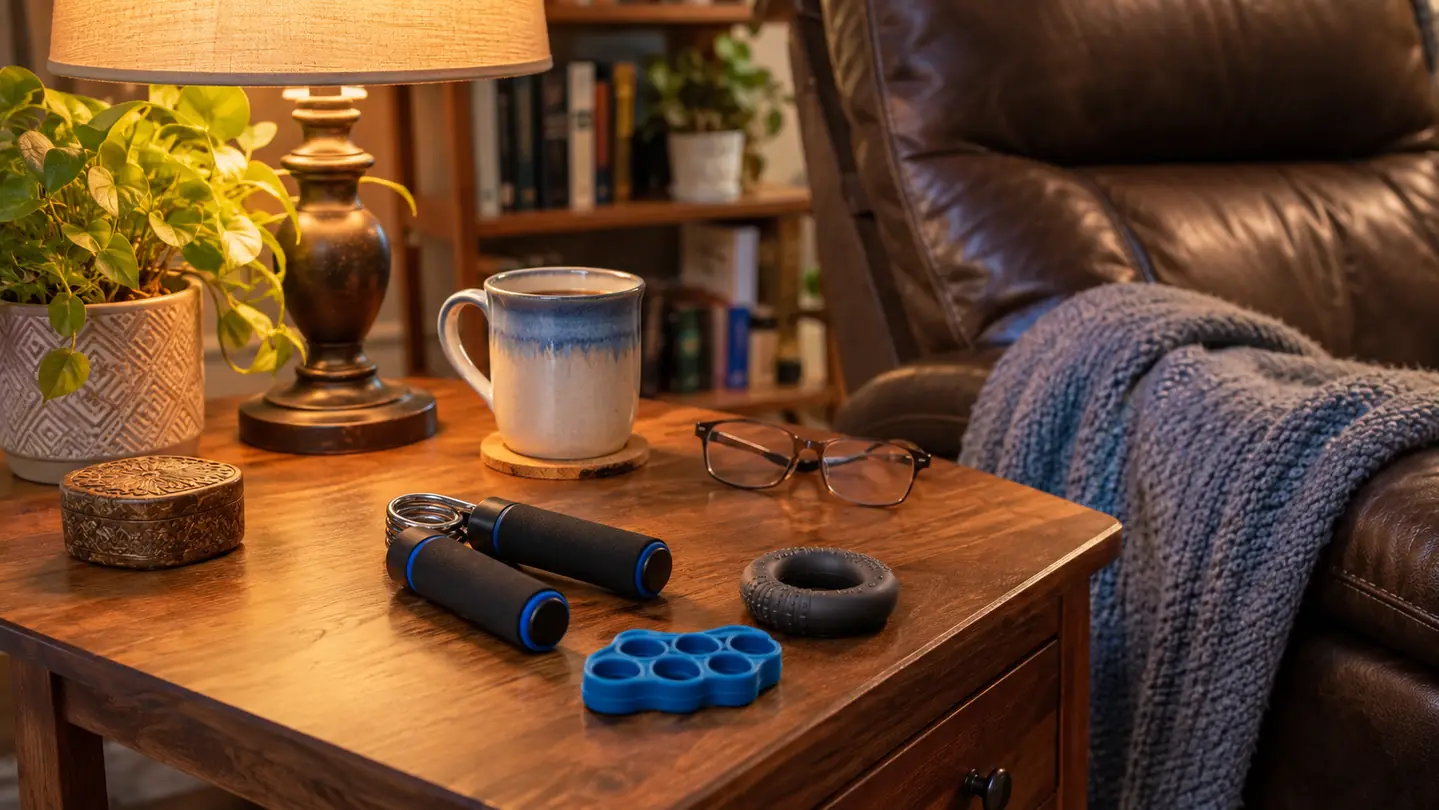
The set lives in the cup holder of my recliner. One gripper also lives in the truck, in the door pocket, for the times I am waiting on Joan outside the grocery store. That is the whole routine. I do ten to fifteen squeezes per hand, two or three rounds, while the news is on. Some nights I skip it. Most nights I do not, because the thing is right there and my hands are already idle.
I started with the lightest gripper in the winter, when the garden was done and my hands had nothing to do. The first two weeks made my forearms sore in a way that surprised me. Not pain, just a deep tiredness, like I had carried a heavy bucket. I backed off to every other night until that settled. By spring I was using the middle gripper for my first set and the lightest one for my last set, which is still what I do.
I noticed the difference most in the cold months. In summer my hands get a workout just from the garden, and the gripper is a supplement to real work. In January, when the ground is frozen and the most I do outside is fill the bird feeder, the evening sets are the only thing keeping my hands from going soft. That is the season the set earns its keep, and it is the reason I would buy it again.
The truck gripper is the one I use least and value most. I squeeze it a few times while I wait for Joan in the parking lot, and a few more on the ride home. It is a strange thing to do in public, but nobody has ever asked me about it. Ten squeezes here and ten there does not feel like a workout, and over a year it adds up to a great many squeezes.
Joan uses the finger stretchers more than I do. She keeps one in the kitchen drawer and uses it while she waits for the kettle. She is 66 and has no interest in the grippers, but she likes the stretchers because they do not require her to make a fist. That is worth knowing if you are buying this for a couple. The set splits naturally into two jobs.
I have closed the middle gripper a few thousand times in a year. I have closed the 50 lb one zero times. That is the honest ledger, and the set still did what I needed.
The 50-Pound Gripper Is Not the Goal
I want to be plain about the 50 lb gripper because the listing leads with that number and it is the number that sells the set. I have never closed it. Not once. I can get it maybe halfway with my right hand on a good day, and not that far with my left. For a man of 68 with a stiff right knee and a lifetime of carrying mail, that is not a failure. It is a boundary.
The gripper that changed my garden work was the middle one. After about four months I could pull a carrot without my hand quitting. After six months I could carry a five-gallon bucket of potatoes from the garden to the porch without setting it down halfway. That is not a gym number. It is the difference between doing the work myself and asking Joan to help.
If you buy this set to conquer the heaviest gripper, you will probably strain something. I came close once, in the spring, when I tried to force the 50 lb gripper after a long day of digging. My right forearm ached for three days. I told my doctor about it at my next visit, and he said what he always says, which is to use the lightest resistance that still makes the muscle work and to stop when the form goes. That is the rule I follow now.
The Jar Test, Six Months In
I mark progress by jars. Joan cans beets and pickles every fall, and those lids go on tight. Before the grip set I opened them by running hot water over the lid and using a rubber pad, and half the time I still handed the jar to her. Around the six-month mark I noticed I was opening them without thinking about it. No hot water, no pad. Just my hand and a twist.
That is the only progress report I have. I did not measure anything. I did not write down how many squeezes I did or which gripper I used on which night. If you want numbers, this set will not give them to you, and that is one of the honest limitations. What it gave me was a hand that stopped being the weakest part of the job.
The First Month Is the Whole Test
Most grip tools get abandoned in the first month, and I think it is because people start too heavy. The set comes with six resistances, so the temptation is to find the one that feels like a workout and use that. Do not do that. Start with the lightest gripper, the 6.6 lb one, even if it feels like nothing. Use it for a week. Then try the next one for a single set and see how your hand feels the next morning.
My routine was five minutes, not twenty. I would do one set of ten on each hand with the lightest gripper, then one set of ten with the middle one if the first set felt easy. That was it. The next day I would do it again if my forearms were not sore. If they were, I would take a day off. This is not complicated, but it is easy to ignore when you are impatient.
The first month is also when you find out whether the set fits your hands. The grippers fit my hand well enough. Joan has smaller hands and she finds the stretchers easier than the grippers. If you have very large hands or very small hands, the fit may be different. The resistance is set by which gripper you pick, so you get what the label says. That is worth knowing before you buy.
Where the Set Falls Short
There is no way to know if you are improving except by feel. I do not need a digital readout for a hand gripper, but I would like a simple card that says start here, then move here. The set does not come with one. You have to make your own plan. For some people that is fine. For others it is the reason the set ends up in a drawer.
The material is silicone, according to the listing, and it has held up. After a year of near-daily use there is no cracking and no fraying. When the pieces get dirty from garden hands I rinse them under the tap, dry them on a dish towel, and put them back where they live. That is the entire maintenance routine, and it is one of the reasons I kept using the set when the weather turned.
The pieces are small. I have not lost one yet, but I have come close. The grippers live in the cup holder; the stretchers live in a kitchen drawer. If you dump the whole set in a toolbox, you will lose the lightest stretcher in a week. That is not a design flaw. It is just what happens with small objects.
What I Liked
- Six resistances cover a wide range, from a hand that has lost strength to a hand that is already strong
- Small and light enough to leave in the chair where you will actually use it
- The finger stretchers add the opening side that most grip tools skip
- Nothing to charge and nothing to maintain
- The three grippers and three stretchers split easily between two people
Where It Falls Short
- The 50 lb gripper is too much for most older hands, which makes one third of the set dead weight for the average buyer
- No progression guide, so you have to figure out your own starting point
- The finger stretchers feel awkward for the first few weeks
- Six small pieces are easy to lose if you do not keep them in one place
- No feedback or tracking, so progress is judged by feel and by chores, not numbers
What the Finger Stretchers Actually Do
The finger stretchers are the part I would have skipped if I had bought only a gripper. They are not exciting. You put your fingertips into the loops and open your hand against the resistance. The set includes three of them, and the lighter ones are gentle enough for a hand that is having a bad week. I use the lightest stretcher after the grippers, for about two minutes per hand.
The effect is not dramatic. What I noticed was that my hand felt less cramped after a long session of pulling weeds or holding a trowel. Before the stretchers, my fingers would curl into a loose fist on their own by the end of the afternoon. After a few weeks of using them, that stopped. I cannot prove it was the stretchers. I can tell you that the timing lines up, and I am not going to stop using them to run an experiment.
Grip Strength for Garden Work, Not Gym Numbers
My reason for doing any of this is the garden. I grow potatoes, carrots, beets, butternut squash, acorn squash, and too much zucchini. That work is a long series of grip tests. Pulling root vegetables. Twisting lids on jars of pickled beets. Carrying a bucket by the handle. Holding a trowel for an hour. None of it looks like exercise, and all of it quits early if your hands do.
The changes came in small, unglamorous moments. I noticed I could wring out a washcloth without using both hands. I noticed I could open a new jar of pickles on the first try. I noticed I could carry the bucket of potatoes up the porch steps without switching hands halfway. Those are the victories I care about. They are not the kind of thing you put on a chart, but they are the reason the set stays in the cup holder.
I still have a stiff right knee and a back that complains in the morning. The grip set did not fix those, and I did not expect it to. I use the balance pad and the bands for the rest of it, and I walk the porch steps when the weather is decent. The grip set is one piece of a routine, not the whole routine. Anyone who tells you a hand gripper will fix your balance is selling something else.
Who This Is For
This is for the person who has noticed a specific decline in their hands and wants a simple way to work on it at home. Maybe you cannot open a jar without running it under hot water. Maybe your hand quits before the garden does. Maybe you are recovering from a minor strain and your doctor or physical therapist has cleared you to do light resistance work. The Pnrskter set is small, simple, and easy to keep in sight, which matters more than any feature.
It is also for the couple who wants one set to share. The grippers and stretchers split naturally. Joan uses the stretchers; I use the grippers. We have never fought over a piece.
Who Should Skip It
Skip it if you have active hand pain, numbness, tingling, or a recent injury. This is not a medical device, and it is not a substitute for a diagnosis. I am not a trainer and I am not a doctor. I checked with mine before I started, and you should check with yours, especially if you have arthritis, carpal tunnel, or a history of tendon trouble.
Skip it if you want a program that tells you exactly what to do every day. There is no chart, no plan, and no tracking. You have to decide your own starting point and your own progression. Skip it if you will put it in a drawer. A grip set in a drawer is a grip set you will not use. And skip it if you are buying it for the 50 lb gripper. Buy it for the middle ones and treat the heavy one as a doorstop.
A year in, the Pnrskter set has earned its place in the cup holder. It is not a cure for anything and it is not a full hand rehabilitation program. It is six small pieces of resistance that made my hands more useful in the garden. For the space it takes up, that is a fair trade.
Start With the Lightest Gripper and Give It Six Weeks
If your hands are quitting before your work is done, the Pnrskter set is a low-fuss place to start. Keep it where you sit. Use the lightest resistance that still makes the muscle work, and check with your doctor first.
Amazon Check Today's Price on Amazon →