

Your hands go quietly. Nobody warns you that a jar lid will beat you before the stairs do. Mine quit on me while I was pulling carrots, and then again the same week on a jar of pickles, and that was the week I stopped pretending it was a small thing. I have used therapy putty since then, and I have used the Pnrskter hand grip set for about a year, and the honest answer is that the two are not really competing for the same job.
Here is the short answer. If your problem is weakness, meaning you can still open your hand all the way but you cannot make it hold anything, the Pnrskter set is the better tool. It gives you six numbered resistance levels from 6.6 lb to 50 lb, so you always know what you closed last month and what you cannot close yet. If your problem is stiffness, meaning the hand aches and will not open smoothly, putty is better, and a hand therapist will usually say so. Most people my age need both. I reach for the grippers far more often.
The Comparison at a Glance
| Pnrskter Hand Grip Set | Therapy Putty | |
|---|---|---|
| Resistance | Six fixed levels, 6.6 lb to 50 lb | Whatever you can knead it into |
| Adjustability | Change grippers to change the load | Adjustable by the ounce, all day long |
| Tracking progress | You know exactly which gripper you closed | Nothing to measure |
| Stiff, aching hands | Loads the hand from the first squeeze | Can be worked with almost no load |
| Finger isolation | The finger stretchers cover the opening direction | One finger at a time, in any direction |
| Mess | No mess at all | Film on the hands, grit worked into the putty |
| Portability | 3.2 ounces, fits a cup holder | Needs a tub, and the tub is a nuisance in a bag |
| Durability | Silicone, nothing to dry out | Hardens and dries out as it ages |
| Best for | Getting measurably stronger | Loosening a stiff or healing hand |
What the Pnrskter Set Actually Is
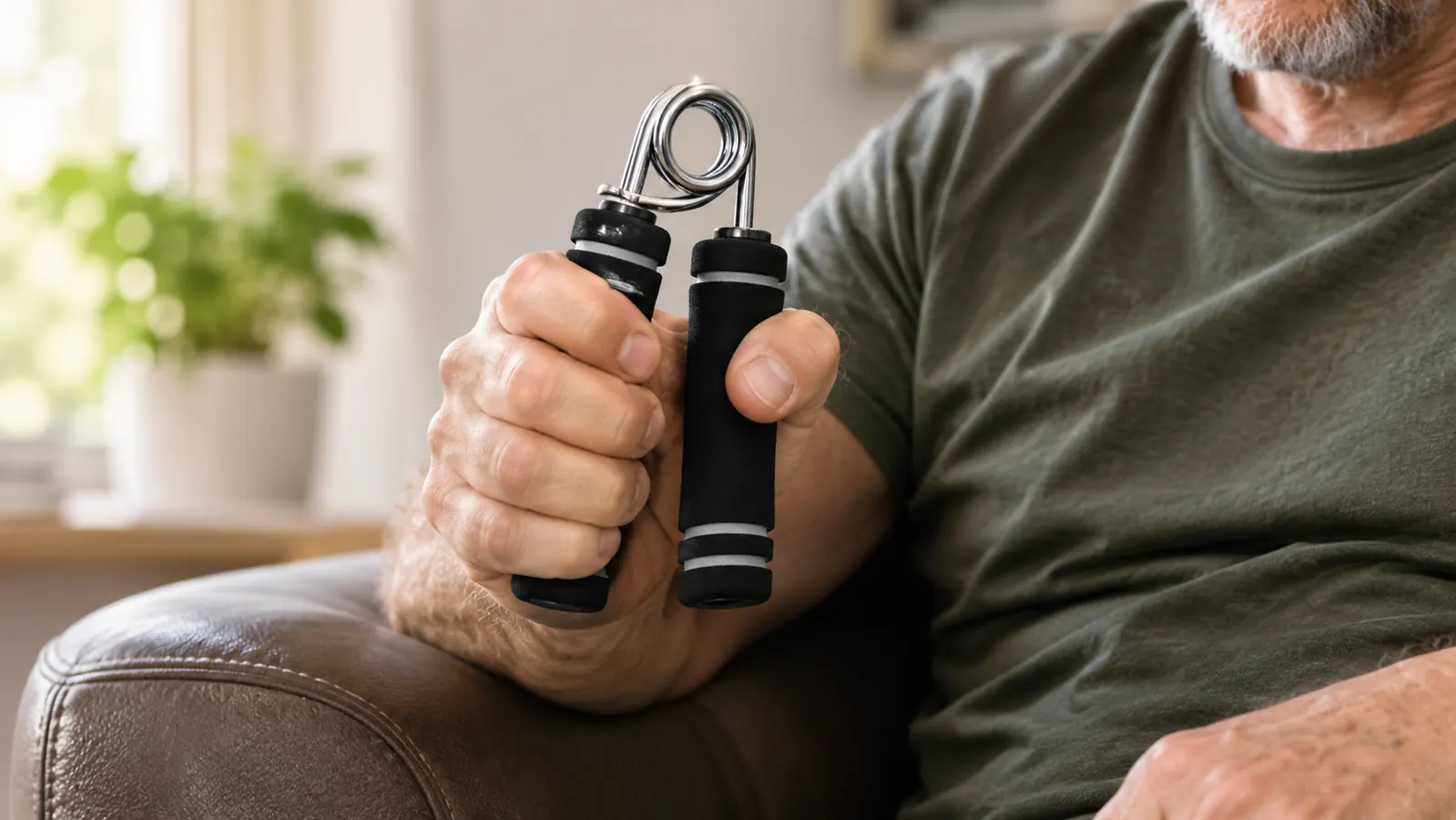
The package is six pieces, not one. Three hand grippers and three finger stretchers, six resistance levels in total, running from a gentle 6.6 lb up to 50 lb. The material is silicone, the set measures 7 by 5 by 2 inches and is listed at 3.2 ounces, which means it goes into a jacket pocket and you forget it is there. One gripper lives in the cup holder of my recliner. One lives in the truck. The third sits in the drawer by the back door, which is where I keep things I actually intend to use.
I started on the lightest gripper and could close it maybe eight times before my forearm complained. A year on, I use the middle grippers for three sets of ten while the evening news is on, and I have never once closed the 50 lb one. That is not a complaint. It is a target. Joan, who is 66, uses the finger stretchers more than the grippers, mostly because her hands stiffen up in the cold and the stretchers give her something to do about it while she watches television.
Where Pnrskter Wins
The first win is that the resistance is a number. Putty does not have numbers. If you want to know whether your hand is stronger in March than it was in January, a gripper answers the question in one squeeze, and putty cannot answer it at all. For anyone who needs proof that the work is doing something, that matters more than it sounds. I am not a man who keeps charts. But I know I could close the middle gripper four times in the spring, and I can close it ten times now, and that is the only progress report I have ever been able to give myself.
The second win is convenience and mess. Putty has to be kept in something. It picks up grit, it leaves a film on your hands, and if you set it down on the arm of a chair you will find it worked into the fabric three weeks later. I learned that one the hard way in the fall, on Joan's good chair, with a walnut-sized lump of the medium-firm putty. I spent twenty minutes with a butter knife and a rag and she has not let me forget it. The grippers do none of that. They are silicone, there is nothing to dry out, nothing to knead, nothing to wash off. When I am done they go back in the cup holder. That sounds like a small thing until you have committed to doing it every evening for a year, which is the only way any of this works.
Where Therapy Putty Wins
Putty wins the warm-up, and it is not close. A gripper asks your hand to work against resistance from the first repetition. Putty asks almost nothing. You can roll it, press it flat, open your fingers through it slowly, and the hand loosens without ever being loaded. If you have arthritis, or if you are a few weeks out from a hand injury, that difference is the whole argument. My right hand is stiff in the mornings, and a gripper at seven in the morning is a bad idea. Putty at seven in the morning is fine.
I tested that one properly last February, on a morning when the thermometer on the porch read nineteen degrees and my fingers would not close around the coffee cup handle. I tried the lightest gripper first, out of habit, and got about four half squeezes before my knuckles told me to stop. Then I sat the gripper down, worked a lump of putty for six or seven minutes, and tried the same gripper again. It went closed without an argument. That is not a scientific result, it is one cold morning in one kitchen, but it is the reason the putty stays in the drawer and the gripper stays in the cup holder until after breakfast.
The second win is that putty is infinitely adjustable in a way the set is not. Six grippers is six levels. Putty is whatever you make it. Roll it into a tight ball and it is hard. Spread it thin and it is barely there. You can work one finger at a time, or isolate the thumb, in a way that a single squeeze does not allow. A therapist can dial putty down to almost nothing for a hand that is not ready for load. The lightest gripper in the set is 6.6 lb, and 6.6 lb is not nothing to a hand that has been resting for a month.
Six Levels, From 6.6 lb to 50 lb, and One of Them Is Your Level Right Now
Three hand grippers and three finger stretchers in one silicone set that weighs next to nothing and lives in a cup holder. Start on the lightest one and move up when the lightest one gets boring.
Amazon Check Today's Price on Amazon →I could close the middle gripper four times in the spring and I can close it ten times now. That is the only progress report I have ever been able to give myself.
How I Tested Both
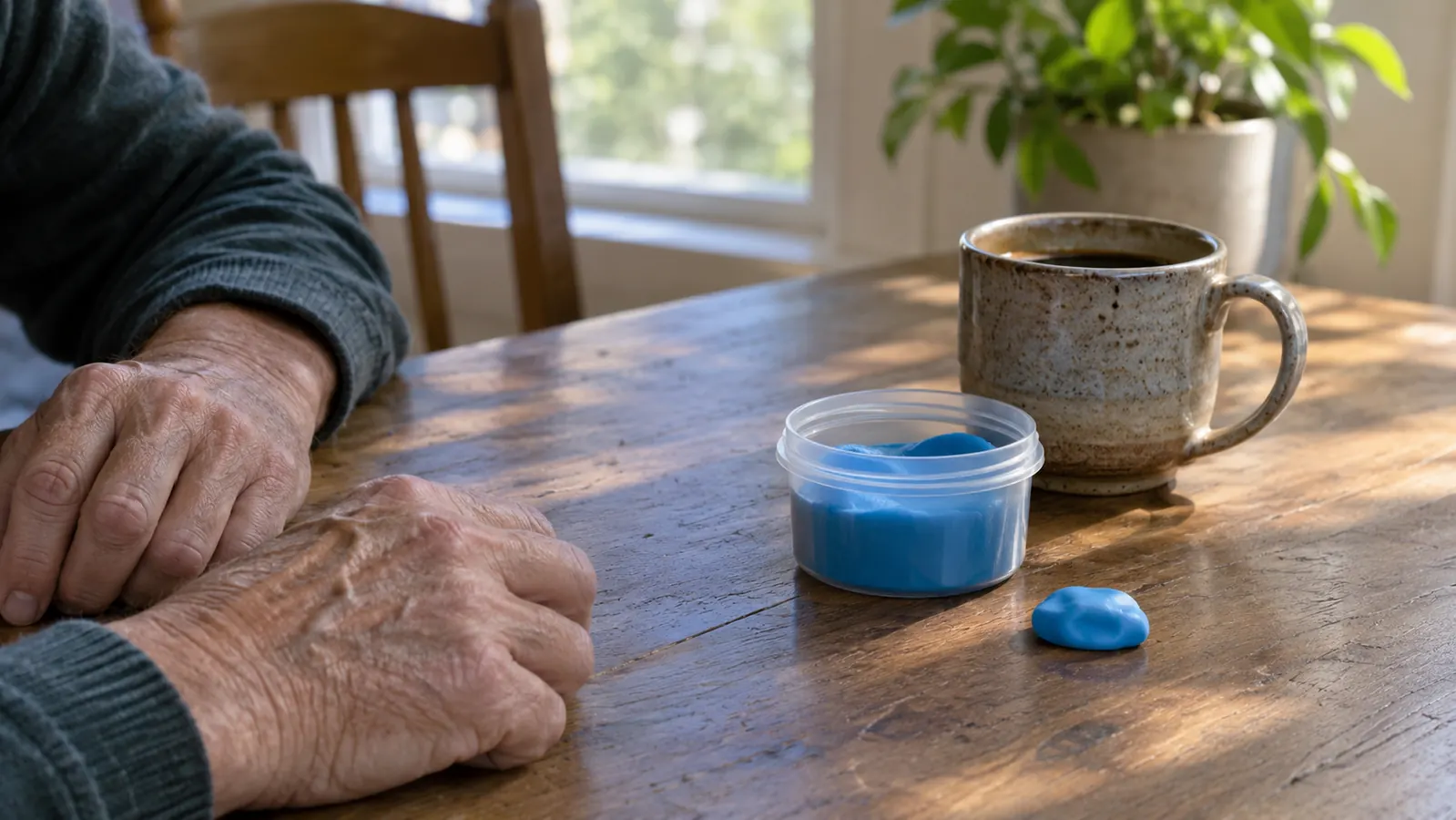
There was no lab coat involved. I used the putty for a few weeks in the evenings, then set it down and did not pick it up again until I sat down to write this. The Pnrskter set I have used for about a year, most evenings, in sets of ten, while the news is on. I also carried one gripper in the truck and used it at stoplights, which no one recommends and which added a few hundred repetitions a week to the total.
The truck gripper taught me something the recliner gripper never did. At a red light on Route 11 in September I closed the middle gripper ten times in a row without thinking about it, and then could not get the third set of ten at home that evening, because the muscle was already tired and I had not counted the truck work. So I stopped using it at stoplights for a few weeks and wrote the totals down on the back of an envelope instead, which is as close to a training log as I am ever going to get. Ten in the morning at the recliner, ten in the afternoon if I remember, and that is the whole program.
What I paid attention to was not the muscle. It was whether the thing I was trying to do with my hands got easier. The test was the garden. Carrying a bucket of beets up the slope behind the house. Twisting a lid off without handing it to Joan. Getting up off the kneeler with one hand on the fence post instead of both hands on the ground. A tool that does not move any of those is not worth the shelf space, no matter how it feels in the moment.
The Resistance Ladder, and Why It Matters After Sixty
The mistake I made early was going too heavy because the lightest gripper felt like a toy. It is not a toy. It is the level you should stay on for two or three weeks, until ten clean squeezes are boring. The jump from one gripper to the next in this set is real, and if you skip a rung you will feel it in your elbow, not your hand. My right elbow complained for a solid week after I moved up too fast, and I went back down a level and stayed there for a month. I am not exaggerating when I say the elbow hurt worse than anything the hand ever did.
The other thing worth saying is that the finger stretchers are not an afterthought. Opening the hand against resistance is the half of the job most people skip. Nearly everything you do with grip is a closing motion, so if you only train closing, you end up strong and short. The stretchers work the other direction. Joan uses those and barely touches the grippers, and her hands are better for it, especially in February. She keeps a set on the end table by her chair and works them during the weather, and she has said more than once that the jar situation in this house has improved.
What Neither One Fixes
Neither tool will fix a hand that hurts because of a nerve. If your fingers go numb at night, or if you drop things without warning, putty and grippers are both the wrong answer and a doctor is the right one. I am not a trainer, and I am not a therapist. I am a 68 year old retired mail carrier who got tired of losing arguments with jars. Whatever you decide to start, run it past your doctor or a physical therapist first, particularly if there is arthritis or an old injury in the picture.
Neither one replaces the rest of it, either. My hands got better in the same year I was using the balance pad and the ankle weights and the seated elliptical, and I cannot tell you which one did the most. What I can tell you is that grip was the last thing I noticed and the thing that changed the most chores. It is hard to carry a bucket with a hand that will not close around the handle. It is harder still to get that bucket up the slope behind the house when you have to stop twice to switch hands.
Who Should Buy Which
Buy the Pnrskter set if you can open and close your hand without pain, you want to get stronger, and you like knowing exactly what you did last month. Buy it if you are the sort of person who needs a target. The 50 lb gripper in the box is a target. I still cannot close it, and I like that it is sitting there waiting, because it means I am not finished.
Buy putty instead if your hand is stiff, if it hurts, if you are recovering from surgery or a break, or if a therapist has told you to keep the fingers moving without load. Buy putty if you want something to do with your hands while the television is on that does not involve a screen. And if you are somewhere in the middle, which is where most of us are, buy the set first, because it is the one that tells you whether you are making progress, and keep a tub of putty for the mornings when your hands are not ready for either. That is what is in my drawer right now, and I do not expect it to change.
The Gripper That Tells You the Truth About Your Grip
Three grippers, three finger stretchers, six resistance levels from 6.6 lb to 50 lb. The lightest one is where you start, and starting is the whole trick.
Amazon Check Today's Price on Amazon →