
I was 64 when I lost my footing on the back porch steps carrying a bucket of potatoes. I caught the rail with my free hand, set the bucket down, and stood there a minute. Nothing happened, which was the frightening part. I had walked a mail route for 31 years for a living and assumed my legs were the one thing I would never have to think about. My doctor checked my heart, said it was fine, and told me the trouble was my legs and my balance.
The obvious fix is to walk more, and I do walk. But a Pennsylvania February, a stiff right knee, and a two-story farmhouse do not make walk more an easy plan to keep. What worked was smaller and duller. I bought a Cubii JR1 seated elliptical, put it under the small desk in the spare bedroom, and quit thinking of leg movement as one 25-minute block in the morning. Now it is spread across the day, a few minutes at a time, in whatever chair I am already sitting in.
Start with the chair you are already sitting in
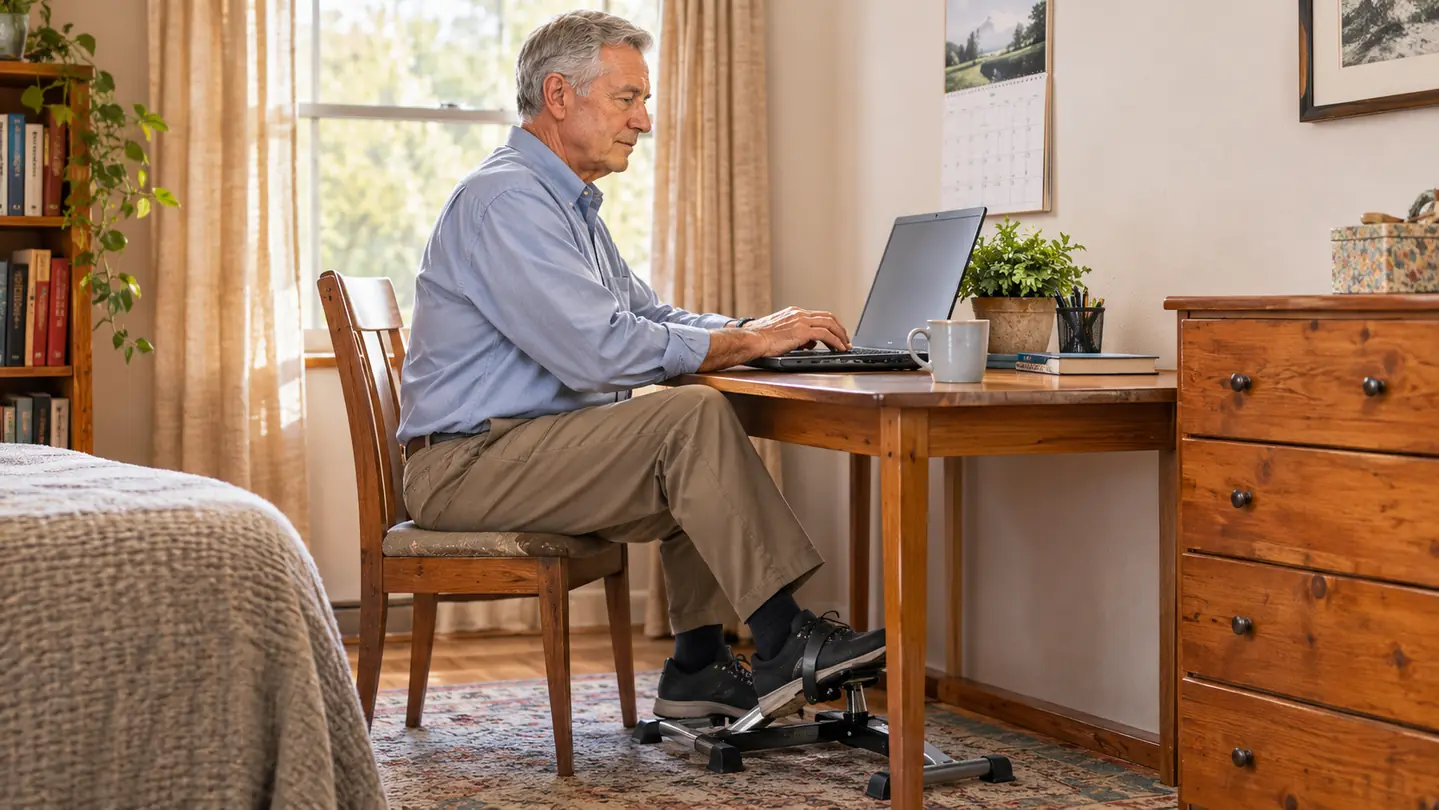
The Cubii JR1 is the under-desk elliptical that has lived beneath my spare-room desk for four years. Eight resistance levels on a manual knob, a battery instead of a cord, and a built-in LCD display that tracks strides, time and calories. You pedal from a chair, which is the whole idea.
Amazon Check Today's Price on Amazon →Step 1: Put It Where You Already Sit Down
The first mistake I made was treating it like gym equipment. I carried it to the basement, set it by the furnace, and used it twice. Basements are for furnaces. If you want your legs moving all day, the machine has to sit within arm's reach of a chair you use anyway.
Mine lives under the spare-bedroom desk where I pay bills and read. On rainy evenings I slide it in front of the recliner and pedal through the evening news. It weighs 25.4 pounds, so moving it is a two-handed job with your knees bent, not something you grab with one hand while holding a coffee cup. Two spots, three feet apart, cover my whole day.
Floor space matters more than you would think. It measures 23.2 inches deep, 17.56 inches wide and 10 inches high, and the pedals travel an 18-inch maximum stride, so leave a little clearance behind you so your heels do not knock the wall. My spare-room floor is old and slightly out of level, and a scrap of quarter-inch plywood under the machine fixed the rocking in five minutes. Cubii also lists a maximum weight recommendation of 150 pounds for the JR1, which is worth checking against your own numbers before you order, the same way you would check the rating on a ladder.
Step 2: Start at Level 1 or 2 and Stay There Longer Than Feels Useful
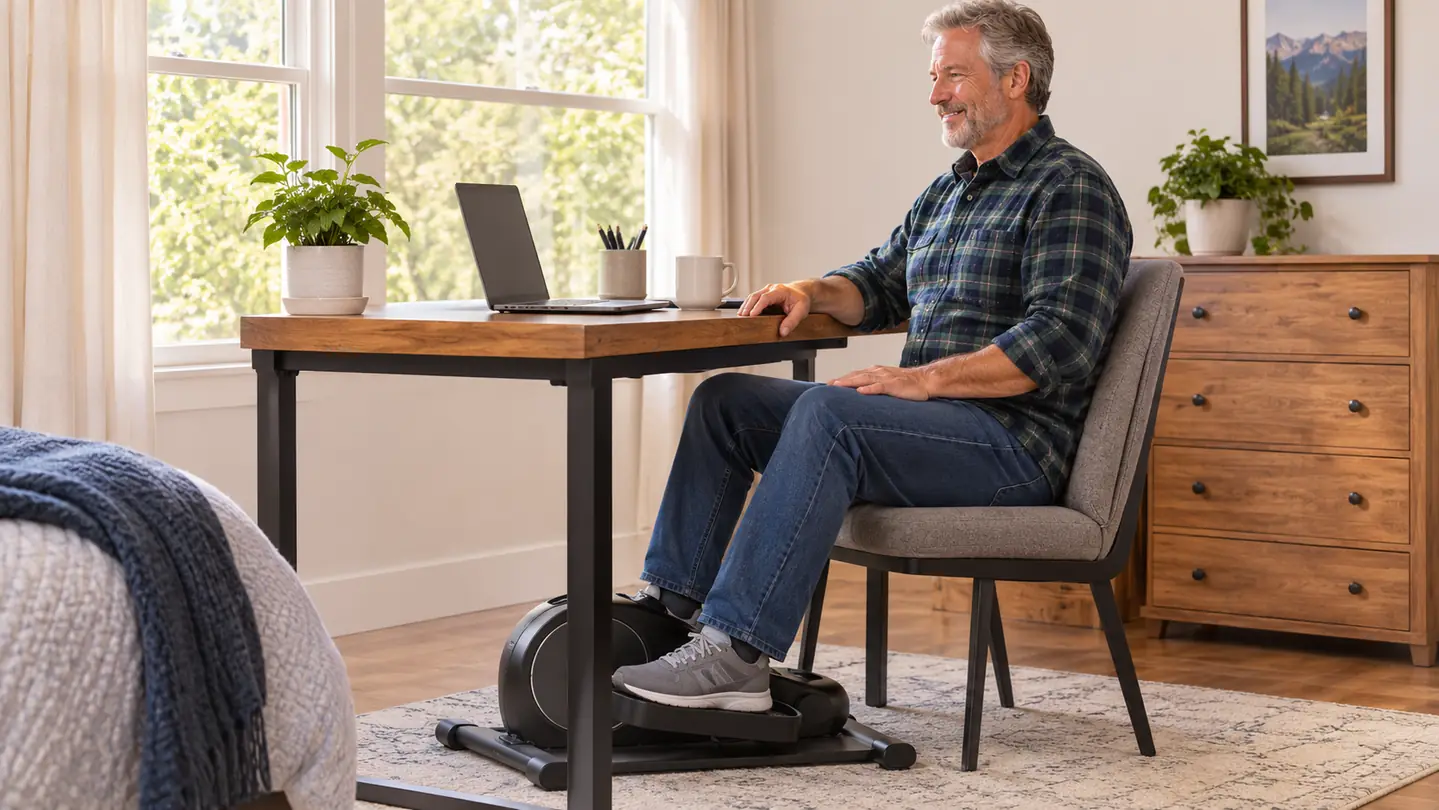
There are 8 resistance levels on a manual knob under the housing. For the first two weeks I did not touch it. Level 2, 15 minutes, most mornings after coffee. It felt like nothing, which was the point.
The temptation with any new machine is to find out how hard it goes. Do not. My right knee has old wear in it and no surgery, and it tells me within a day when I have overdone it. Spend two weeks at a resistance where you could hold a conversation and forget you are pedaling. If a knee complains anyway, drop back a level and shorten the time before you drop the habit.
Four years on I use level 4 or 5, usually 5 when the knee is loose and 4 in cold weather. Fifteen to 20 minutes is the whole program. I have never gone past 5 and I do not intend to. Boring and repeatable is what kept me at it.
If you miss a week, and you will, do not restart the clock. I missed most of one February two years ago with a chest cold, and I came back at level 3 for a few days and then went on. People quit these things over the all-or-nothing arithmetic, not over the missed days.
Level 2 for two weeks felt like nothing. That was the point, and it is the only reason I was still pedaling in March.
Step 3: Hitch the Minutes to Things You Already Do
This is the part that turned it into an all-day habit. A workout needs motivation. A habit attached to something you already do needs none. I pedal while the coffee brews, while I am on hold with the pharmacy, and while the news is on.
A normal Tuesday looks like this. Seven or eight minutes before breakfast. Ten minutes mid-morning while I go through the mail. Fifteen in the evening if the weather kept me inside. None of those sessions is impressive on its own. Added up they come to about half an hour, and none of them required changing clothes or driving anywhere.
Joan joins me some mornings, usually with a magazine and no interest at all in what the display says. That is fine. Nothing says the minutes have to be consecutive and nothing says they have to be hard. On a day when the knee aches I do five minutes at level 3 and call it done, because five minutes I actually did beats thirty I skipped.
The other thing that helped was leaving it out in the open. Not pushed against the wall, not draped with a towel. If it is visible from the doorway I use it without thinking about it. Put it away and I forget it exists.
Holidays are where I used to lose a routine. Now the machine goes in the truck if we drive to our daughter's for a few days, since 25 pounds is manageable with two hands and it is not a suitcase. It rides in the back seat, and I pedal in her spare room while she is at work.
Step 4: Sit Right, Because the Machine Cannot Fix a Bad Chair
My lower back was cranky in the mornings for the first month and I blamed the elliptical. It was the chair. I was sitting on a kitchen chair that was too tall for the pedals, so I was reaching for them with my toes and rounding my back to do it.
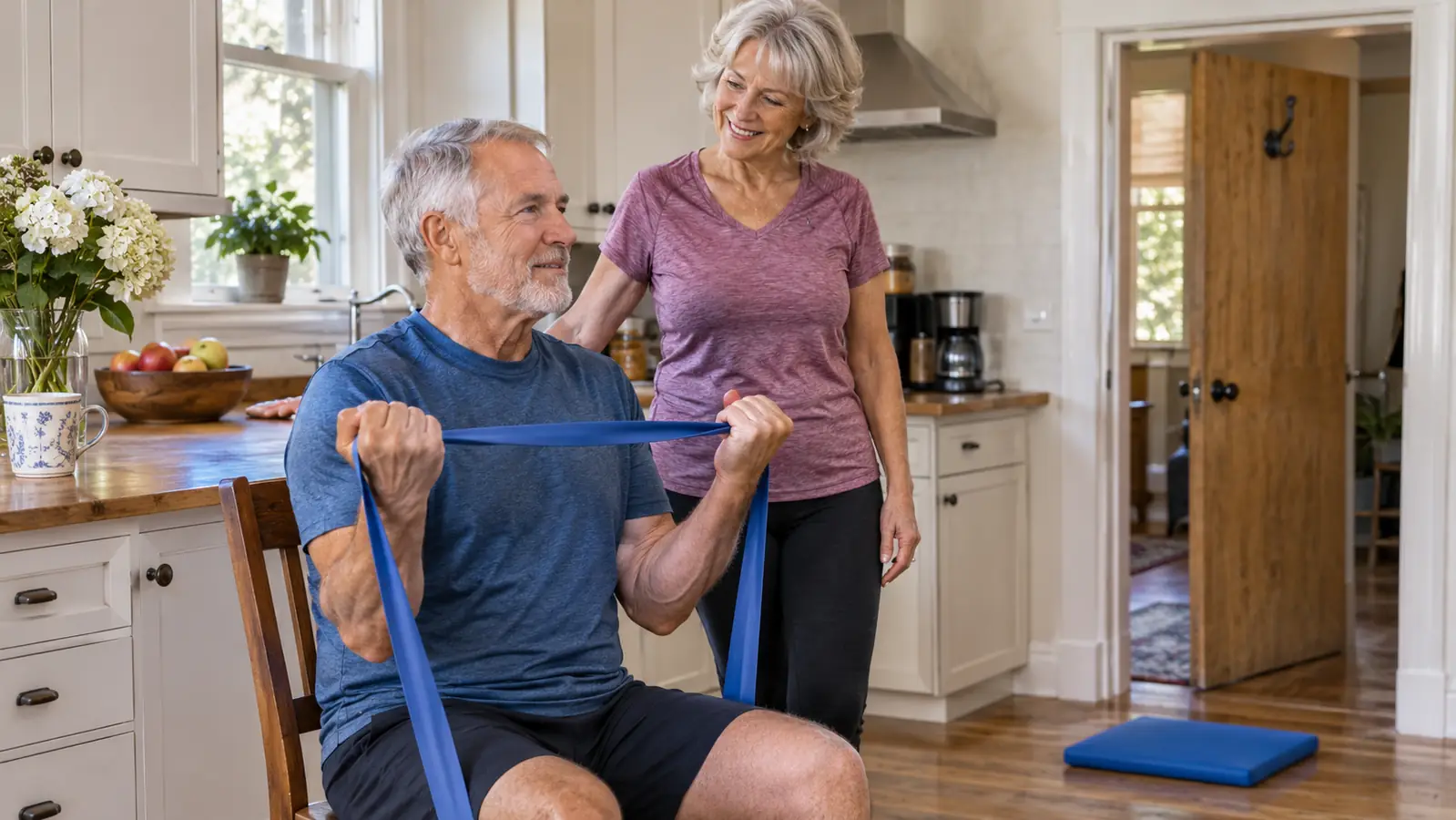
What fixed it was plain. Whole foot flat on the pedal, not just the ball of the foot. Back against the chair back. Hips level. No leaning forward to chase a number on the display. If the chair is too tall your heels will lift; if it is too low your knees will come up near your chest. A firm cushion under you is worth more than any setting on that knob.
Chair height is easy to test. Sit down, put your feet on the pedals, and look at your knees. They should be roughly level with your hips, maybe a hair lower. If they are up near your chest you are on the wrong chair, and no amount of adjusting resistance will make that comfortable.
And keep it seated. The JR1 is built to be pedaled from a chair, and standing up on the pedals is not what it is for. The dresser is right beside mine, which is where my hand goes when I stand up. I have never once been tempted to put my weight on the machine.
One more thing, and it sounds silly. Wear something on your feet. Barefoot or in loose slippers my feet slid forward on the pedals and I spent the whole session re-seating them. A pair of old sneakers I keep by the desk solved it.
Step 5: Track It in a Way You Will Actually Keep Up
The built-in LCD display tracks strides, time and calories. I look at strides and time and ignore the calorie number, which is an estimate and not the reason I am doing this. The reason is that I want to get up off the garden kneeler without a hand on the fence, and carry two buckets of potatoes up the porch steps without stopping halfway.
For the first year I wrote the minutes on the kitchen calendar. Nothing more elaborate than a pen mark. When I stopped marking it I stopped doing it, and it took me a month to notice the gap.
The Cubii mobile app will track your progress, but you enter the numbers from the display yourself, by hand. I never bothered. If you like an app, it is there. If a pencil on a calendar is enough, that is enough too.
The first month I was lucky to log 40 minutes in a week. By the end of that first year it was closer to 90, and the change I noticed was on the porch steps. Not in a week. Over a season.
Do not chase a number a machine made up. Strides per session and days per week are the only two things I have ever written down, and they told me everything I needed to know about whether the habit was holding.
What Else Helps
Pedaling is one piece, not the whole thing. My doctor was clear that balance was half my problem, and no elliptical trains balance. The rest of my morning is short and unglamorous.
The THERABAND flat bands have hung on a hook behind the spare-bedroom door for about three and a half years. Seated rows, chest presses, shoulder work, all from a kitchen chair with a firm seat. I started on yellow, use red for most moves now, and green for rows.
The ProsourceFit balance pad sits flat on the floor next to the dresser. I stand on it for a few minutes each morning with one hand on the dresser top and the other hand free. That is the entire exercise. In summer it goes out back and does duty as my garden kneeler, which is honestly its best job. Joan uses it too and it has held up fine.
The Sportneer ankle weights live in a basket by the door. Two pounds per ankle when I started, four now, for seated leg extensions and marching in place. Never outdoors and never while walking, because a turned ankle on a gravel drive is the last thing I need. A walk still belongs in the week when the weather allows, and nothing replaces it.
Last, the Pnrskter hand grip set sits in the recliner cup holder. That has nothing to do with my legs. It is there because my grip gave out pulling carrots a year ago and I got tired of asking Joan to open jars. The two problems turned out to be the same problem, which is that I had stopped using what I had.
The order I would do it in, if I were starting over: the elliptical first, since it is the one thing you can do without getting up out of the chair. Bands second, because they cost little and cover the upper body. Balance work third, and never skip it, since falling is what scared me in the first place.
One caution. I did not start all of this in one month. The elliptical came first, the bands three months later, the pad the winter after that, the ankle weights a year on. Adding one thing at a time is the only way I have ever kept any of it. And if you are starting at 60 or past it, run the plan past your doctor or a physical therapist before the first session. Mine was the one who told me my heart was fine and my legs were the job.
Three minutes in the chair beats twenty you never get around to
The Cubii JR1 has been under my desk for four years and it has never needed a repair. If your knees are stiff and your day is mostly sitting, this is the smallest thing I know of that helps. Check the current price and the full specs at the link.
Amazon Check Today's Price on Amazon →