

The morning I found out my grip had gone, I was pulling carrots. Not lifting a feed sack, not wrestling a stubborn lid. Pulling carrots. My right hand closed around the tops, I leaned back, and the greens came off in my fist while the carrot stayed put in the ground. I stood in the wet dirt holding a handful of leaves and understood that I had been losing this for a while and had not wanted to notice.
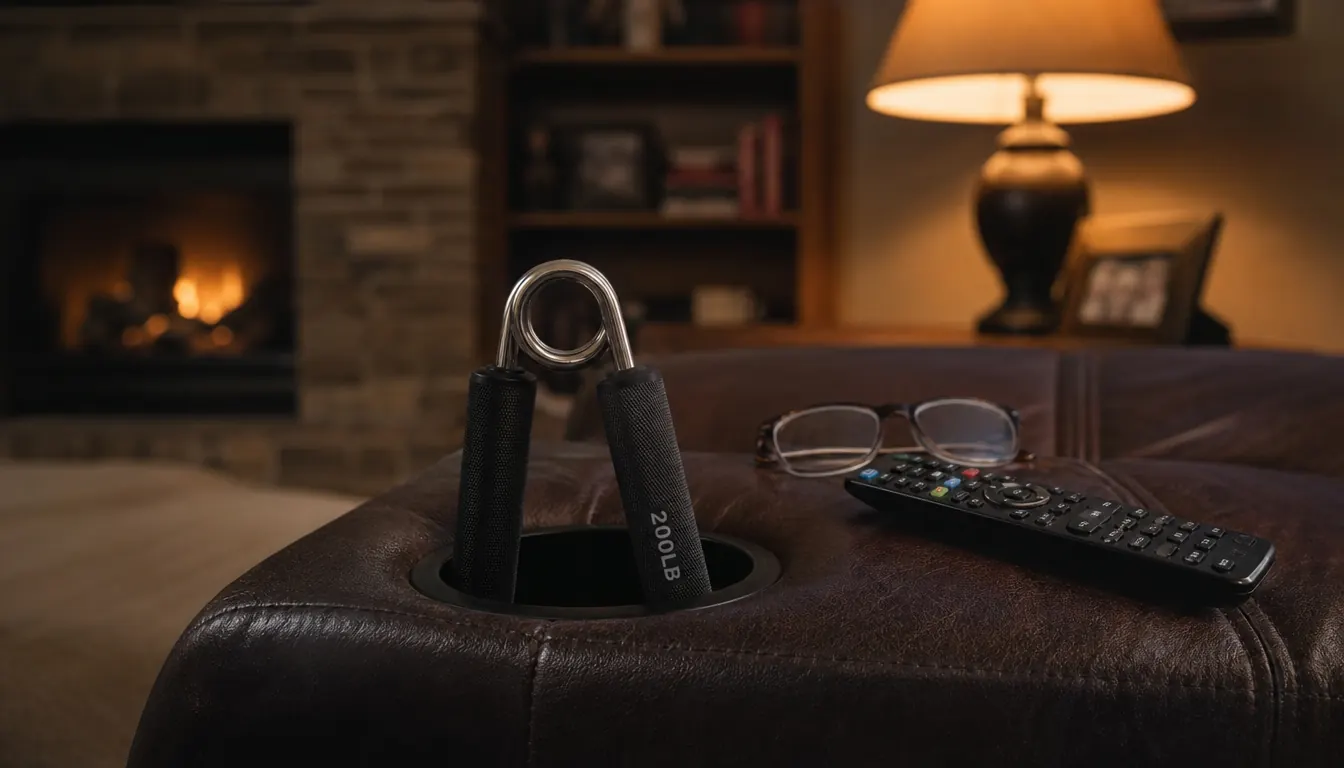
I am 68 and I am not a trainer, so I will not dress this up as a program. About a year ago I bought the Pnrskter hand grip set, which is three hand grippers and three finger stretchers in six resistances from a gentle 6.6 lb up to a 50 lb gripper I still cannot close. It is small and light, and it lives in the cup holder of my recliner. I use it in short sets through the evening news, not because I drew up a schedule, but because it is sitting right there and my hands are already idle.
What I was doing before that was not a plan. I was gardening more, which is the thing that hurt me in the first place. I was opening jars with a rubber band and a bad attitude. I was telling myself that grip is something you either have or you do not have. That last one is the only genuinely wrong idea in the bunch. Grip is a thing you use and a thing you lose, and it responds to being used on purpose.
Start Where I Started: The Lightest Gripper in the Set
Six resistances from 6.6 lb to 50 lb, three hand grippers and three finger stretchers, small enough to keep in a recliner cup holder. I spent my first three weeks on the lightest gripper and did not touch the rest.
Amazon Check Today's Price on Amazon →Step 1: Find Out Which Grip Is Actually Failing
Your hand does two jobs and they fail separately. Closing is the one everybody thinks about: making a fist, holding a bucket handle, keeping hold of a rake while you pull. Opening is the one nobody thinks about until the fingers curl up on their own after an hour of weeding and will not straighten out without help. Most people over 60 who tell me their grip is gone are describing one and ignoring the other.
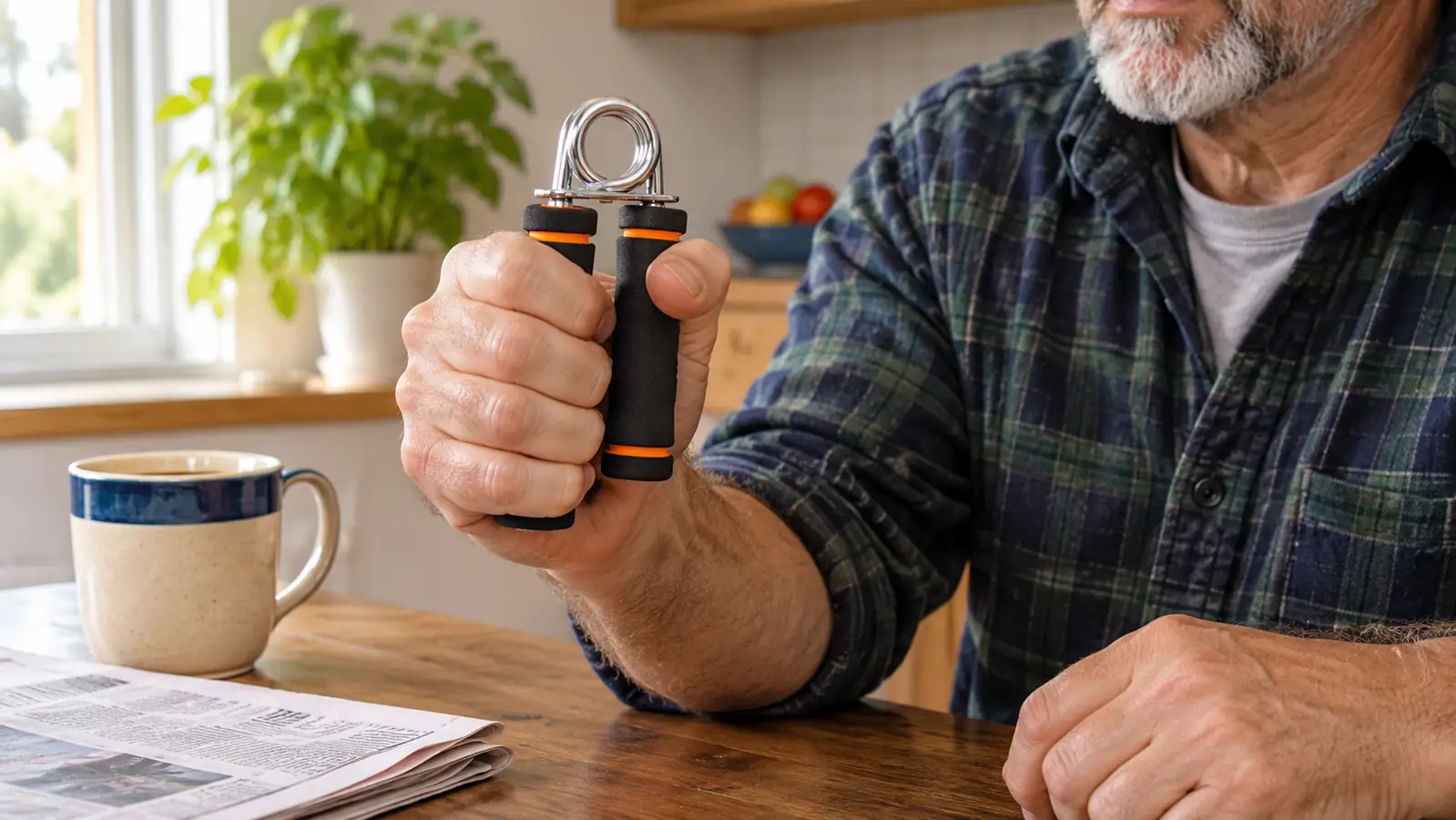
Here is the test I used, and it takes about four minutes. Sit down. Pick up the lightest gripper and close it ten slow times with your right hand. Then ten with your left. Pay attention to which hand quits first, and whether the quitting is in the fingers or in the meat of the palm below the thumb. Write it on the back of an envelope if you have to. When I did it, my right hand managed ten and my left managed eight, and the left was shaky by the end. I dumped the whole Pnrskter set out on the kitchen table first, all six pieces, so I could see what I was choosing between instead of digging through a box. The 50 lb gripper went straight to the far end of the table and stayed there for a season.
Then do the same with the finger stretchers, which work the opposite direction: the piece goes around the fingers, you spread them apart, hold, let them back in. Ten of those each hand. My opening side was far weaker than my closing side, which makes sense for a man who spent 31 years gripping a mailbag and never once practiced letting go of anything. That told me where to spend the first month. If you remember one number from this whole article, make it the gap between your two hands. An eight and a ten is nothing. A four and a ten is worth a conversation with your doctor before you start loading it.
Step 2: Start on the Lightest Gripper and Stay There Longer Than You Want To
The 50 lb gripper is the reason most people quit. It is the one in the set that looks like the point of the set, and it is not. I tried it the first week, closed it maybe a quarter of the way, felt something in the base of my thumb that I did not like, and put it back in the box. I have never closed it. I have stopped treating that as a verdict on me.
What worked was five to ten slow closes with the lightest gripper, held for a two-count at the top, then a full rest. Two or three of those sets per hand while the news runs. That is the whole routine. Slow matters more than hard. A gripper you can close fully and control on the way back out is doing more for you than a heavier one you fight and drop.
I stayed on the lightest gripper for about three weeks before moving to the middle ones, and I moved because the closes had gotten boring and easy, not because a calendar told me to. If you feel it in the knuckles the next morning, you went too heavy or too long. If a joint in your hand complains for more than a day, back off, and mention it to your doctor before you go again. The middle gripper in the Pnrskter set is the one I use most now, and the jump from the lightest to the middle is bigger than it looks. My first week on it I did three closes and quit, because the fourth one was going to be ugly. Three was the right number that week. It took me from roughly Memorial Day to Labor Day to build up to four sets of six.
Step 3: Train the Open Hand, Not Just the Fist
This is the part I would have skipped if Joan had not started using the finger stretchers herself. She has arthritis in both hands and found the stretchers easier to tolerate than the grippers, so she used them while I squeezed, and the two of us sat there like a pair of odd birds. It turned out the stretchers were doing the work I needed most.
The movement is simple: the stretcher goes around all four fingers and the thumb, you spread the hand wide, hold for two seconds, and let it come back slowly. Ten to fifteen of those, once a day. The set gives you three stretchers at three tensions, the same idea as the grippers. I use the lightest one, mostly, and the middle one on good days. Joan uses the lightest one and stays there, and that is fine.
In the garden this shows up as letting go. Opening your hand to release a trowel. Dropping a fistful of weeds instead of peeling your fingers off them one at a time. Pulling a beet and then releasing it into the bucket without a second thought. It is a small thing until you have spent a summer without it. Joan does hers at the kitchen table with her coffee, which is a better spot than mine. She keeps the lightest stretcher in the silverware drawer and does ten spreads before she gets up. Her hands are still bad, but she says the mornings are less stiff, and I have watched her open her own jars since spring.
Step 4: Keep a Gripper Where Your Hands Already Rest
The hardest part of any hand routine is remembering it exists. I have started and abandoned more good intentions than I can count, and the only ones that stuck were the ones where the equipment was already in my lap. So one gripper lives in the cup holder of my recliner. It has been there for a year and I do not have to think about it.
The second one lives in the truck, in the door pocket, and gets used at the lumber yard when I am waiting on a load or sitting in a parking lot before an appointment. It is the light gripper from the Pnrskter set. I have used it in the lot down in Forty Fort more times than I can count, waiting on Joan to come out of the pharmacy, and sawdust from the yard wipes right off it. The third one stayed in the box on the shelf in the spare bedroom, and I have to be honest that I forget it exists most weeks. Two out of three in the path is plenty.
I do not schedule it and I do not track it. I pick it up during commercials, do a set, and put it back down. Some evenings I do four sets. Some evenings I do none, because my hands are tired from a day of digging and forcing it would be foolish. A year in, the habit is the cup holder, not my willpower.
Step 5: Carry It Back Into the Garden on Purpose
The gripper is practice. The garden is the exam. It is easy to get good at squeezing a small handle and never connect it to anything, so I made a point of testing the strength on real work rather than on the gripper itself.
The way I test now is the potato bucket. Five gallons, filled partway, carried from the back rows to the porch. A year ago I made two trips and set it down twice, once in the middle of the garden and once at the bottom of the steps. This past fall I carried it the whole way without setting it down, and I did not need anybody to tell me the work had taken. That carry, not the gripper, is what I actually bought.
The other test is getting up off the kneeler. That is legs and balance as much as hands, and I will not pretend otherwise, but a hand that can push off the ground without folding is part of it. Twisting lids is the third test. I open the beet jars now without the rubber band. Joan still opens the pickles, and I am at peace with that. The carrots got their own test in October. I pulled forty of them in one afternoon without losing a single top, and the year before I would have lost five or six and sworn about every one.
What Else Helps
Grip does not live alone in the hand. The forearm, the shoulder and the upper back all have to hold what the fingers latch onto, and a strong hand on a tired shoulder still drops the bucket. I do two or three sets of seated rows and chest presses with flat resistance bands a few times a week, in a kitchen chair, and that has done as much for my carrying as the grippers have.
Balance work matters for the garden more than most people admit. I stand on a foam balance pad for a few minutes each morning with one hand on a dresser, and in summer that same pad is my garden kneeler, which is the best use I have found for it. Kneeling on it and standing back up, twenty times in an afternoon of weeding, is its own kind of training.
And the boring advice, which I will give anyway because my doctor gave it to me and was right: check with your doctor or a physical therapist before you start a hand routine, especially if you have arthritis, a past wrist injury, or numbness in the fingers. If your hands are swollen or the joints are hot, that is a day to skip. None of this is a race, and the set will still be in the cup holder tomorrow.
A year ago I made two trips with the potato bucket and set it down twice. This past fall I carried it from the back rows to the porch without setting it down, and I did not need anybody to tell me the work had taken.
One Small Set, Six Resistances, Kept Where Your Hands Already Sit
Three grippers and three finger stretchers, 6.6 lb to 50 lb, small enough for a cup holder and light enough to forget you are holding it. Start on the lightest one and give it a month before you judge it.
Amazon Check Today's Price on Amazon →